

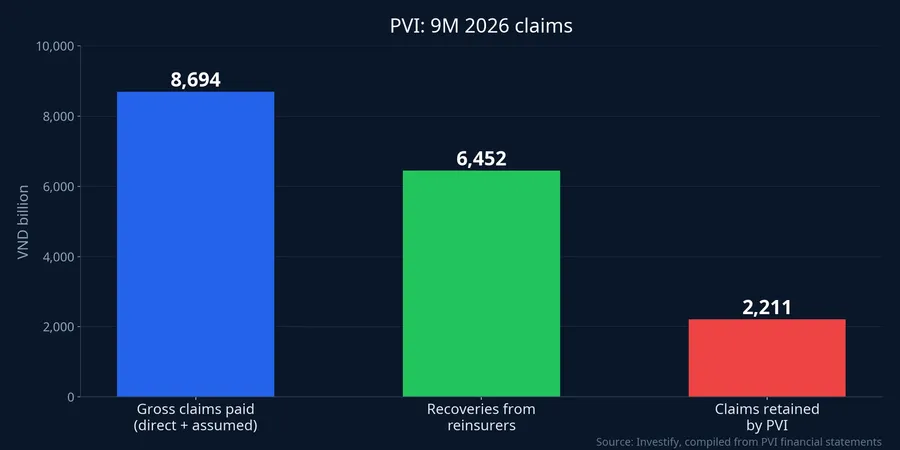
In the first nine months of 2026, PVI Holdings (ticker PVI, HNX) paid out VND 8,694 billion in direct and assumed reinsurance claims, up 79.3% from a year earlier.Người Quan Sát The claims PVI actually kept on its own books came to just VND 2,211 billion, up about 13%. The gap between those two figures is the key to reading the Q3 report: why profit slipped even as revenue grew, and what an insurer's earnings really rest on.
The numbers point to three things: insurance costs outran revenue, reinsurance absorbed most of the burden, and deposit income now makes up a large share of profit.
Q3: revenue up, gross profit down
On PVI's consolidated Q3 2026 statements, pre-tax profit was VND 507.3 billion, down 7.2% year on year. After-tax profit was VND 388 billion, down 3.7%. It is the first quarter of 2026 in which profit came in below the prior-year period.Người Quan Sát
Net revenue still rose 13.5% to just over VND 2,751 billion. Cost of services grew faster, up 20.1% to nearly VND 2,336 billion. Gross profit therefore fell 13.2% to about VND 415.5 billion, and the gross margin narrowed from roughly 19.7% to 15.1%.Mekong ASEAN
For an insurer, "cost of goods" is mainly claims plus the expenses attached to the policies. In Q3, two groups of these costs jumped.
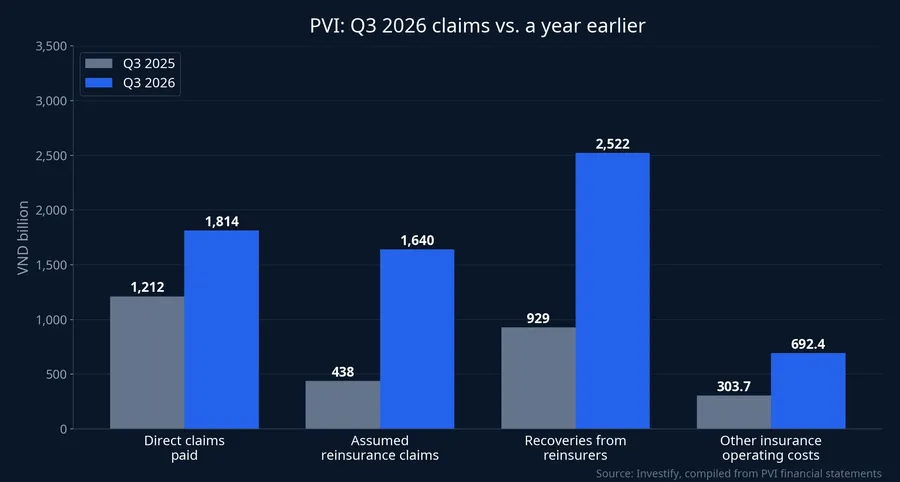
The first is claims. Direct claims paid rose to over VND 1,814 billion from nearly VND 1,212 billion. Claims on assumed reinsurance, meaning what PVI pays on behalf of other insurers that passed part of their risk to it, climbed from over VND 438 billion to over VND 1,640 billion, almost four times as much.Mekong ASEAN Premiums did not keep pace: direct premiums grew only 5.9% in Q3 and assumed reinsurance premiums grew 23%.Người Quan Sát
The second group gets less attention. According to the notes to the statements, other insurance operating costs rose from VND 303.7 billion to VND 692.4 billion, more than double.Người Quan Sát That extra VND 389 billion or so is the largest visible increase in the Q3 cost structure, bigger than the gross profit that was lost.
The press coverage names no specific loss event behind the higher claims, and does not explain why other operating costs doubled. There are at least three readings. One: Q3 contained one or several large claims, the kind common in industrial and energy cover. Two: the assumed reinsurance book grew quickly, pulling up both claims and related costs. Three: timing differences in how items were booked between quarters. The 23% rise in assumed premiums partly supports the second reading. But it cannot explain assumed claims rising almost fourfold, so a large loss in the quarter remains possible.
Reinsurance: the cushion under most of the claims
Looking only at gross claims, PVI's Q3 looks heavier than it really was. The reason is how reinsurance works.

When an insurer sells a large policy, say for a factory or a drilling rig, it usually passes part of the risk to reinsurers and pays them part of the premium. When a loss occurs, PVI pays the customer first and then collects the matching share from the reinsurers. That receivable is booked as reinsurance recoveries.
In Q3 these recoveries rose from over VND 929 billion to over VND 2,522 billion.Mekong ASEAN By our calculation from these figures, total Q3 direct and assumed claims were about VND 3,454 billion, and PVI recovered roughly 73% of that from reinsurers. A year earlier the ratio was only about 56%. In other words, most of this quarter's claims money passed through PVI's books and went on to the reinsurers.
The nine-month figures show the same mechanism. Reinsurance recoveries reached VND 6,452 billion, leaving retained claims at VND 2,211 billion.Người Quan Sát Note that simply subtracting recoveries from gross claims does not give exactly VND 2,211 billion, because other deductions exist that the press has not itemised. The recovery ratios above should be read as approximate.
The cushion has a price. To recover claims, PVI has to cede part of its premiums to reinsurers. That is why nine-month revenue from services reached VND 24,791.8 billion, yet after ceded premiums and other deductions, net revenue was only VND 8,488.6 billion.Người Quan Sát The two figures measure different things, so when comparing with a plan or with another company, it matters which one is being used.
Reinsurance also shares risk rather than removing it. At 30 September 2026, PVI carried over VND 18,765 billion of reinsurers' share of claims provisions among its receivables.Mekong ASEAN That is money PVI expects to collect from reinsurers, so the quality of those counterparties is part of the quality of PVI's earnings.
Financial income: nearly half of nine-month profit
The rest of the story sits outside the insurance business itself. Insurers collect premiums first and pay claims later, and in between they put the cash in bank deposits or investments. At 30 September 2026, PVI's term deposits stood at nearly VND 15,673 billion, up 33.2% from the start of the year, of which short-term deposits were over VND 13,713 billion. The bond portfolio fell 40.1% to about VND 2,047 billion, while the cost basis of the trading equity portfolio rose 33.4% to nearly VND 2,019 billion.Mekong ASEAN
That deposit pile is earning real money. In Q3, interest on deposits and loans brought in over VND 282 billion, up 38.2%, while income from bonds and other debt instruments fell from nearly VND 100 billion to over VND 59 billion. Financial revenue rose 31.4% to about VND 482.4 billion.Mekong ASEAN
The exchange rate cuts both ways. Realised FX gains in Q3 were nearly VND 128 billion, against nearly VND 51 billion a year earlier.Mekong ASEAN On the other side, financial expenses rose 82.7%, mainly on FX losses.Người Quan Sát That fits a company with international reinsurance business, which carries both receivables and payables in foreign currency. The press has not separated the FX loss, so it is not possible to say what share of profit it took. After expenses, net financial income in Q3 still reached nearly VND 289 billion.
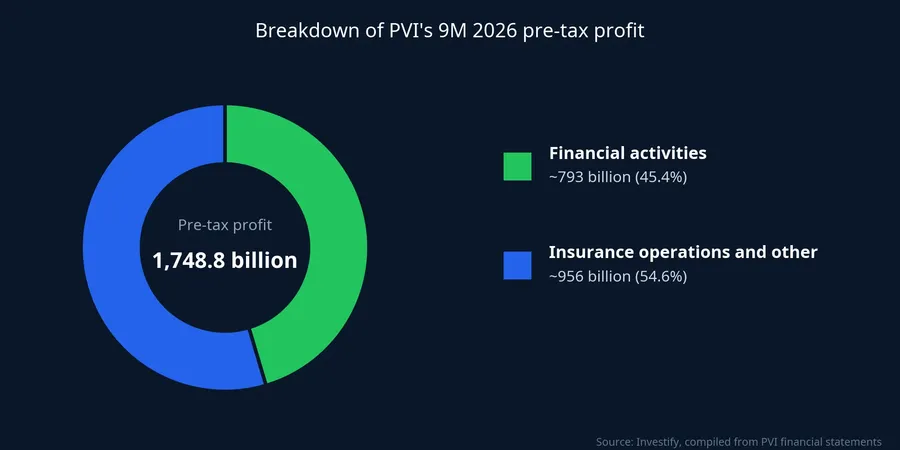
Put the figures side by side and PVI's earnings structure appears. Over nine months, net financial income was about VND 793 billion, or 45.4% of VND 1,748.8 billion in pre-tax profit.Người Quan Sát For Q3 alone, gross profit of about VND 415.5 billion minus VND 195 billion of general and administrative expensesMekong ASEAN leaves roughly VND 220 billion. By this calculation, financial income of VND 289 billion already exceeded the insurance profit after overheads, and made up about 57% of quarterly pre-tax profit.
Nine-month profit is still up 17.6%,Người Quan Sát but in Q3 the support for earnings came more from the deposit book than from insurance contracts.
Why deposit rates and the exchange rate matter for PVI
This structure makes PVI's profit sensitive to two variables that many holders of insurance stocks pay little attention to: deposit rates and the exchange rate.
Deposit rates are falling. In the week of 19 to 24 October 2026, a number of banks cut deposit rates in line with State Bank of Vietnam guidance, typically by 0.5 percentage points a year, concentrated in tenors of six months or longer.Tạp chí Kinh tế Tài chính

Most of PVI's deposits are short-term, so as they mature and are redeposited, they may earn less. The effect will not arrive immediately in Q4, because existing deposits keep their old rate until maturity. But if the new rate level holds into 2027, the income that supplied almost half of nine-month profit will struggle to grow as fast as it did this year.
The exchange rate is the second variable, and harder to predict. Q3 showed the same currency moves producing gains on some items and losses on others. As the international reinsurance book grows, that sensitivity grows with it.
The annual plan, and how to read "above plan"
At the 17 April AGM, PVI set its 2026 pre-tax profit plan at VND 1,243 billion, nearly 15% below the 2025 result. After nine months it has reached about 140.7% of that plan.Người Quan Sát That ratio says more about a cautious plan than about how the latest quarter performed.
What to watch in Q4
PVI's profit now stands on two legs: insurance sales with reinsurance as a cushion, and income from a deposit book of more than VND 15,000 billion. Q3 showed the first leg can weaken quickly when claims and related costs jump, even with reinsurance absorbing most of the load. The second leg is firm, but the new deposit-rate level will gradually slow its growth.
The Q4 financial statements, expected around the end of January 2027, will show whether Q3 was an unusual claims quarter or the start of a trend. The first line to check is other insurance operating costs. If it returns near the VND 303.7 billion of Q3 2025 and gross profit recovers, Q3 was most likely a heavy-loss quarter. If it stays around VND 700 billion, insurance profit is thinning structurally, and PVI will have to lean on its deposits just as deposit rates are falling.