

In Q3 2026 alone, the amount Hoa Phat Group (HPG) paid into the state budget rose about 56% year on year, almost matching the 54% increase in steel sold over the same quarter. That overlap suggests the VND 12,038 billion figure announced on October 28 reflects how hard the plants are running, not the profit that belongs to shareholders. The useful question is not whether paying more means earning more, but what this tax bill actually measures.
The announced figure
According to Hoa Phat's announcement, the group paid VND 12,038 billion into the state budget across 20 provinces in the first nine months of 2026, up 28% from a year earlier.CafeF That is the sum of taxes, fees and other payments, not a single tax.
The two biggest contributors were Hoa Phat Dung Quat Steel with VND 7,352 billion (up 26%) and Hoa Phat Hai Duong Steel with VND 2,331 billion (up 66%). Behind them came Hoa Phat Steel Pipe (VND 713 billion), Hoa Phat Refrigeration (VND 390 billion), Hoa Phat Hung Yen Steel (VND 345 billion) and Hoa Phat Construction & Urban Development (VND 309 billion). By location, Quang Ngai province, home to the Dung Quat complex, received VND 7,332 billion, about 60% of the total.CafeF
Q3 ran much faster than the first half
The nine-month number is only the big picture. To see the latest pace, set it against the six-month figure: in the first half, Hoa Phat paid VND 8,478 billion, up 19% year on year.Vietnam Financial Times
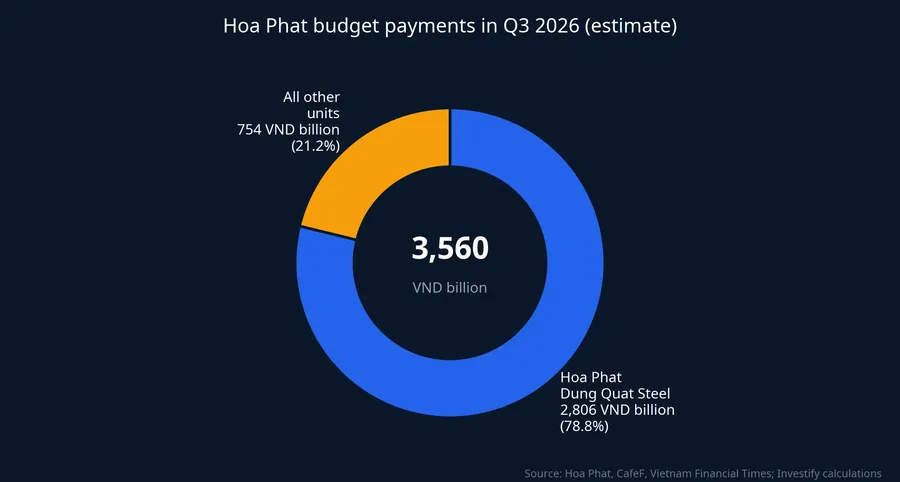
Subtracting the six-month total from the nine-month total, the group paid roughly VND 3,560 billion in Q3 alone (our own calculation from the two announcements). Working backward from the 19% and 28% growth rates, Hoa Phat paid about VND 2,280 billion in Q3 2025, which puts this year's Q3 up about 56%. Both source growth rates are rounded, so read 56% as "a bit more than half", not a figure precise to the percentage point.
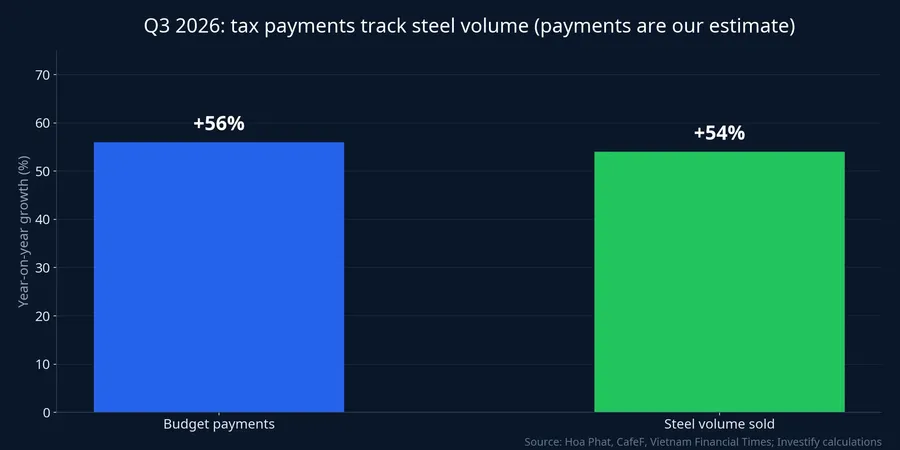
That increase lines up with steel volumes. By the figures Hoa Phat released in mid-October, it sold 3.8 million tonnes of construction steel, high-quality wire rod, hot-rolled coil and billet in Q3, up 54% from Q3 2025. For nine months, volume reached 10.3 million tonnes, up 39%.CafeF
Dung Quat carries nearly all of the acceleration
At the subsidiary level, the Q3 pace is even clearer. In the first half, Hoa Phat Dung Quat Steel paid VND 4,546 billion, up just 11%.Vietnam Financial Times By nine months the growth rate had reached 26%. The subtraction shows Dung Quat paid roughly VND 2,806 billion in Q3 alone, up about 60% year on year and close to 79% of the group's Q3 payments.
Quang Ngai's share shifted too. In the first half the province took VND 4,519 billion, about 53% of the total.Vietnam Financial Times After nine months, its share was about 60%.
Hoa Phat Hai Duong Steel posted the highest nine-month growth (66%), nearly double Dung Quat's, so it is easy to read as the unit where output is rising fastest. The period data says otherwise: most of that increase was already in the first half. In six months the company paid VND 1,935 billion, up 68%, already most of its VND 2,331 billion nine-month total.Vietnam Financial Times In Q3 alone, Hai Duong paid about VND 396 billion. The Q3 driver was therefore Dung Quat, while Hai Duong's 66% is mostly a first-half story.
Taxes follow goods, not profit
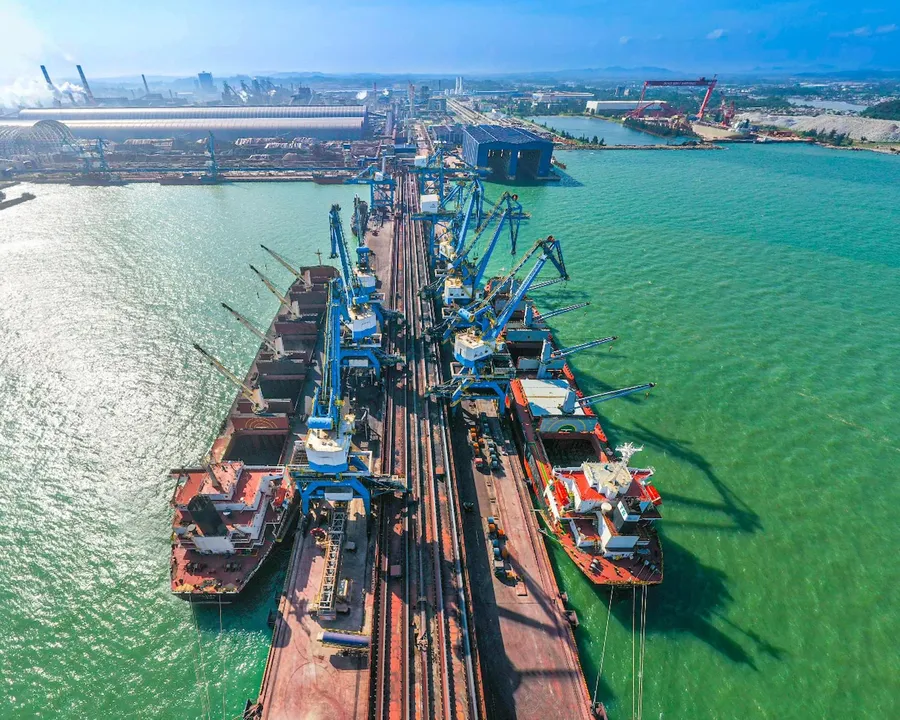
Dung Quat's payments include import VAT, import and export duties, domestic taxes and other items, according to Hoa Phat's announcement.CafeF Dung Quat is a blast-furnace complex that must import iron ore and coal through its port. Import VAT and duties are charged on the value of goods crossing the border. A plant that imports more raw material, or pricier raw material, pays more, whether the steel made from it earns a profit or a loss. Import VAT is also creditable against output VAT later, so in essence it tracks the turnover of goods.
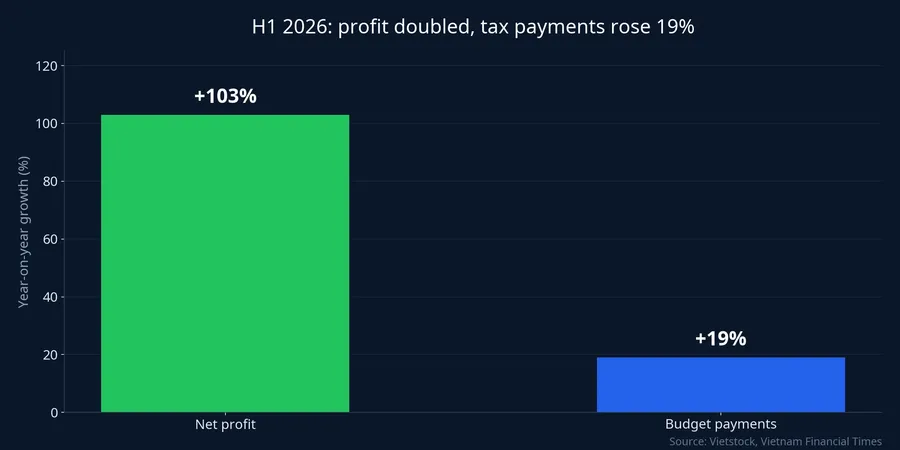
The clearest evidence comes from the first half itself. Hoa Phat's six-month net profit reached VND 15,480 billion, up 103%, with revenue up 47%.Vietstock Over the same period, budget payments rose only 19%. Profit doubled while tax payments rose by less than a fifth: the two numbers did not move together.
Other explanations for the Q3 rise deserve acknowledgment. Swings in iron ore, coal or steel prices could move the tax bill even with flat output. The timing of quarterly provisional corporate income tax, or a one-off levy, could also distort the quarterly rhythm. Still, with budget payments up about 56% and steel sold up 54%, the scale-of-goods reading is the most credible. The VND 12,038 billion is a total across all payments, not broken out by tax type, so no single tax can be said to make up most of it.
What to read next
On October 28, HPG closed at VND 20,750, down 1.19%, on a day the VN-Index rose 0.27% to 1,766.65 points. The share price showed no notable reaction to the budget news, which is understandable: the figure mostly confirms what the market learned from mid-October sales data, that Hoa Phat's steel plants are running at a much larger scale than a year ago.
What HPG holders really need is how much profit that larger scale produced. The answer sits in Hoa Phat's Q3 financial statements. When they arrive, set the growth in gross profit against the 54% rise in steel sold. If gross profit grows as fast as or faster than volume, margin per tonne held and the bigger scale turned into bigger profit. If it grows much slower, lower selling prices or higher raw-material costs ate into the gain from volume, and the larger tax bill simply reflects busier plants.