

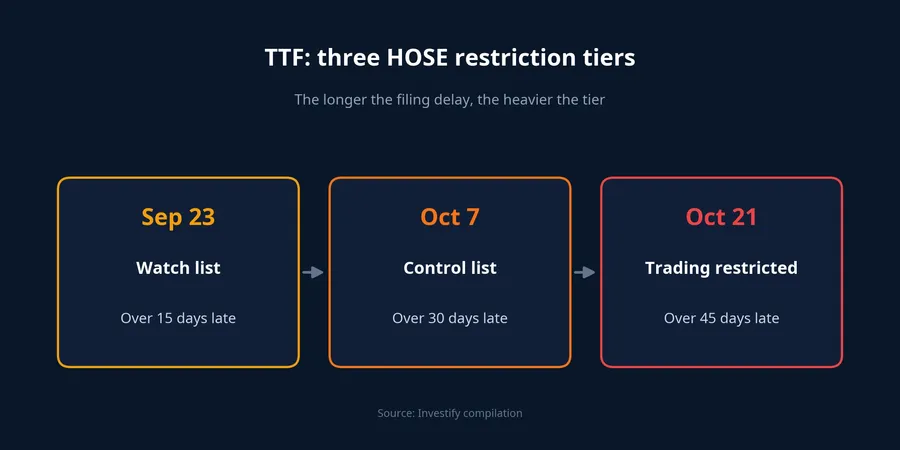
Between September 23 and October 21, HOSE moved Truong Thanh Furniture (TTF) shares from the watch list to the control list, and then down to restricted trading. On October 21, HOSE also sent the company a notice: TTF could face mandatory delisting if its auditor issues a disclaimer of opinion on the 2026 annual financial statements.
As of the morning of October 27, no delisting decision has been made. What has changed is how current holders can trade the stock, and the date that will settle whether TTF stays on HoSE is now clear: the audit opinion on the 2026 annual accounts. This piece lays the milestones out in order so a shareholder can see where they stand.
Sep 23 and Oct 7: late filing, tighter restrictions
It began with a late report. Truong Thanh Furniture filed its reviewed 2026 half-year financial statements more than 15 days past the deadline, so from September 23 the stock fell onto the watch list under the listing and trading rules issued on March 16, 2026.Tin nhanh chứng khoán The company said the review ran long because it needed more time to "review, explain and complete documentation on several receivable and payable items."FireAnt That detail matters, because those same balances later became the reason the auditor declined to conclude.
The report still had not appeared. Once the delay passed 30 days, HOSE moved TTF to the control list, effective October 7.FireAnt The two steps are mechanical: same reason, only the number of days late differs.
Oct 15: the report arrives, the auditor declines to conclude
On October 15, the company published its half-year report, reviewed by Ernst & Young Vietnam (EY). It came late and carried the heaviest outcome a review report can have: EY declined to express a conclusion.Tin nhanh chứng khoán
EY cited two groups of issues as of June 30, 2026. The first is receivables and prepayments whose recoverability EY could not assess: VND 141.45 billion owed by Made By Vietnam (formerly Truong Thanh Trading, or TTF Trading), with VND 28 billion provisioned; nearly VND 4.47 billion receivable from Anneco Group; and VND 66.5 billion prepaid to Anneco. The second covers balances tied to two companies bearing the Truong Thanh name: VND 258.6 billion with Truong Thanh JSC (VND 216.1 billion provisioned) and VND 171.17 billion with Truong Thanh Wood Processing JSC (VND 76.49 billion provisioned).Tin nhanh chứng khoán Because the information provided was limited and the explanations EY needed were not received, EY could not gather enough evidence to know how much of these amounts can be recovered.
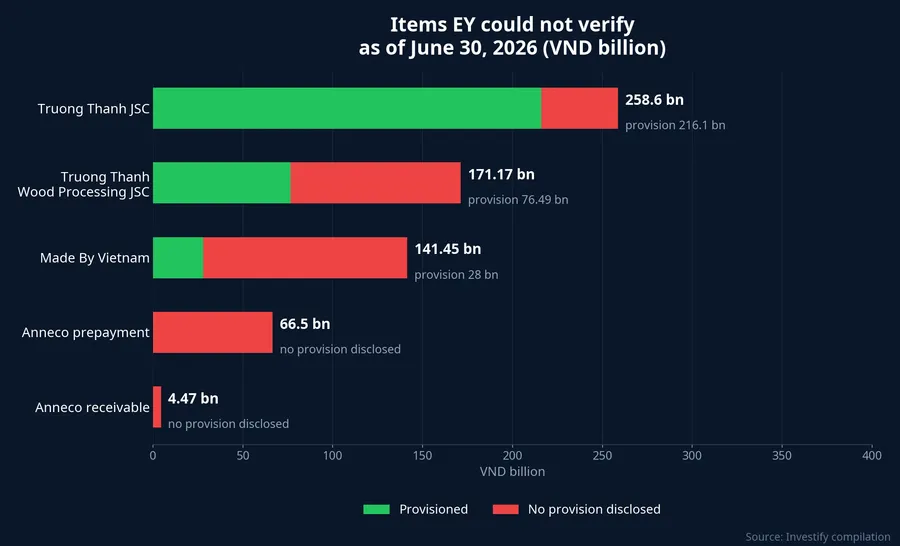
Added up, the items EY flagged come to roughly VND 642.19 billion, of which about VND 320.59 billion is provisioned (our own sum from the reported figures). The total mixes receivables, prepayments and investments, so it should not be read as the company's total receivables. Provisioning also does not mean the rest will certainly be collected. What EY said is that it lacked the evidence to know.
The review also deepened the loss: from VND 270.2 billion in the self-prepared reportTin nhanh chứng khoán to VND 327.1 billion for the first half of 2026, versus a VND 4.78 billion profit a year earlier. Some outlets report VND 372.1 billion; we use 327.1 because it fits better with the increase in accumulated losses between the two reports. Accumulated losses at June 30, 2026 stood at VND 3,584.5 billion, equal to 87.17% of the VND 4,111.98 billion charter capital.Tin nhanh chứng khoán
Oct 21: restricted trading and the HOSE notice
Two things happened on October 21, from two different causes.
The first is the move to restricted trading. It did not come from EY's opinion. HOSE moved TTF down to this tier because the reviewed half-year report was filed more than 45 days late.Tin nhanh chứng khoán For holders, the biggest change is how orders match: restricted stocks trade only in round lots through periodic auctions of 15 minutes each, opening with an auction that sets the opening price and ending with one that sets the closing price. Orders cannot be amended or cancelled during the opening and closing auctions, or in the last 5 minutes of each periodic auction. Put simply, TTF holders no longer trade continuously during the session; orders are collected and matched once at the end of each auction.
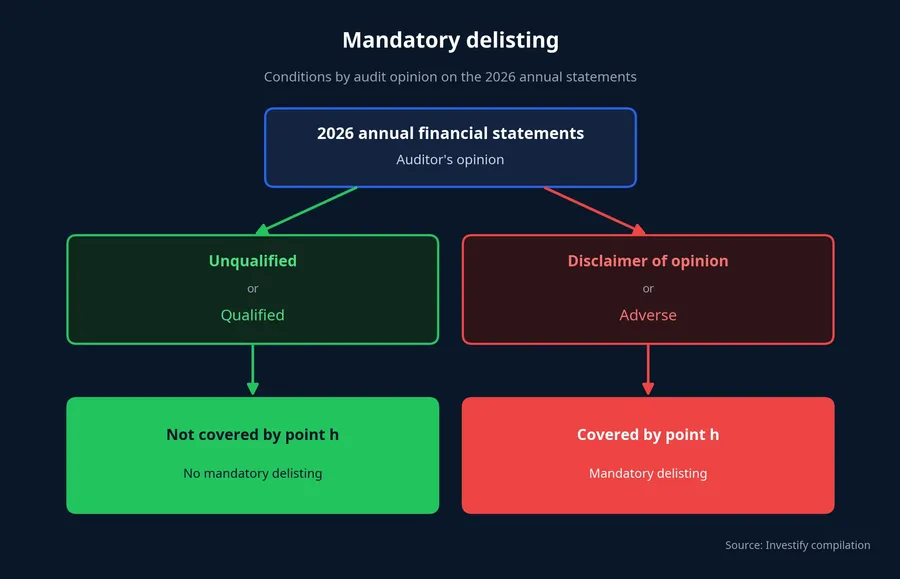
The second is the notice on possible mandatory delisting, which is tied directly to EY's opinion. HOSE cited point h, clause 1, Article 120 of Decree 155/2020/ND-CP: a stock is delisted when the auditor issues a disclaimer or adverse opinion on the most recent annual statements, or a qualified opinion on annual statements for 3 consecutive years.Tin nhanh chứng khoán
The key word is "annual." The report EY declined to conclude on is a reviewed half-year report, while the delisting rule refers to audited annual financial statements. That is why HOSE stopped at flagging a possibility rather than issuing a decision.
Oct 23 to 26: a new finance lead and a shareholder meeting date
On October 23, the company announced the dismissal of Ms. Phan Thị Thanh Tuyền, former Chief Accountant of Truong Thanh Furniture Corporation (TTF), effective October 24, and the appointment of Mr. Phan Hồng Hoàng as Chief Financial Officer effective October 23.Người Quan sát The announcement gave no reason and did not say whether Mr. Hoàng also takes the chief accountant role. It could be preparation for the annual audit or an internal change for other reasons. The available information is not enough to say, and a change of personnel does not by itself answer the auditor's question.
On the evening of October 26, the company set a record date of November 20 for an extraordinary shareholder meeting, tentatively on December 21; the agenda has not been disclosed.Tin nhanh chứng khoán Without a proposal, it is not yet possible to say what the meeting will offer on the items EY flagged. Until the balances with Made By Vietnam, Anneco and the two Truong Thanh companies are publicly verified, EY's question remains unanswered, and the December 21 meeting is the first chance for shareholders to hear management's plan.
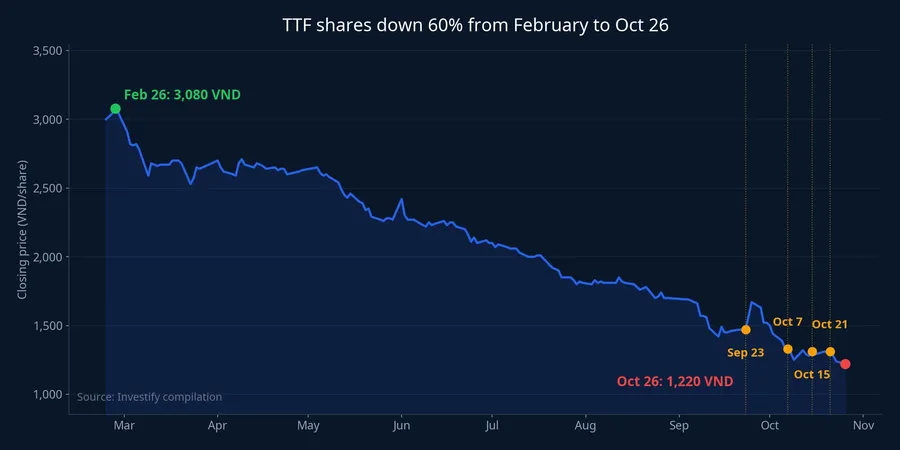
On October 26, TTF closed at VND 1,220, about 17% below the September 23 close and about 60% below VND 3,080 on February 26. The decline ran through the whole year alongside the losses and late filings, so it cannot be pinned on any single HOSE decision.
The milestone still ahead: 2026 annual accounts
Under Circular 96/2020/TT-BTC, listed companies must publish audited annual statements within 90 days of fiscal year-end.For a fiscal year ending December 31, 2026, that falls around the end of March 2027. Since the company filed this year's half-year report more than 45 days late, the actual date of the annual report remains unknown.
The audit opinion will then land in one of two branches. If it is unqualified or qualified, the "disclaimer" condition in point h does not apply; a single qualified opinion is also not enough for delisting, since the rule requires qualified opinions for 3 consecutive years. If it is a disclaimer or adverse opinion, the stock falls squarely into the mandatory delisting case HOSE flagged.
The receivables do not disappear at year-end. If the balances with Made By Vietnam, Anneco and the two Truong Thanh companies are still on the books at December 31, 2026 without evidence of recovery or explanation, the annual auditor will face the same issues EY raised.
Delisting would not mean the business stops operating or that shareholders lose their shares. Under current rules, a company delisted but still a public company registers its shares on UPCoM; shareholders keep ownership, attendance and voting rights, and only the trading venue changes, possibly with a gap between the two exchanges. For TTF there is no transfer schedule because there is no delisting decision.
How to read the chain of events
The story has two strands to keep apart. The late-filing strand has taken TTF through the watch, control and restricted tiers, and its consequence is in force today: the stock matches only in 15-minute auctions. The audit-opinion strand has stopped at a notice, and its answer lies in the 2026 annual accounts.
The dated signals ahead are the proposals for the extraordinary shareholder meeting before December 21 (whether any plan covers the receivables and the balances with the two Truong Thanh companies), further HOSE notices on TTF's trading status, and, most decisive, the audit opinion on the 2026 annual accounts, due around the end of March 2027 at the latest if the company files on time. Until then, TTF has not been delisted, and it has not left the risk zone HOSE has named.