

Vietnam's average retail electricity price has stood at VND 2,204.07 per kWh (excluding VAT) since May 10, 2025, nearly 18 months without a change.FireAnt On October 27, 2026, state utility Vietnam Electricity (EVN) was told to draft a plan to cut the price from November 1. If it goes through, it would be the first adjustment since May 2025 and the first one downward. The same meeting also put the special consumption (excise) tax on gasoline up for review, with a view to taking it back to 0% for the second time this year.
One point first: these are instructions to build and assess plans, nothing more. No size of cut has been set and no decision has been issued. This piece walks through both timelines, power and fuel tax, so you can see where each one stands and when the first answers are due.

The October 27 meeting: who got which task
Deputy Prime Minister Nguyễn Văn Thắng, head of the government's Price Management Steering Committee, chaired the meeting on scenarios for managing fuel and electricity prices at the Government Office. According to Người Quan Sát, the conclusions assigned work to three bodies.Người Quan Sát
- EVN: review and calculate quickly, and cut costs as far as possible, to draft a plan to lower the average retail power price over five months, tentatively November 1, 2026 to March 31, 2027.
- Ministry of Industry and Trade: lead the review of EVN's proposal and keep the timetable for November 1. Anything beyond its authority must be reported up promptly.FireAnt
- Ministry of Finance: lead, together with the Industry and Trade and Justice ministries, a review of the legal basis, authority, impact and feasibility of taking the excise tax on all gasoline types to 0% over the same period. The report for the competent authority to consider and decide must be done before November 1.
Per Người Quan Sát, the size of the power price cut has not been stated. Any figure on "how much your bill falls" is guesswork for now.
Track one: electricity since May 2025
On May 10, 2025, the average retail price was raised to VND 2,204.0655 per kWh before VAT, up 4.8%.Argus Media That is the latest adjustment, and the average has not changed since.
On July 9, 2026, the government issued Decree 278/2026/ND-CP, amending Decree 72/2025 on the price adjustment mechanism. The current rules split into two cases. If the recalculated average price falls by less than 1%, EVN makes no adjustment and only reports to the ministry. If it falls by 1% or more, EVN must file a proposal with the ministry, which has up to 15 working days from receiving a complete file to give written comments, after which EVN decides on the cut.Vietstock
At today's price, 1% is about VND 22 per kWh. A cut smaller than that would not reach household bills.
On October 24, 2026, EVN published its 2025 electricity production and business costs, based on accounts audited by Deloitte Vietnam. Total cost was VND 601,680.1 billion for 287.51 billion kWh sold, a unit cost of VND 2,092.70 per kWh.FireAnt So the average selling price sits about VND 111.37 per kWh above cost, or 5.32% of cost. That is the clearest basis for a cut.
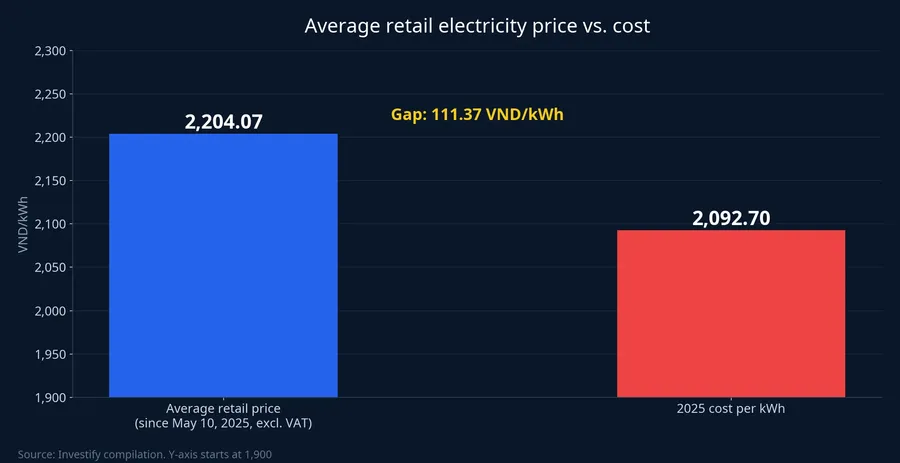
Still, the 111.37 figure cannot be turned directly into a cut, for two reasons.
First, the two numbers cover different periods. Cost is for all of 2025, while the VND 2,204 price applied only from May 10, 2025. Also, a pricing plan is built on projected costs for the coming period, not last year's costs.
Second, some costs have not yet entered the price. EVN says VND 17,506.64 billion remains unrecorded in unit cost, cumulative to the end of 2025. It consists of leftover 2021 foreign-exchange differences and FX differences from 2022 to 2025 that have not been recognised or paid to power plants. Spread over 2025 sales volume, that adds about VND 61 per kWh, more than half of the VND 111 gap. This is an illustration only, because the rules do not require the whole amount to be loaded into a single year. Even so, how that FX balance is handled will likely decide most of the room for a cut.
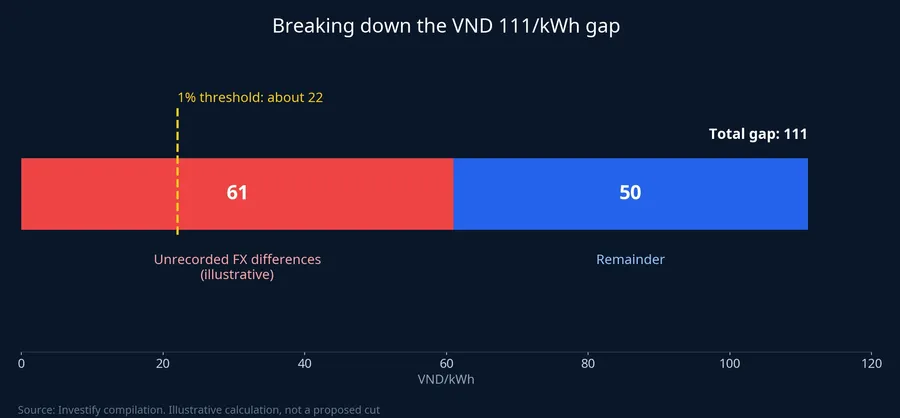
The October 27 meeting came three days after the cost figures were published, and it told EVN to draft a cut.
Track two: excise tax on gasoline in 2026
On March 26, 2026, the Prime Minister signed Decision 482/QD-TTg, taking the excise tax on gasoline to 0% from midnight on March 26 through April 15.Tạp chí Công Thương At that day's price review, E5 RON92 fell from VND 30,110 to VND 23,320 per litre. That drop bundles several taxes and world price moves, so it cannot be credited to the excise tax alone.
From April 16 through June 30, the National Assembly's Resolution 19/2026/QH16 kept the rate at 0%.Cần Thơ portal From July 1 the tax returned under Excise Tax Law 66/2025/QH15: 10% on mineral gasoline, 8% on E5 and 7% on E10.Báo Pháp luật At the July 1 review, E5 RON92 rose VND 1,430 to VND 20,780 per litre. World prices also moved in that period, so the rise shows only the rough scale of the tax, not its exact amount.
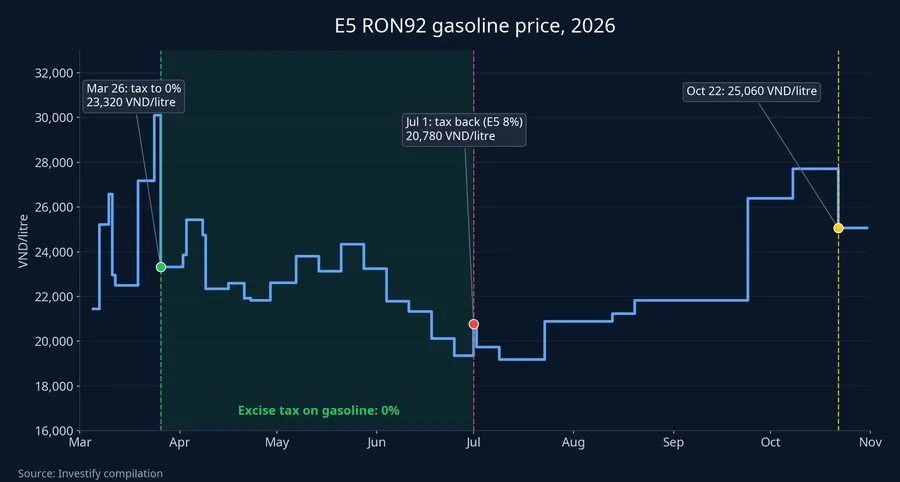
The latest review, on October 22, put E5 RON92 at VND 25,060 per litre, about VND 4,280 above the July 1 level of VND 20,780. With a higher base price, the same 8% rate means more tax per litre.
On October 27, the Finance Ministry was asked to assess taking the tax to 0% from November 1 to March 31, 2027. The first question this time is legal basis and authority. The April extension needed a National Assembly resolution, so who may decide is a hurdle to clear before any rate is discussed.
Who gains and who pays if both plans go ahead
Households, drivers and heavy electricity users stand to gain, though how much depends on the plans. The cost side is also clear. EVN would cut its selling price while still carrying VND 17,506.64 billion of FX differences outside unit cost, so that balance would be recovered more slowly or handled another way. On gasoline, the budget would forgo excise revenue for five months.
The meeting's conclusions also set a condition for the cut to reach users: real impact depends on the plan approved, the specific adjustment and the ability to pass cost savings on to consumers.Người Quan Sát For gasoline there is one more variable: if world oil prices rise during a review period, that rise can offset part of the tax relief.
Why November 1 is hard
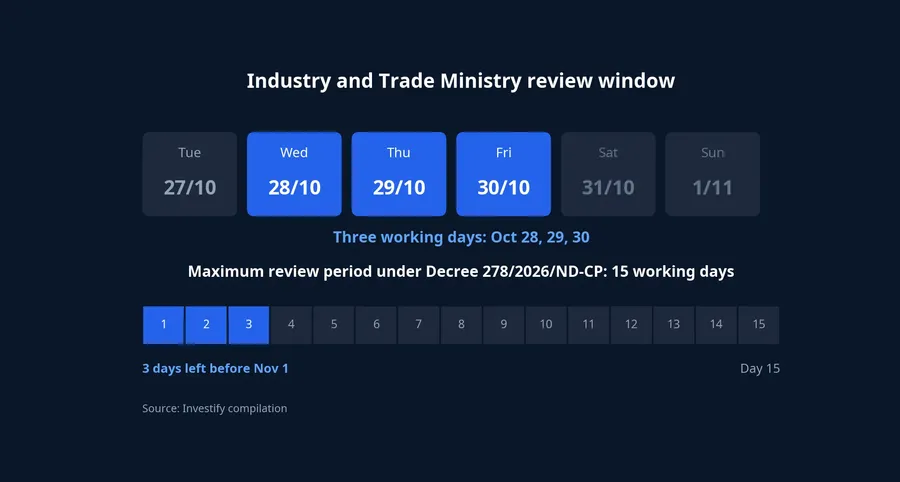
Counting from the evening of October 27, only three working days remain before November 1: October 28, 29 and 30. Decree 278's normal framework gives the Industry and Trade Ministry up to 15 working days to review a power price plan. To make November 1, EVN would have to file almost immediately and the ministry would have to respond far faster than its maximum. The instruction to "keep the timetable for November 1" targets exactly this gap.
For gasoline, the deadline is also before November 1, but the Finance Ministry's product is a report to the competent authority, not a new tax rate. If approved, relief reaches drivers only through a price review by the Industry and Trade Ministry. In March, the 0% rate took effect from midnight on March 26 and retail prices were adjusted the same day.
Two signals to watch
On electricity, the first thing to read is the size of the cut when EVN files its plan. Anything under 1%, about VND 22 per kWh, would not be adjusted under the rules. The closer it gets to the VND 111 per kWh gap, the more it suggests EVN has not loaded the FX balance into this period's price.
On gasoline, the signal is a document from the competent authority before November 1 and an accompanying price review. Without one, the 8% tax on E5 stays in November pump prices. For now the evidence supports only that two plans are being drafted, not that they will succeed. The next three working days will give the first answer.