

Every dollar of stock-sale proceeds or dividends you receive lands in a commercial bank account. For the Ministry of Finance, that is reason enough to exempt these two withdrawals from money-laundering controls. The State Bank of Vietnam (SBV) reads the same cash flow the other way: the moment money comes out is exactly when it needs screening.
Both readings appear in the SBV's newly published summary of comments from ministries and agencies on a draft decree amending Decree 19/2023/ND-CP, which implements the Law on Anti-Money Laundering.VietNamNet The text is still a draft. This piece looks at why the SBV did not accept the exemption request, and what that means for anyone withdrawing money from a brokerage account.
The Ministry of Finance's case: the money already passed through a bank
In its comments on the draft's scope, the Ministry of Finance said securities law requires investors' money transactions to go through commercial banks. It therefore asked the drafters to consider exempting two types of transactions: withdrawing stock-sale proceeds and withdrawing dividends from securities investment at a brokerage.VietNamNet
The logic is easy to follow. Money enters the market through a bank and leaves through a bank, so a credit institution sits at both ends of the flow. An extra layer of control at the withdrawal stage could be seen as duplicating what the system already does.
How the SBV reads the withdrawal: as the integration step
The SBV replied that withdrawals of stock-sale proceeds and dividends remain within the scope of anti-money-laundering law. Its stated reason: a withdrawal may relate to the integration stage, the final step of a laundering scheme.VietNamNet
To see why that stage matters, look at how dirty money gets cleaned. First, illicit funds enter the financial system. Then they are moved through many transactions to erase the trail. The last step is integration: the money returns to its owner under a perfectly lawful-sounding label.
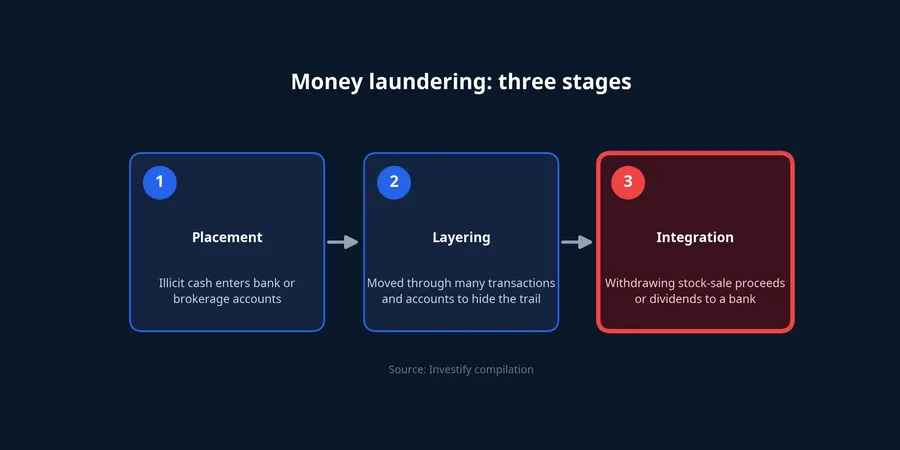
The stock market supplies such labels ready-made. Money that bought shares and then sold them arrives back at the bank tagged "securities sale proceeds." A dividend paid on shares held is also income with clear paperwork. For a launderer, the value of both labels is that they look clean.
So the two arguments do not really clash on the facts. Both accept that the money passes through a bank. They differ on what that passage proves: the Ministry treats it as evidence of transparency, while the SBV treats the exit from the market as the place where laundered money appears for the last time as legitimate money. Exempt that step, and the control chain would have a hole at its final link.
A caveat on what we know. The response as reported gives only the integration-stage rationale. Another explanation could be that the draft follows international standards: on crypto-assets, the SBV did cite Recommendation 15 of the Financial Action Task Force (FATF).Người Quan Sát But the reports do not say the SBV used that reasoning for securities, so the stated basis remains the integration stage.
What applies today and what sits in the draft
For investors, the key is separating rules in force from new content that exists only as a draft.
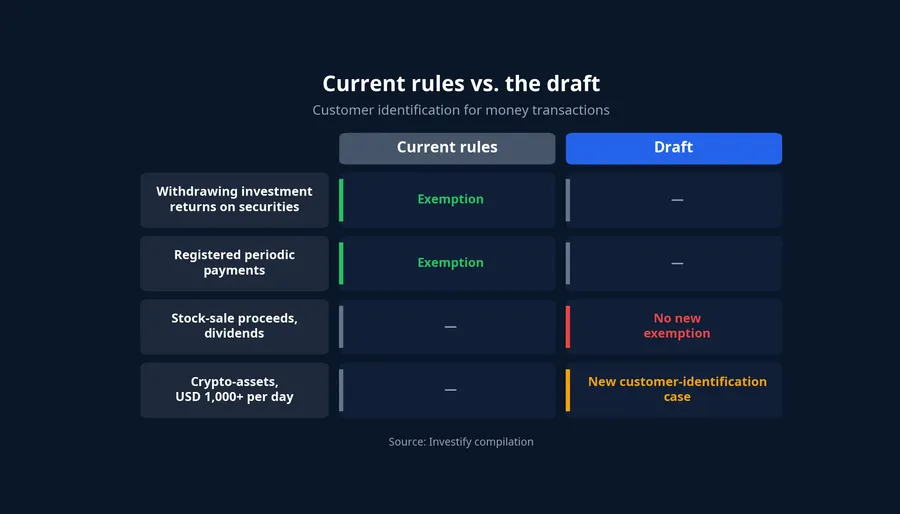
Under current rules, as VietNamNet recounts them, customer identification is already excluded for withdrawals of returns from securities investment and for registered periodic payments. That exclusion rests on the money-laundering risk of those activities. Transactions outside the exclusions must meet customer-identification obligations as usual.VietNamNet
Customer identification does not mean being asked for documents at every withdrawal. Clause 1, Article 6 of Decree 19/2023 lists when financial institutions must identify customers: when first establishing a relationship, when a transaction meets the prescribed conditions, when there are signs of suspected money laundering, or when the accuracy of collected information is in doubt.Người Quan Sát Anyone who opened a brokerage and a bank account passed the first case at account opening.
What the response does, then, is decline to add a new exemption for stock-sale proceeds and dividends. In what the press reports, no new obligation is created for these two transaction types either. Someone withdrawing stock-sale proceeds or dividends to a bank account today stays under the same framework.
The clearest new element: a USD 1,000 threshold for crypto-assets
The most concrete novelty in the draft concerns crypto-asset transactions. The SBV proposes adding point đ to Clause 1, Article 6. Customer identification would be required when a customer has no crypto-asset account or wallet, or has one but made no transactions for 6 consecutive months, and then carries out one or more crypto-asset transactions worth a combined USD 1,000 or more in a single day.Người Quan Sát
BIDV and Vietcombank both commented on the scope. They asked for clarity that the obligation applies only to crypto-asset service providers, not to other reporting entities such as credit institutions. Their reasoning: banks already identify customers for certain deposit, withdrawal and transfer transactions, and without a clearly defined subject they could face an additional identification layer at the USD 1,000 threshold, creating overlap.
The SBV replied that the planned provision applies only to crypto-asset service providers, not to credit institutions. These are a reporting entity newly added under Law No. 23/2026/QH16. It said the USD 1,000 threshold suits the fast, cross-border nature of such transactions and is consistent with Resolution 05/2025/NQ-CP.Người Quan Sát
Two more comments show the SBV keeping the draft's structure. First Commercial Bank, Hanoi Branch, asked to lengthen the no-activity window from 6 to 12 months. The SBV kept 6 months: FATF requires customer identification for occasional transactions from USD/EUR 1,000 but sets no time period, so the draft chose 6 months to align with how other anti-money-laundering rules define occasional transactions. Crypto exchange CAEX asked for confirmation that the threshold does not force re-identification of customers who have completed procedures and maintain a relationship. The SBV said the new provision only determines when the obligation arises, while later verification and information updates follow general rules.Người Quan Sát
Where the document stands in the process
Everything above belongs to a draft that is still being finalized and is not a rule in force.Người Quan Sát The SBV has reached only the stage of compiling comments and responding to them. Still ahead: finalizing the draft, submission to the Government, signing and issuance, and entry into force. No issuance date has been announced.
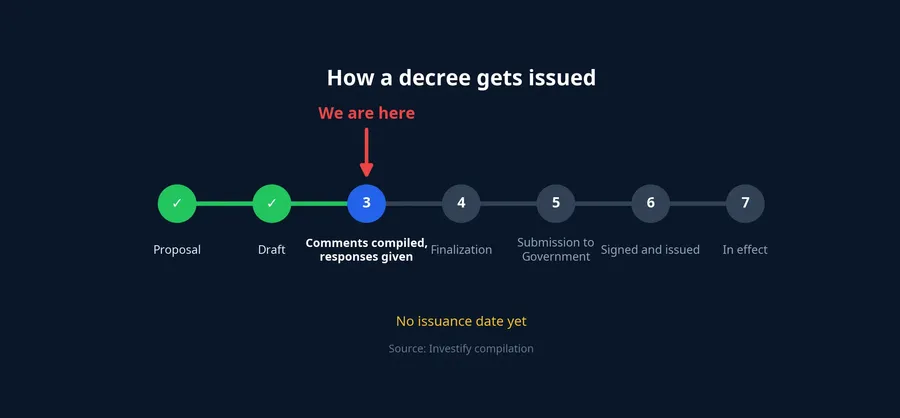
That also means the SBV's position in its response is not the final wording. The Ministry of Finance put its request in writing, and the signed decree will be the last word on which transactions are exempt.
How a withdrawing investor should read this
For stock-sale proceeds and dividends, the draft keeps the current approach: no new exemption, and the reports mention no new procedure specific to these two withdrawals. The exclusion for returns on securities investment and for registered periodic payments is restated as a rule already in force. The clearest change falls on crypto-asset traders, with a USD 1,000 per-day threshold, and that obligation sits with the platform, not the bank.
The conclusion from what has been reported is that there is no reason yet to expect the brokerage-withdrawal process to change. The signal to watch is the signed decree. If Clause 1, Article 6 keeps today's list of exclusions, withdrawing money will work exactly as it does now. If the Ministry of Finance's request is adopted in the final round of revisions, that list would grow by two lines.