


Viet Capital Bank (BVBank, ticker BVB) has released its Q3 2026 financial statements, showing cumulative nine-month pre-tax profit of more than VND 825 billion, up 90% year on year.CafeF On October 27, Vietnamese media widely reported that the bank had beaten its full-year plan. The figure is right, but only against one of the two benchmarks BVBank set for 2026.
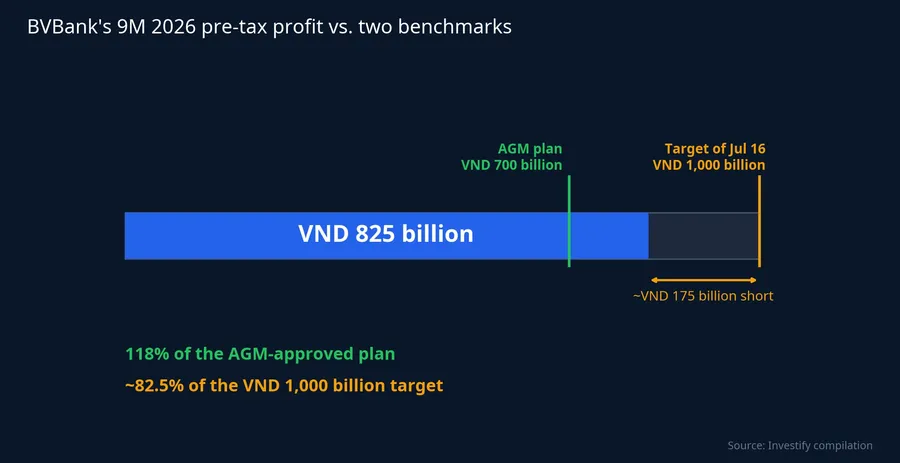
The first is VND 700 billion, approved by the annual general meeting (AGM) at the start of the year; BVBank has reached 118% of it. The second is VND 1,000 billion, a target management gave investors on the afternoon of July 16, just before BVB shares moved to HoSE. Against that one, the bank is about 82.5% of the way there and roughly VND 175 billion short.
Where the profit comes from
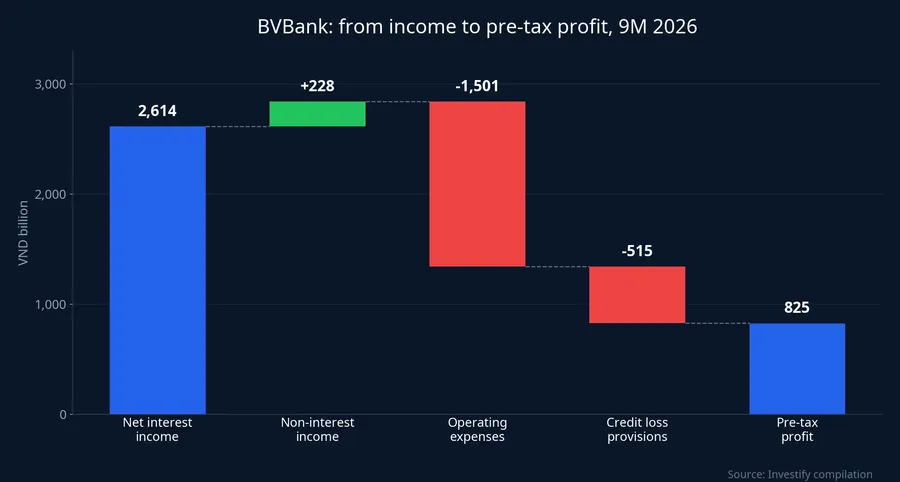
Lending is still BVBank's main earner. Net interest income for the nine months reached VND 2,614 billion, up 40% year on year.Fili Total operating income topped VND 2,800 billion, up 36%.CafeF In other words, nearly all income comes from the gap between what the bank earns on loans and what it pays depositors.

Non-interest income was VND 228 billion, up 28%, but the pieces are uneven. According to figures Vietstock compiled from the financial statements, foreign-exchange gains rose 20% to VND 90 billion, and other operating income rose 23% to over VND 143 billion, helped by the recovery of nearly VND 152 billion in loans previously written off against provisions.Fili The services line swung from profit to a loss of over VND 11 billion, as payment-service costs reached more than VND 217 billion. So the rise in non-interest income owes mostly to old loan recoveries, which are unlikely to repeat steadily every quarter.
On costs, operating expenses were VND 1,501 billion, up 23%. That is slower than income growth, so the cost-to-income ratio fell 5.8 percentage points.CafeF Finally, BVBank set aside nearly VND 515 billion for credit-risk provisions, up 21%, leaving over VND 825 billion in pre-tax profit.
How the two benchmarks differ
The VND 700 billion figure is the official plan, voted through by the AGM. It is also the yardstick in BVBank's press release, which says the bank has completed 118% of its annual plan and calls itself the first in the system to complete its 2026 full-year plan, as CafeF relayed.CafeF
The VND 1,000 billion figure has a different origin. At the July 16 meeting with investors, Mr. Nguyen Hoang Son, Deputy General Director in charge of Finance at BVBank, said management had raised its 2026 pre-tax profit target to VND 1,000 billion.Doanh nhan Phap luat The sources available do not show that the AGM has re-approved it, so it is a commitment management made to the market, not a plan with voting weight.
The distinction matters to anyone reading headlines. When a bank says it has "beaten its plan," the first question is which plan, and who approved it. For BVBank, the shareholder-approved plan is met; the target management raised itself is not yet.
Q3 was lower than Q2
In Q3 2026 alone, BVBank earned nearly VND 278 billion before tax, down 19% year on year.Fili That is also below Q2, when pre-tax profit was nearly VND 332 billion,CafeF so Q3 fell about 16% from the previous quarter. According to Vietstock, profit slipped because the bank sharply increased credit-risk provisions. The sources available do not break out Q3 provisioning on its own, so it is not possible to say exactly how much the charge rose from Q2.
Asset quality sends mixed signals. The NPL ratio fell from 3.01% at the start of the year to 2.08% on September 30, 2026. In absolute terms, however, bad debt is still VND 2,452 billion, up 5% from the start of the year.Fili A falling ratio alongside a rising absolute figure suggests new bad debt is still emerging; the loan book is simply growing faster.
The Q4 arithmetic is the notable part. To reach VND 1,000 billion, BVBank needs about VND 175 billion of pre-tax profit in the last three months of the year. That is below every one of the first three quarters: about VND 216 billion in Q1,Dai bieu Nhan dan nearly VND 332 billion in Q2 and nearly VND 278 billion in Q3.
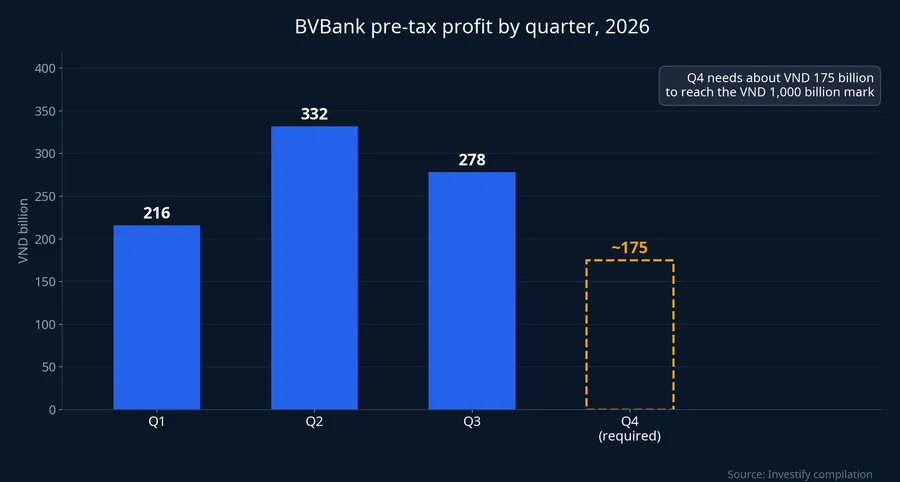
At the pace already set, the raised target does not require Q4 to accelerate. The deciding variable is provisioning: if the Q4 charge keeps rising as sharply as in Q3, the gap to VND 1,000 billion narrows considerably.
Where the capital raise stands
Events have moved further than the October 27 press release's description of the bank as "finalizing the plan." BVBank fixed the record date for the new-share offering on September 24, 2026, at a 2:1 ratio: shareholders holding two shares may buy one new share. The offer price is VND 10,000 per share, with registration and payment from September 29 to October 19.Tin nhanh chung khoan
According to the offering results the bank has just announced, of 320.4 million shares offered, shareholders registered and paid for 232.58 million, or about 72.6%. That leaves 87.8 million shares unsubscribed. BVBank will sell 87.5 million of them to 10 individuals at the same VND 10,000, with payment due by the end of November 2. These re-allocated shares are subject to a one-year transfer restriction.FireAnt
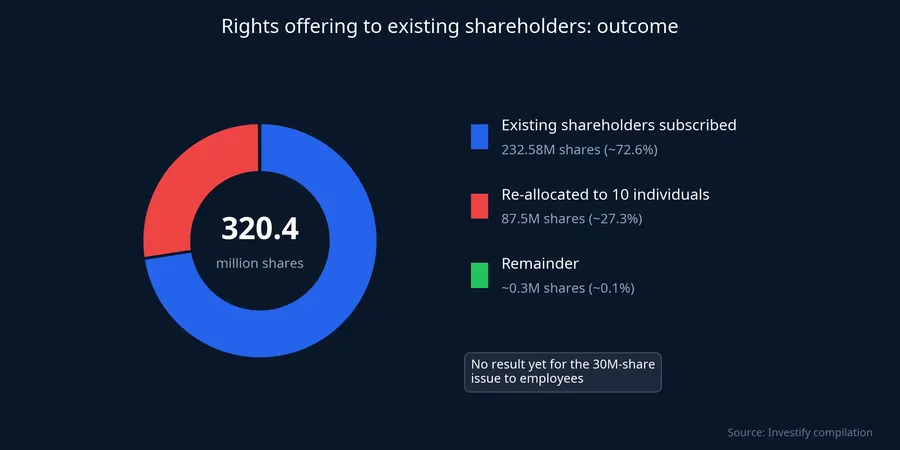
In parallel, the bank is issuing 30 million shares to employees, also at VND 10,000, with payment from October 12 to 23 and a one-year transfer restriction. No result for this tranche appears in the sources available. If both tranches complete, charter capital rises from VND 6,408 billion to VND 9,912 billion.FireAnt
About 27% of the subscription rights went unused, and the sources give no reason. One related detail is that the gap between the market price and the offer price is thin: on October 27, BVB closed at VND 10,450, only about 4.5% above the offer price. When the market price sits close to the subscription price, the incentive to put in more cash weakens. That is only one possible explanation; individual shareholders' funding needs and the fact that the rights could not be transferred may also have played a part.
What changes in a BVB holder's account
For those who held BVB on the September 24 record date, the mechanical effect depends on whether they subscribed. If they bought through their rights, every two old shares become three, at a cost of VND 10,000 for each new share. The sources available do not say when the new shares will reach accounts and begin trading.
If they did not subscribe, their share count stays the same but their ownership percentage is diluted. Charter capital of VND 6,408 billion corresponds to roughly 640.8 million shares. Once the rights offering (including the re-allocated portion) and the employee issue are both complete, the total rises to about 991.2 million. A holder who did not subscribe keeps only about 65% of the original stake, while one who took up their full rights is still diluted slightly, to about 97%, because of the employee issue.
The second effect is on earnings per share. The share count rises about 55%, so from 2027 BVBank's profit will be divided among far more shares. For that figure not to decline, the roughly VND 3,500 billion of new capital has to be lent out and earn a return quickly enough. The bank says the proceeds will go toward lending capital.FireAnt
Finally, 117.5 million shares (87.5 million re-allocated and 30 million for employees, if fully sold) cannot be sold for a year. Shares shareholders bought through their rights are not subject to this restriction.
Signals to watch
BVBank's picture is fairly clear: profit growth is real, driven mainly by net interest income, and the shareholder-approved plan has been met. The VND 1,000 billion target does not require Q4 to surge, so the main risk to it is provisioning costs, not the pace of income growth.
The nearest date is November 2, the payment deadline for the 10 individuals buying the surplus shares. After that, the bank will report the final results of both issues and say how much charter capital has actually risen.
The next is the Q4 financial report, expected in late January 2027. Q4 pre-tax profit of roughly VND 175 billion or more would confirm the target management stated in July. The provisioning line in the same report will show whether Q3 was a one-off increase or the start of a new pattern.