

Asia Commercial Bank's (ACB) nine-month results release on October 27, 2026 put two pieces of news side by side. First, Fitch Ratings raised ACB's credit rating one notch, from BB- to BB, with a Stable outlook.FireAnt Second, the bank published a tougher way of measuring its own bad debt, and on that measure its provisions no longer cover all non-performing loans (NPLs).
The two items need to be read together. A rating speaks to the bank's long-term foundation. The coverage ratio speaks to the provisioning cost ACB will carry in the final three months of the year, which is the part of the 2026 profit plan still to be earned.
What the Fitch upgrade rests on
ACB did not give the date of Fitch's decision, only saying "recently", and Investify could not find Fitch's original release. Everything below about the reasons for the upgrade is therefore ACB's account of Fitch's report, not Fitch's own words.
According to that account, Fitch judged ACB's asset quality to be better than the sector average, with a low and stable NPL ratio for many years and a loan book with a high share of collateral. ACB stresses one point above all: its risk appetite is ranked among the most conservative in Vietnam's banking system. ACB says the upgrade stems from an improved standalone financial profile, meaning the bank's own capacity rather than any expectation of state support. Earlier, in May 2026, Moody's had raised ACB's rating outlook to Positive.FireAnt
Where does BB sit? Fitch rates Vietnam at BB+, one notch below investment grade.FireAnt That puts ACB one notch below the sovereign and two notches below the investment-grade threshold (BBB-). It is still sub-investment-grade territory, but the gap to the sovereign ceiling has narrowed.
A higher notch matters most in practice when a bank borrows abroad. In the third quarter ACB raised a US$500 million international syndicated loan.FireAnt A foreign agency's rating is one input lenders use to set pricing and limits, so a higher rating tends to lower borrowing costs or make it easier to open more headroom next time. ACB has not disclosed any specific saving, so this is a directional effect that cannot yet be measured in money.
Two ways to count bad debt, two different buffers
The part of the release most worth reading closely is asset quality. At the end of the third quarter, ACB's own NPL ratio was about 1.04%. Adding the NPLs affected by CIC (the National Credit Information Center) lifts it to 1.18%.FireAnt
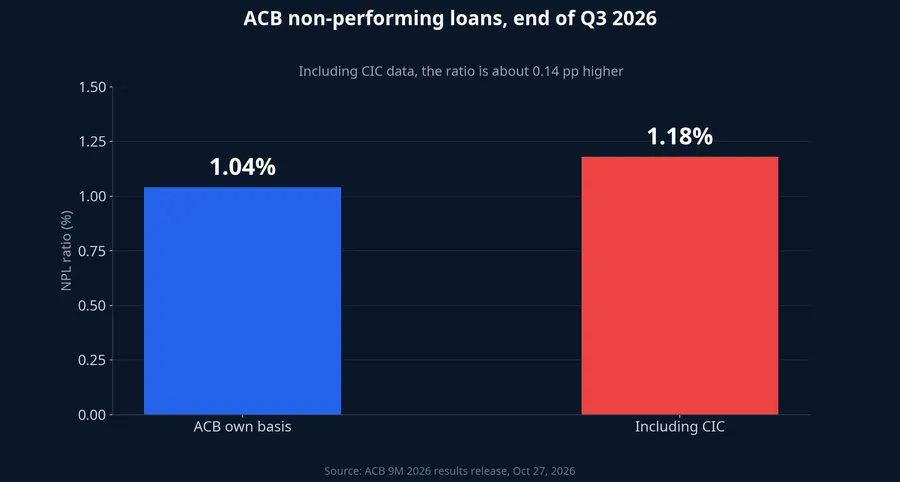
ACB does not disclose the detailed formula for the gap. As banks usually present it, NPLs "affected by CIC" are loans reclassified into a worse group after checking against system-wide credit data, even when the borrower is not yet overdue at that particular bank. Put differently, 1.04% is ACB looking at its own books, while 1.18% is ACB's customers viewed against their entire borrowing history.
This slice of bad debt is growing fast. According to the release, CIC-affected NPLs rose by more than 40% in the third quarter alone. ACB attributes this to liquidity pressure and persistently high interest rates through 2026.FireAnt
Change the measure and the provision buffer changes too. ACB's coverage ratio is 104% on its own NPLs and 91% once CIC-classified NPLs are included.FireAnt The mechanism is simple: the coverage ratio is provisions divided by NPLs. Provisions stay the same, but the denominator rises from 1.04% to 1.18% of loans, so the ratio slides from above 100% to below it. A reverse check shows the two figures are consistent: 104% times 1.04% gives provisions of about 1.08% of loans, and dividing that by 1.18% gives about 91%.
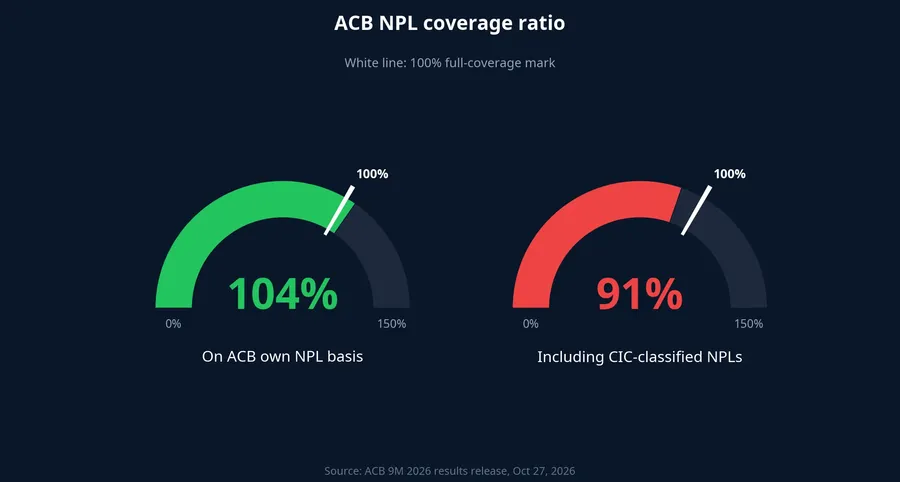
Below 100% means that on the tougher measure, provisions do not fully cover NPLs. A rough calculation on customer loans of VND 765 trillionFireAnt suggests ACB would need to set aside roughly VND 750 to 800 billion more to bring the CIC-inclusive coverage ratio back to 100%. This is Investify's estimate from the rounded figures in the release, not a number ACB published, and the bank is under no obligation to bring the ratio back to 100%.
It is worth noting that ACB itself put the 1.18% and 91% figures in the release, right next to the upgrade news. It could have reported only 1.04% and 104%, which look better. That presentation fits the conservative risk appetite ACB attributes to Fitch's report, and it also serves as advance notice to shareholders about upcoming costs.
The rest of the profit plan depends on Q4 provisions
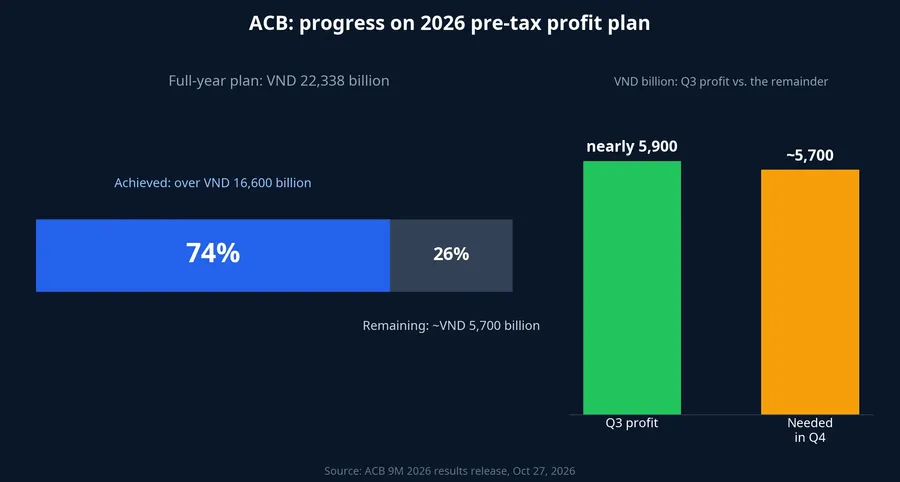
After nine months ACB has earned more than VND 16,600 billion in pre-tax profit, 74% of its annual plan.FireAnt The plan approved at the April annual general meeting is VND 22,338 billion.Báo Pháp luật That leaves about VND 5,700 billion of pre-tax profit for the fourth quarter, roughly the nearly VND 5,900 billion earned in the third quarter alone. In other words, the bank needs a fourth quarter close to the third.
Underlying income is rising. Nine-month net interest income was above VND 23,000 billion, up more than 16% year on year; service income was above VND 2,600 billion, up 16%. Third-quarter NIM was 3.08%, the cost-to-income ratio 31%, and customer lending was up about 11.5% from the start of the year.FireAnt
The harder variable to call is provisioning cost. In the third quarter it fell almost 12% from the second quarter, which, along with higher interest income, helped third-quarter profit. Yet ACB's management says the bank will keep a cautious stance in the fourth quarter and proactively set aside provisions to strengthen its risk buffer.FireAnt
Put those two points together and the fourth quarter can go one of two ways. If CIC-inclusive NPLs level off, ACB can provision at a moderate pace and still earn enough to reach the plan. If CIC-affected NPLs keep rising at the third-quarter pace, the bank will have to provision more to hold its buffer, and that extra charge competes directly with the VND 5,700 billion of profit still missing. Even the VND 750 to 800 billion estimate for lifting CIC-inclusive coverage to 100% would be around 13 to 14% of the fourth-quarter profit required.
What depositors can read from the safety ratios
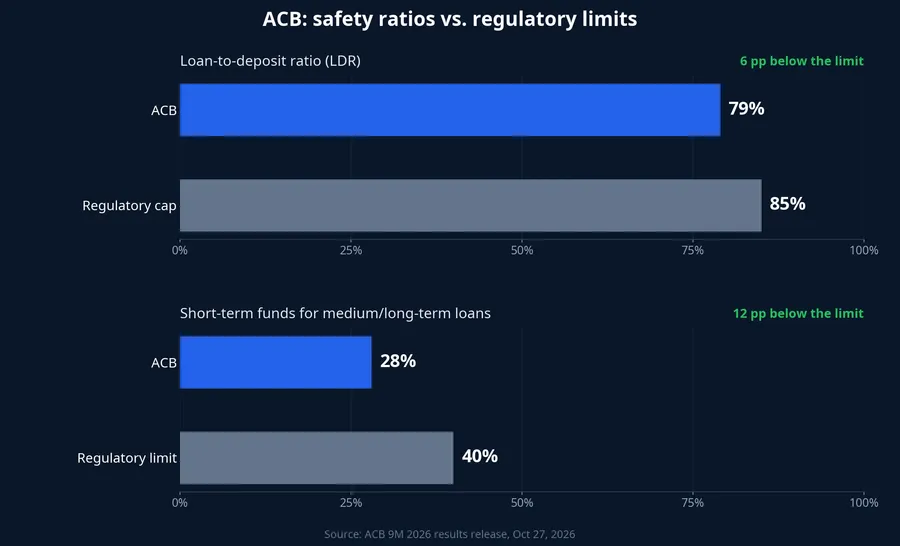
For people with savings at ACB, the liquidity ratios show the bank sitting well clear of regulatory limits. The loan-to-deposit ratio (LDR) under Circular 25 is about 79%, below the 85% cap. The share of short-term funds used for medium and long-term loans is about 28%, below the 40% limit under the State Bank of Vietnam's new rules. The consolidated capital adequacy ratio under Circular 14 is about 12%.FireAnt
Funding is also growing steadily: total mobilized funds were above VND 807 trillion, up 12.3% from the start of the year, while customer deposits were above VND 596 trillion, up 3.4% in the third quarter alone.FireAnt

The bad-debt story above is therefore mainly a shareholder story. More provisioning lowers profit but thickens the cushion protecting the bank, which benefits depositors. For a depositor, a bank that provisions proactively as bad debt rises sends a better signal than one that keeps profit looking good by provisioning less.
What to watch in the Q4 report
The BB rating reflects a foundation ACB has built over many years, and the liquidity ratios confirm that foundation in the short term. What remains unanswered is how much it will cost to maintain it in the fourth quarter.
The fourth-quarter financial statements, expected at the end of January 2027, will answer through three figures read together: the CIC-inclusive NPL ratio against 1.18%, the CIC-inclusive coverage ratio against 91%, and fourth-quarter provisioning cost against the third quarter. If CIC-inclusive coverage edges up while full-year profit stays close to plan, ACB will have paid for its caution out of its own earnings. If profit reaches the plan but coverage keeps falling, profit is being preserved by deferring provisions. And if the bank provisions heavily and misses the plan, shareholders should read that as a choice to prioritize the buffer over the annual number, just as management said it would.