
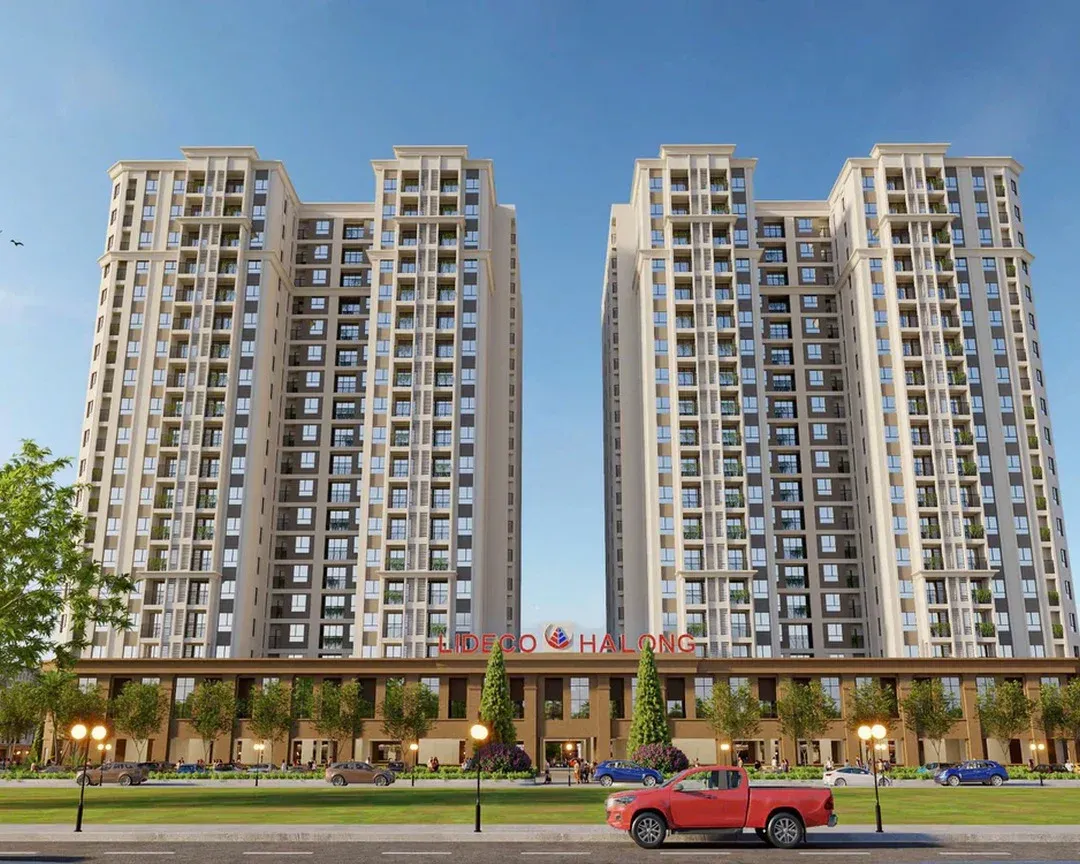

Tu Liem Urban Development JSC (Lideco, ticker NTL on HoSE) is a homebuilder. Yet its third-quarter 2026 loss did not come from selling homes. According to the financial statements released on October 26, Lideco reported a net loss of VND 76.61 billion, against a profit of VND 12.7 billion a year earlier.ĐTCK The core business still earned a gross profit. What pulled the result down was financial expenses, which CafeF attributes to provisions for securities investments.CafeF
The story deserves a closer read because it lands just as the company's cash pile has thinned dramatically. Lideco's money now sits in three places: a stock portfolio, the Dich Vong urban area construction site in Hanoi, and the OXH-01 social housing tower in Ha Long. Each affects earnings in a different way.
A positive gross profit, wiped out by financial expenses
Start with the numbers. Net revenue in Q3 was VND 4.45 billion, up from VND 3.86 billion in Q3/2025. Cost of goods sold fell from VND 4.49 billion to VND 3.84 billion, leaving a gross profit of about VND 610 million, versus a gross loss of nearly VND 629 million a year earlier.ĐTCK
These figures are small relative to the company's size. The result was decided by two financial lines. Financial revenue shrank to nearly VND 3.47 billion from VND 57.65 billion a year earlier. Financial expenses rose to over VND 75.8 billion, almost the entire net loss for the quarter.ĐTCK Add VND 7.27 billion of general and administrative expenses and the company swings from profit to loss.
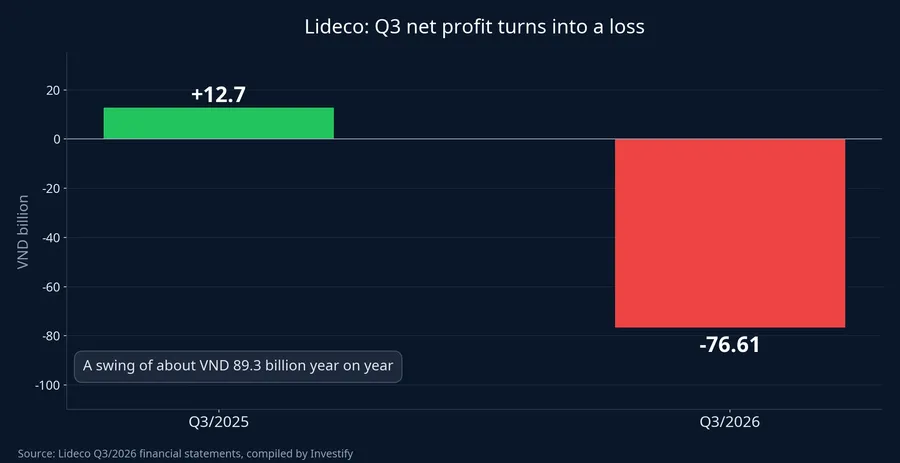
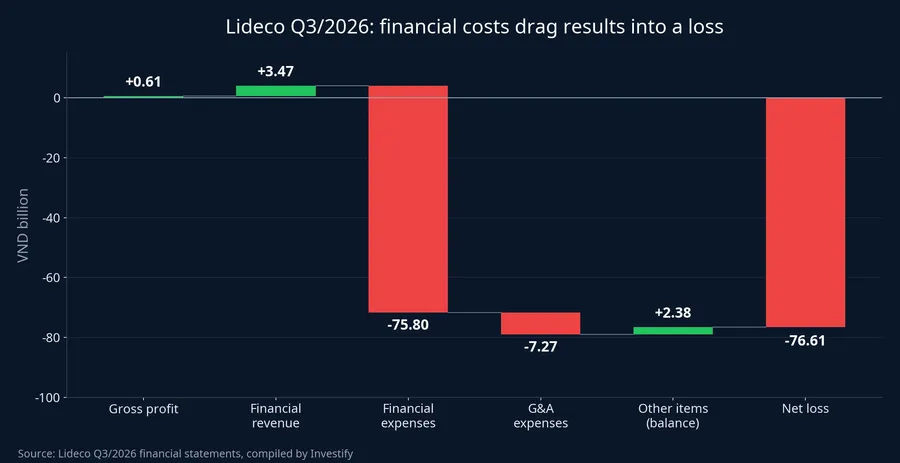
For the first nine months, Lideco posted a net loss of VND 55.55 billion, against a profit of over VND 20.5 billion a year earlier. Nine-month financial expenses were VND 76.76 billion, meaning almost all of this year's financial expenses landed in Q3.ĐTCK
One point needs care: a provision is a book write-down to period-end market prices. The company has not sold those shares and has not lost cash because of this charge. If prices in the portfolio recover in later quarters, the provision can be reversed and flow back into profit. The opposite also holds: further price declines would raise the provision.
The stock portfolio: which tickers drove the provision is unknown

The two news reports on Q3 do not say which tickers caused the provision this quarter. The Q2 report did show the trading securities portfolio taking up a large share of total assets, but that is a June 30 figure, not the position at September 30. This post therefore does not attribute the Q3 provision to any specific stock, and it makes no call on the price of any ticker in the portfolio.
What can be read with confidence is the gap in scale. Lideco's quarterly net revenue is only about VND 4 billion, while financial expenses in Q3 alone exceeded VND 75.8 billion. Swings in the investment portfolio therefore overwhelm the core business on the income statement. Ticker-level detail sits only in the notes to the Q3 report.
Cash from over VND 512 billion to nearly VND 83 billion
At the end of Q3, Lideco held nearly VND 83 billion in cash and cash equivalents, down from over VND 512 billion at the start of the year, a drop of about VND 429 billion in nine months. At the same time it took on short-term loans of over VND 215.8 billion to build social housing in Cao Xanh, Ha Lam (Quang Ninh), at 6.1% a year in the first half and 7% a year from July 1, 2026.ĐTCK
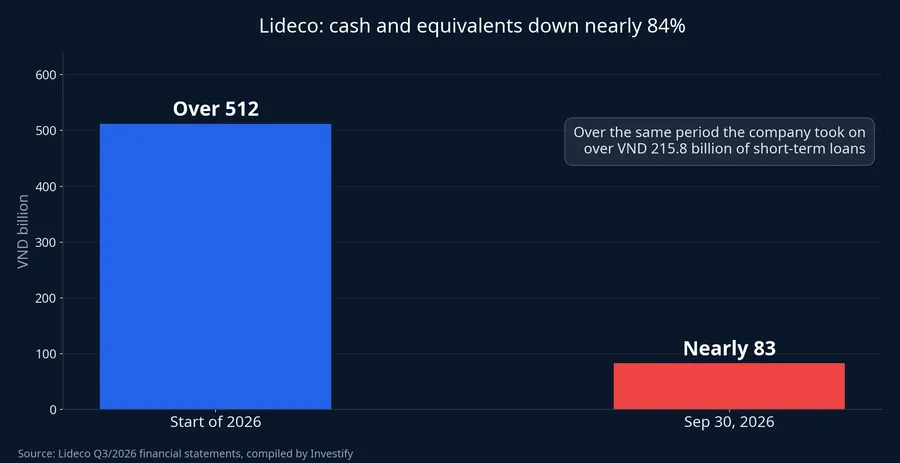
The cash outflow shows up most clearly in inventory. At September 30, 2026, inventory stood at over VND 888.4 billion, up about 56.6% from the start of the year. Work-in-progress costs made up VND 860.35 billion of that, compared with VND 539.17 billion at the start of the year, split across two sites.ĐTCK
Dich Vong urban area (Hanoi) carries over VND 594 billion of work in progress. Per the notes to the financial statements, the project's total investment has been revised up to VND 5,124.8 billion, with completion pushed back to Q1/2029. Work in progress is only about 12% of total investment, so most of the remaining capital has yet to be committed.
OXH-01 social housing (Ha Long) saw work in progress rise from VND 44.19 billion at the start of the year to VND 261.47 billion, nearly 5.9 times in nine months. The project was assigned under Decision 2962/QĐ-UBND dated July 29, 2025, and consists of one 19-storey tower with 850 apartments and an approved total investment of about VND 967 billion.ĐTCK
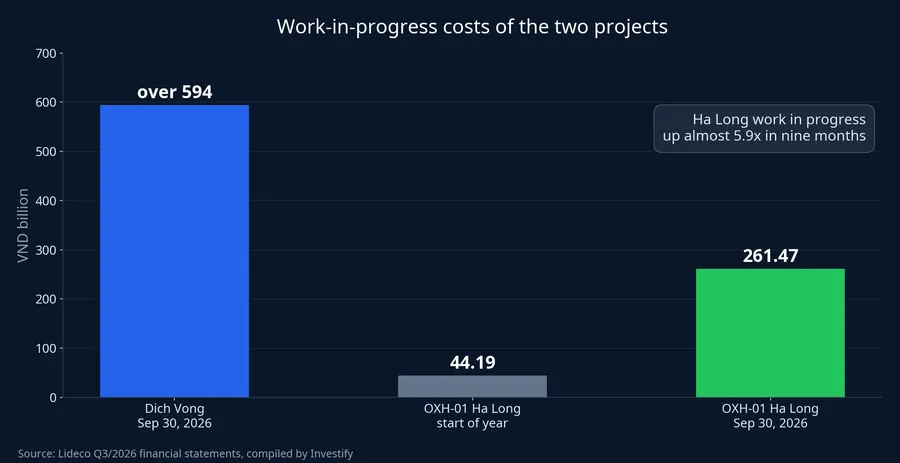
Set side by side, the figures reveal a gap. Company-wide work in progress rose by about VND 321 billion in nine months, while cash fell about VND 429 billion and the company borrowed another VND 215.8 billion. Work in progress has absorbed only about half of the cash that left. The rest could sit in other items such as term deposits longer than three months (not counted as cash equivalents), prepayments to contractors or for site clearance, or additional share purchases. The available reports do not break this out, and only the notes to the Q3 report can answer it.
The first revenue comes from Ha Long, not Hanoi
According to the company, OXH-01 received 556 eligible applications in the first round and is now accepting second-round applications for the remaining 200-plus units. Lideco says the project begins generating revenue inflows in Q4/2026.CafeF
"Inflows" needs to be read carefully. Money buyers pay under contract while the building is still under construction is usually booked as advances from customers. That is cash in the bank, and it eases reliance on the 7%-a-year loan, but it is not yet revenue on the income statement. As Báo Đầu tư Chứng khoán notes, accumulated project costs do not automatically turn into revenue or profit; that depends on completion, handover and accounting recognition rules.ĐTCK
For NTL shareholders, Q4 may therefore improve cash flow before it improves profit. Dich Vong is much further out: with completion pushed to Q1/2029, most of the money sunk into the Hanoi site has no scheduled return this year or next, based on what the reports state.
Reading the Q4 report through two lines
Lideco's earnings over the next few quarters will be driven by two separate forces. The first is the price of the shares the company holds. As long as the portfolio stays large relative to housing revenue, each quarter-end the prices of its holdings will decide whether the company books more provisions or reverses them, in either direction. The second is the Ha Long social housing project, where buyers' money starts arriving in Q4 but will show up in customer advances and cash before it becomes revenue.
The Q4 report is therefore best read through two lines. The provision for trading securities shows how much the portfolio still drags on earnings. Customer advances, set against the cash balance, show how far the social housing money has arrived. If cash keeps falling while short-term borrowing rises, the construction sites are running ahead of the money coming in. If cash edges up on customer advances, the social housing project has started to fund its own construction.