

Hoa Phat Agriculture (HoSE: HPA) reported Q3/2026 net profit of VND 300 billion. Over nine months it has booked VND 948 billion, or 94% of its full-year target of VND 1,005 billion.Người Quan Sát That leaves roughly VND 57 billion for Q4 to hit the target, less than a fifth of what the company earned last quarter.
The result arrives while live hog prices are still sliding. On October 25, northern live hogs fetched VND 46,000–48,000 per kg.FireAnt Six days earlier, the nationwide range was VND 50,000–53,000 per kg.Báo Văn hóa In one low-price quarter, HPA and Dabaco (DBC) produced very different outcomes. This piece puts the two side by side on the same yardsticks to see what each company's profit actually rests on.
HPA: sold less than a year ago, kept more of each dong
HPA's consolidated Q3 revenue was VND 1,685 billion, down 19% year on year. Net profit fell 16%, a slower decline than revenue. According to the company, revenue fell mainly because it sold fewer hogs and cattle than a year earlier.Người Quan Sát
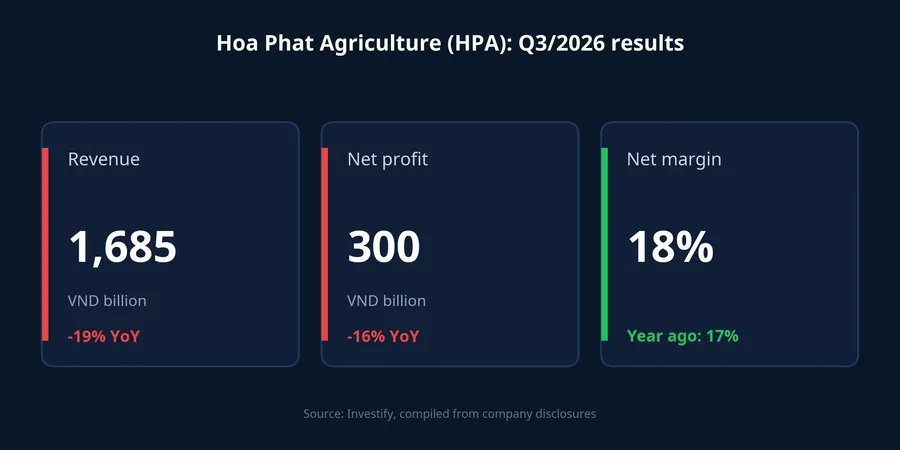
Because profit fell more slowly than revenue, the net margin edged up. Gross margin was 25% and net margin 18% in Q3, against 17% in Q3/2025.Người Quan Sát HPA sold less but kept more from every dong of revenue.
The company points to two cost foundations. The first is genetics: HPA says it runs 8 farms with 25,000 sows and fully controls its DanBred supply, from great-grandparent and parent stock to commercial hogs, at 33–34 weaned piglets per sow per year.Người Quan Sát The second is in-house feed: of nearly 98,000 tonnes of feed sold in Q3, more than 46,000 tonnes went to its own farms.Vietstock These are the company's own explanations. Only the detailed financial statements will show how much lower the cost per kg of hog really is.
Versus Q2: many more hogs sold, revenue barely higher
Against the prior quarter the picture runs the other way. HPA sold more than 151,000 hogs in Q3, up 47% from Q2. Commercial hogs came to nearly 107,000 head, up 41%, while weaned piglets topped 44,000, up 67%. Yet revenue rose only 8% from Q2.Người Quan Sát First-half profit works out to about VND 648 billion (VND 948 billion for nine months minus VND 300 billion for Q3), so quarterly profit was nearly flat despite the jump in volume.
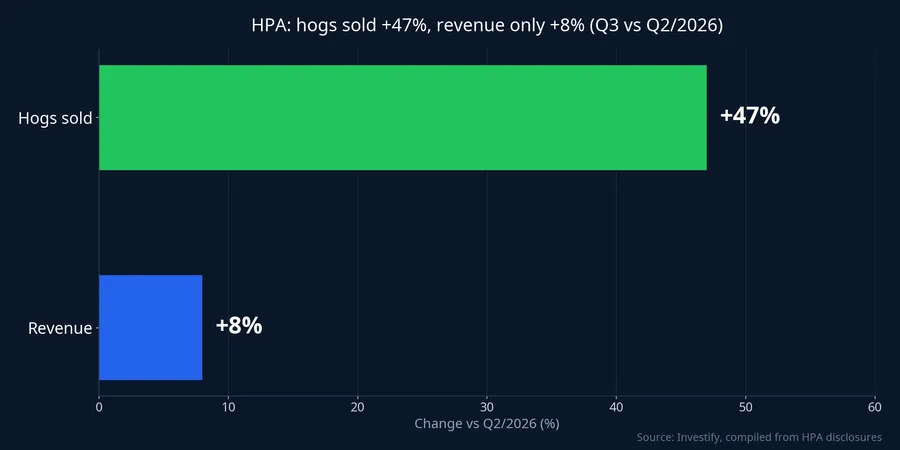
The gap between head count and revenue can come from several places. Lower live-hog prices pull down the average price per animal. Weaned piglets grew fastest, and each piglet sells for far less than a finished hog. Revenue also includes cattle, feed sold to outside buyers and eggs. The company has not disclosed average selling prices by hog type, so the split cannot be separated yet. The segment revenue note in the financial statements will answer it.
Dabaco: more sales, a thinner margin
Dabaco moved the opposite way. Q3/2026 net revenue topped VND 5,138 billion, about three times HPA's. But gross margin fell to 11.4% and net profit to roughly VND 200.2 billion.FireAnt That implies a net margin of about 3.9%, against HPA's 18%.
Below the gross-profit line, Dabaco also carries financing costs. Q3 financial expenses reached nearly VND 102.2 billion, and borrowings plus finance leases at quarter-end stood above VND 7,622 billion. In the company's explanation, falling hog prices dragged down revenue and profit at the group's livestock units, and growth in animal feed and vegetable oil did not offset it. After nine months, Dabaco has completed 77.3% of its annual profit plan, well below HPA's 94%.FireAnt
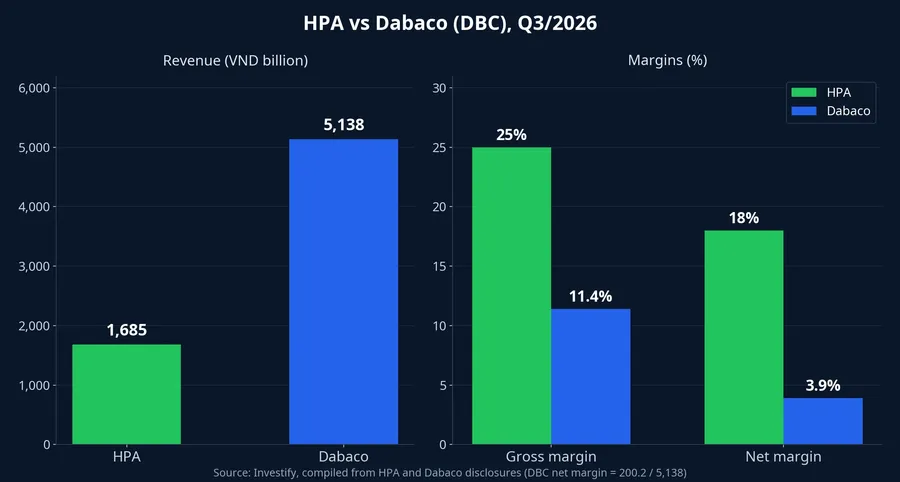
How much is business model, how much is debt
The margin gap between the two is wide. Still, it would be wrong to read all of it as HPA raising hogs more cheaply than Dabaco. At least three explanations coexist.
Revenue mix. Feed sold externally and vegetable oil are thin-margin lines. Both grew strongly within Dabaco's revenue, which drags the blended gross margin down even if the hog business has not worsened. At HPA, nearly half of the feed goes to its own farms, so revenue leans more toward hogs, eggs and cattle.
Farming cost structure. Self-sufficient genetics and in-house feed, in HPA's words, make cost of goods less dependent on outside suppliers. That is a structural edge if true, but for now there is only the company's word and no cost per kg to check it against.
Debt burden. Financing costs above VND 100 billion a quarter come straight out of Dabaco's profit. This is independent of hog prices: even if prices recover, the interest stays. HPA did not disclose quarter-end borrowings in its results release, so the leverage of the two cannot yet be compared at the same date.
The evidence at hand points to revenue mix and debt as the two clearest reasons for Dabaco's thin net margin. HPA's farming-cost advantage is plausible but needs the detailed statements to be verified.
Two different risks for shareholders
That gives a frame for reading the two tickers. HPA's profit in this weak-price quarter rests on holding costs, so its main risk is volume: the company is expanding its herd and selling more animals while each one brings in less money. HPA itself names rising input prices and persistently high borrowing rates as the two challenges for the rest of the year.Người Quan Sát Dabaco's profit is exposed to margin and interest at the same time, so the same dip in hog prices hits its bottom line harder.
HPA's ability to hold its margin was proven in Q3, when it sold fewer hogs than a year earlier. What is not yet proven is whether an 18% margin survives when HPA sells more hogs, with October live-hog prices already below the Q3 average. The Q4/2026 report, expected around the end of January 2027, will answer that. If Q4 net margin stays near 18% while hogs sold keep rising, HPA's cost advantage is real and lasts longer than one quarter. If the margin shrinks clearly as volume grows, most of Q3's difference came from HPA selling fewer hogs at a bad moment for prices.