

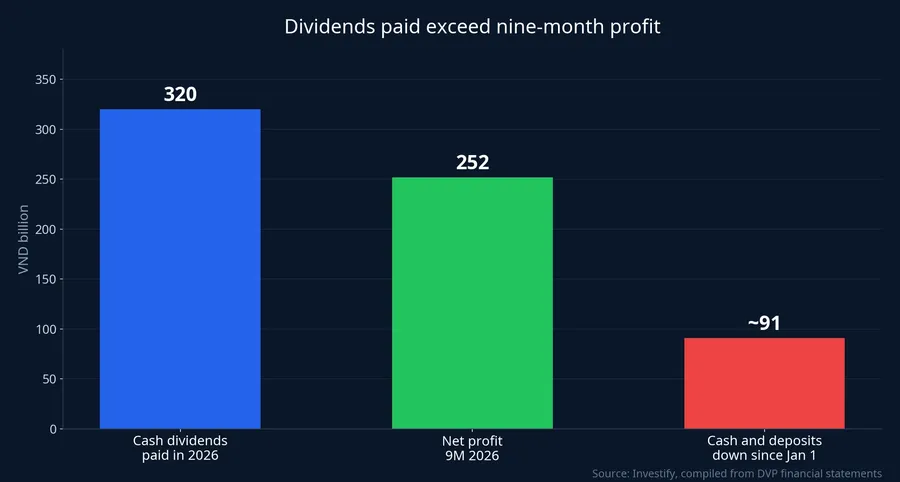
In 2026, Dinh Vu Port Investment and Development JSC (HoSE: DVP) has paid shareholders VND 320 billion in cash across two dividend installments. Over the same stretch it earned VND 252 billion in net profit. The arithmetic says payouts exceeded nine-month earnings, yet the September 30 balance sheet still carries more than VND 1,000 billion in bank deposits.
For anyone holding DVP, the question is concrete: does the dividend come from running the port, from bank interest, or from cash accumulated over many years? The Q3 financial statements, just released, answer most of it.
Two installments and what is left
DVP's 2025 dividend is 80% in cash, or VND 8,000 per share, paid in two installments. The first, at 50%, was paid on June 29, 2026. The second, at 30%, was payable on September 30, 2026. With 40 million shares outstanding, the two payments come to roughly VND 200 billion and VND 120 billion, VND 320 billion in total.
That money was distributed out of 2025 profit. The company earned VND 338.17 billion after tax that year, so about 95% of full-year profit went back to shareholders. The balance sheet shows it: undistributed after-tax profit fell from VND 436.3 billion at the start of the year to VND 235.9 billion on June 30, right after the first payment.
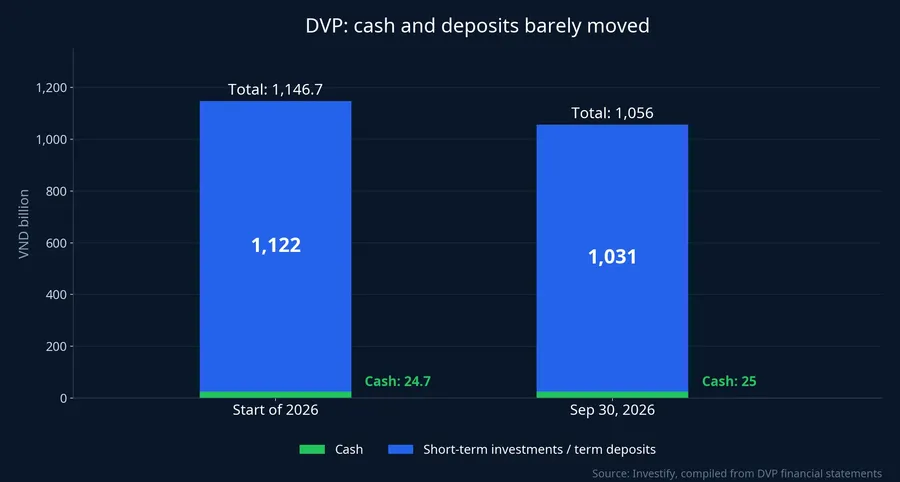
By September 30, total assets stood at nearly VND 1,489 billion, down 5% from the start of the year.Người Quan Sát Most of that is VND 1,031 billion of held-to-maturity investments, all of them term bank deposits, plus just over VND 25 billion in cash and cash equivalents.Doanh nhân Together they exceed VND 1,056 billion.Mekong ASEAN
At the start of the year the equivalent lines were VND 24.7 billion in cash and VND 1,122 billion in short-term financial investments, about VND 1,146.7 billion combined. So after nine months, and after VND 320 billion in dividends, cash and deposits shrank by only about VND 91 billion.
One detail suggests the second installment was probably paid on time: liabilities at the end of Q3 were about VND 130 billion, mostly taxes payable and wages owed.Người Quan Sát Had the VND 120 billion second payment still been outstanding, it would sit in liabilities and inflate that figure noticeably.
The profit that comes from running the port
The cash pile did not fall much because port earnings keep flowing in. In Q3, net revenue was VND 172 billion, up 33% year on year. Cost of goods sold was VND 88 billion, up 37.5%, and gross profit was nearly VND 84 billion, up 27%.Người Quan Sát Because costs grew faster than revenue, gross margin slipped from 51% to 49%. That is still high: of every VND 100 of port revenue, the company keeps nearly half after direct costs.
Q3 pre-tax profit was VND 109 billion and net profit VND 94 billion, up 15.7% and 15.2% respectively. For the nine months, net revenue was VND 507 billion, up 16%. Gross profit of VND 275 billion, pre-tax profit of VND 307 billion and net profit of VND 252 billion each rose 18%.Người Quan Sát
The VND 275 billion of gross profit from port services is the largest block of nine-month earnings. It is the main source of dividend cash, not the deposit balance.
The profit that comes from financial activity
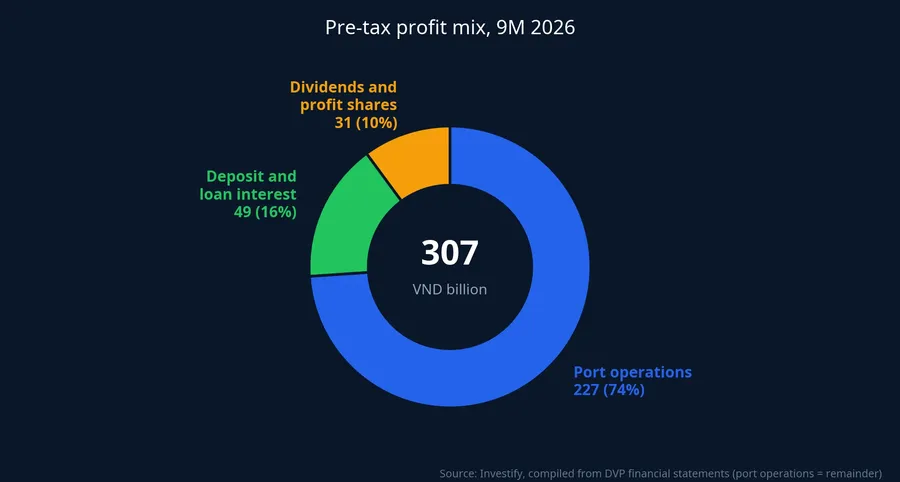
The rest comes from banks and investments. Nine-month financial revenue was VND 82 billion, up 37% year on year. According to the notes to the financial statements, it consists mainly of VND 49 billion in interest on deposits and loans and VND 31 billion in dividends and profit shares received in cash.Mekong ASEAN
Set against VND 307 billion of pre-tax profit, all financial revenue is about 27%. Deposit and loan interest alone is about 16%. Put differently, of every VND 100 of pre-tax profit, roughly VND 16 is interest paid by banks on the company's deposits. That share is not dominant, but it is large enough to matter when interest rates move.
Financial expenses are close to zero: only about VND 17 million in Q3. The reason is that Dinh Vu Port has no financial borrowings, short-term or long-term.Doanh nhân
Why the company can pay so much cash
Put the pieces together and the model is simple. Port operations generate most of the profit at a gross margin near half of revenue. With no debt, the company pays no bank interest and sets aside nothing for principal. The deposit balance of over VND 1,000 billion is both a cushion and a source of extra interest.
That lets the company distribute nearly all its profit each year without borrowing. This year's VND 320 billion outlay exceeds nine-month earnings, but the shortfall was covered by profit retained from earlier years, and deposits fell only slightly. The VND 91 billion decline is larger than the VND 68 billion gap between dividends and nine-month profit. The remaining roughly VND 23 billion may relate to investment spending and working capital in the period; the cash flow statement will show line-by-line detail.
There is an alternative reading worth weighing: is the company eating into its deposits to keep dividends high? The available data does not point that way. The VND 91 billion decline is less than a tenth of the opening cash and deposits, while port earnings keep rising quarter after quarter. This year's payout looks large mainly because the 2025 dividend distributed nearly all of that year's profit, and both installments landed in the same calendar year.
Risks: interest rates and the 2026 dividend plan
The model has a flip side. Because about 16% of pre-tax profit comes from deposits and loans, lower bank rates would directly thin that slice. A rough calculation on about VND 1,056 billion of cash and deposits suggests each percentage point of rate decline is worth around VND 10 billion in annual pre-tax profit. The VND 31 billion of dividends received from investments is also not fixed from year to year.
Another pressure comes from this year's own plan. The AGM approved a 2026 pre-tax profit target of VND 460 billion; after nine months, the company has completed about 67%.Doanh nhân To hit it, Q4 needs about VND 153 billion in pre-tax profit, well above Q3's VND 109 billion.
On the 2026 dividend, AGM documents published on April 3, 2026 proposed a minimum of VND 7,000 per share,Doanh nhân or about VND 280 billion across 40 million shares. That is a proposal in meeting materials; no public document yet fixes the final payout for 2026. Against VND 252 billion of nine-month net profit, the VND 280 billion floor would still need Q4 earnings before 2026 profit alone covers it in full.
What is known and what is pending
What is clear: the 2025 dividend has been paid in full at 80%, the company carries no debt, cash and deposits remain above VND 1,000 billion, and port earnings are still growing.
What is pending: the 2026 dividend will be set by a board resolution on an interim payment, or by the 2027 annual AGM resolution. The 2026 annual financial statements will show whether full-year profit reaches the VND 460 billion plan, and whether deposit interest starts to slide with the broader rate environment.
For a company with no debt and most of its assets in deposits, the dividend question comes down to two numbers: full-year net profit and total cash distributed. While total payouts stay below net profit, the deposit balance holds steady or grows. If payouts exceed profit year after year, the deposit balance is what gets drawn down.