

On October 21, ACB Securities (ACBS), a subsidiary of Asia Commercial Bank (ACB), published a members' council resolution adjusting round 2 of its 2026 public bond offering. The margin on all three maturities rises by 0.5 percentage point: from 2.3% to 2.8% for one year, from 2.5% to 3.0% for two years and from 2.7% to 3.2% for three years. The issue date slips from the third quarter to the fourth quarter of 2026.Fili
At first glance, buyers are being offered a higher coupon. But the ACBS coupon is a reference rate plus a margin, and that reference rate is the 12-month savings rate at four state-owned banks. On October 20 and 21, all four cut their 12-month rate by 0.5 point. What ACBS added and what the banks removed almost cancel out.
Round 1 sold only 60%
Round 1 offered 10 million bonds with a face value of VND 100,000 each, VND 1,000 billion in total, split into three tranches: 3 million one-year bonds, 3 million two-year bonds and 4 million three-year bonds.ACBS According to a FireAnt roundup on October 23, ACBS sold only 6 million bonds, raising VND 600 billion.FireAnt
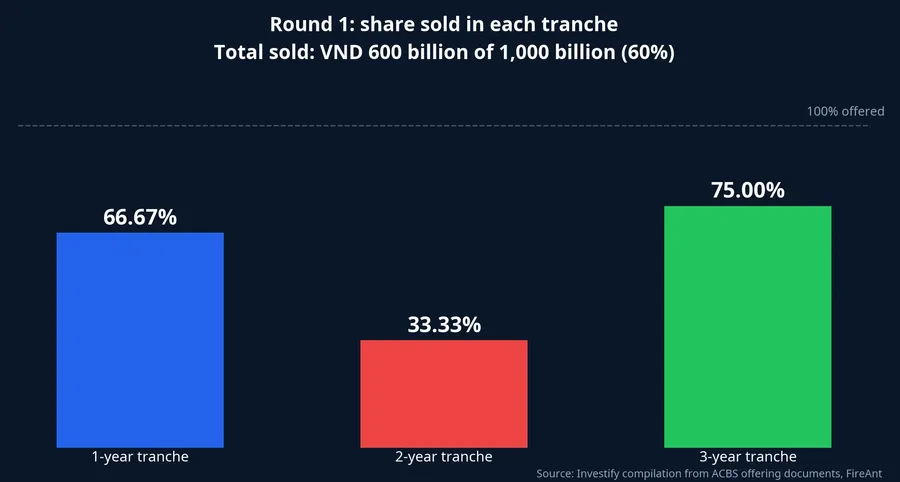
The one-year tranche sold 66.67% of the amount offered, the three-year tranche sold 75%, and the two-year tranche managed only 33.33%, a third. Unsold bonds were cancelled. The coupons were 8.2%, 8.4% and 8.6% a year, more than 2 points above the 12-month counter savings rate at the state-owned banks.ACBS That gap was still not enough to fill the offering.
The original plan was three rounds of VND 1,000 billion each. In the resolution, ACBS says it made the change to meet its funding needs, attract customers and compete better with other institutions.Fili
How the ACBS coupon is calculated
The round 1 offering notice sets out the formula: coupon equals reference rate plus margin. The reference rate is the average 12-month personal savings rate, interest paid at maturity, published on their websites by Vietcombank, VietinBank, BIDV and Agribank on the rate-determination date. That date is the day registration opens for each round.ACBS
Two details matter for buyers. The rate is fixed once, on the day registration opens, then stays unchanged for the whole term and is paid every 12 months. The margin is set by ACBS, while the reference rate follows the four state-owned banks. On July 28, 2026 the reference rate was set at 5.9%.ACBS Add margins of 2.3%, 2.5% and 2.7% and you get exactly the 8.2%, 8.4% and 8.6% of round 1.
Where the extra 0.5 point went
From October 20, Vietcombank and VietinBank cut their 12-month counter savings rate from 5.9% to 5.4% a year.CafeF Agribank moved its 12-to-18-month tenors from 5.9% to 5.4% in its October 20 schedule.Kenh14 BIDV followed in its October 21 update with the same cut.CafeF Per those reports, the cuts came after the State Bank of Vietnam asked credit institutions to lower listed deposit rates by at least 0.5 point for tenors of six months and longer.
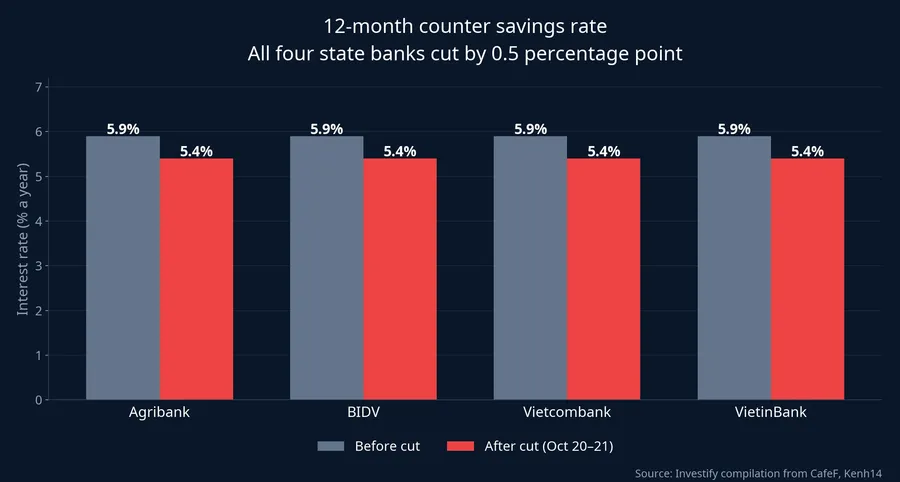
With all four banks at 5.4%, the average is 5.4% too, exactly 0.5 point below the round 1 figure. If their rates stay put until round 2 registration opens, the sums come out at 5.4% + 2.8% = 8.2% for the one-year tranche, 5.4% + 3.0% = 8.4% for two years and 5.4% + 3.2% = 8.6% for three years. All three match round 1.
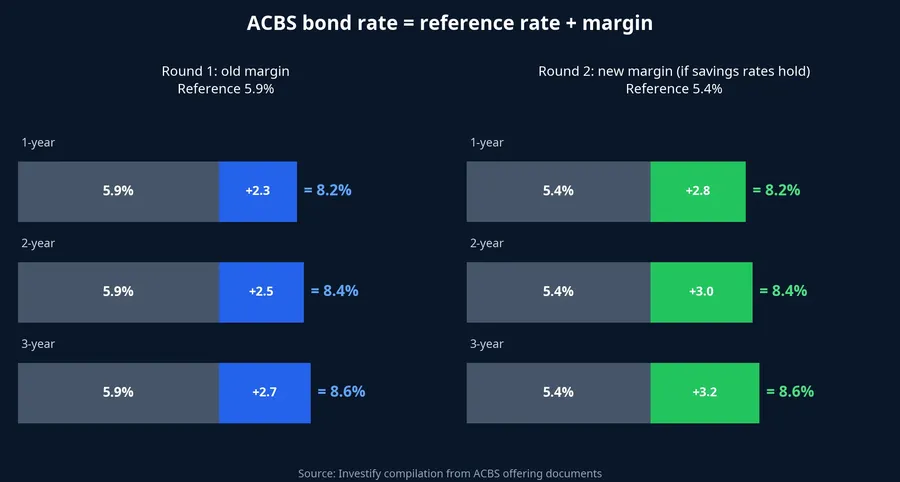
In absolute terms, then, round 2 buyers are likely to get the very coupon that round 1 failed to sell out. What changes is the gap over savings: ACBS bonds used to sit 2.3 to 2.7 points above the state banks' 12-month counter rate, and the gap now widens to 2.8 to 3.2 points.
Why 0.5 point exactly? The available data cannot settle it. One reading is that ACBS is deliberately paying more to win buyers back after a weak round, as the resolution says. The other is that without the higher margin, the round 2 coupon would have slid to 7.7% to 8.1% on the new reference rate, even lower than the level that failed to draw buyers in round 1. The resolution was signed on October 21, the same day BIDV published its new schedule, so the timing overlap is real. But ACBS does not explain how it arrived at 0.5 point. What is certain is the outcome: the new margin keeps the nominal coupon where it was while savings rates fall.
The rate-determination date for round 2 has not been announced. Savings rates could still change before then, and the final coupon is fixed only when ACBS issues its official notice.
Where the new borrowing will go
Under the original plan, all VND 3,000 billion across the three rounds is earmarked for proprietary trading. The October 21 resolution says that covers trading in stocks, bonds and covered warrants, and it moves the third-quarter public bond requirement into the fourth quarter, raising the fourth-quarter requirement from VND 1,000 billion to VND 2,000 billion.ACBS
The consolidated third-quarter results show the state of the business that will receive the money. Gains on financial assets at fair value through profit or loss halved to VND 442 billion. After losses in the same category and proprietary trading costs, ACBS was left with a net profit of just over VND 14 billion from this business.FireAnt For scale, the extra 0.5 point of margin on VND 1,000 billion, if fully sold, is worth about VND 5 billion in interest a year (Investify's own calculation from the margins in the resolution). Total interest on round 2 at 8.2% to 8.6% is far larger than the VND 14 billion proprietary trading earned in the third quarter.
What current holders and prospective buyers actually own
For anyone who bought in round 1, the 8.2% to 8.6% coupon was fixed on July 28 and stays fixed for the term. The state banks' savings cut does not drag it down, and ACBS's higher round 2 margin does not apply retroactively. The offering notice also states that ACBS will not exercise an early buyback right.ACBS
For those being offered round 2, the nature of the investment is unchanged from round 1. These are non-convertible bonds, with no attached warrants and no collateral.ACBS Buyers are lending to ACBS, a securities firm, not depositing money at ACB. Neither the offering notice nor the articles cited here mention any ACB commitment to repay on ACBS's behalf. Deposit insurance covers only deposits at credit institutions, so a securities firm's bond falls outside it, even with ACB's name attached. Interest is also paid once every 12 months, at the end of each year, not monthly like many savings books.

The roughly 3-point premium over savings is compensation for those differences. It is best read as the price of credit risk, not as a savings book with a better rate.
Signals to watch
The new margin shows that borrowing from individual investors is no longer as easy as ACBS planned. To hold on to a nominal coupon that failed to sell out in round 1, ACBS has to pay another 0.5 point above savings rates.
Two signals will settle the rest. The first is the reference rate on the day ACBS opens round 2 registration: if the four state banks still sit at 5.4%, the round 2 coupon will be 8.2% to 8.6%, and if they cut again, it will come in below round 1 even with the higher margin. The second is the share sold when ACBS reports the round 2 result. If sales hover around 60% as in round 1, a gap of about 3 points over savings still does not persuade buyers to lend unsecured to a securities firm.