
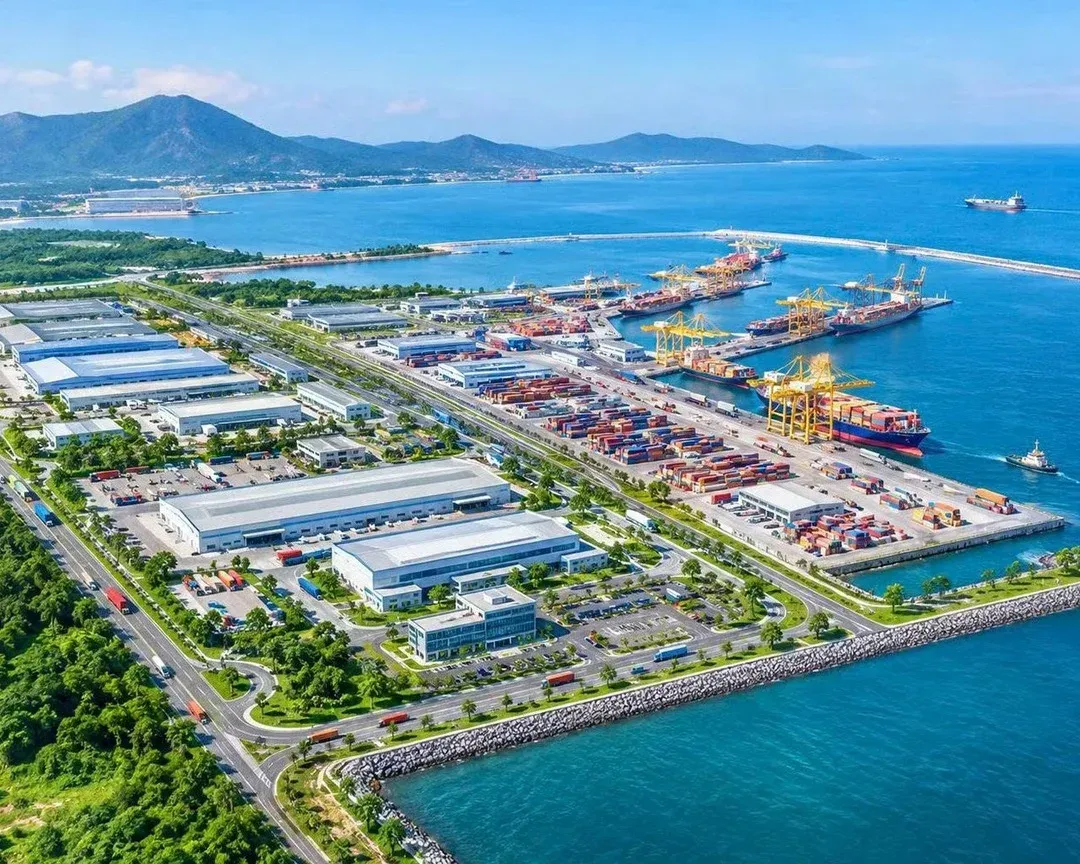

On October 24, the Ha Tinh Economic Zone Authority issued Decision No. 231/QD-KKT, approving the investment policy and the investor for the Son Duong Logistics and Port Services Center in Vung Ang ward. The investor is Vinhomes Ha Tinh Industrial Park Investment JSC, headquartered in Hanoi.Nguoi Quan Sat The figure most often quoted is total capital of VND 39,600 billion, about USD 1.5 billion.CafeF
For anyone holding VHM shares, that headline number says little. The useful reading sits in two layers underneath: who puts in how much money, and in which year the money starts coming back.
What the decision grants
According to press reports on October 25, the project covers about 472.63 ha of land and sea area, of which 158.2 ha is reclaimed from the sea.Chuyen Dong Thi Truong The operating term is 70 years, with a designed capacity of about 50 million tonnes of cargo a year.Nguoi Quan Sat
The main components are general cargo warehouses, container yards and depots, a commercial and port-logistics services zone, an operations area, parking, and the sea dikes, reclamation dikes and site levelling. Once running, the company earns from storing, sorting, consolidating and distributing cargo, and from leasing warehouses and service space.
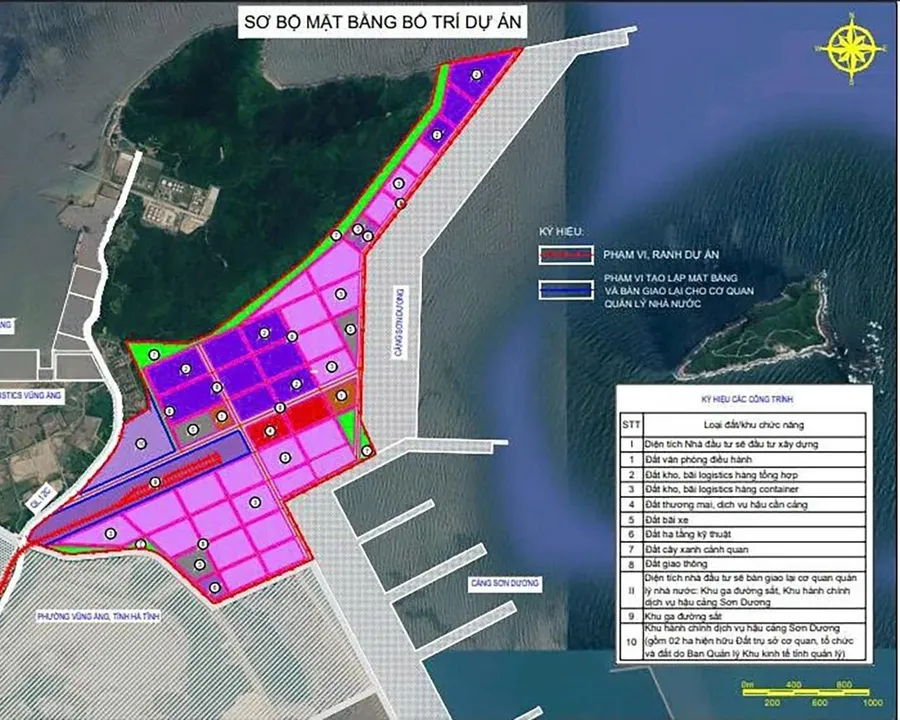
One distinction matters: this is approval of the investment policy and the investor, not a construction permit. The company still has to finish procedures on planning, construction, land and sea-area use. The Authority also told the investor to take responsibility for the project's investment returns.
Layer one: 15% equity, 85% to be raised
Of the VND 39,600 billion total, the investor's equity is VND 5,940 billion and the planned mobilised capital is VND 33,660 billion.Chuyen Dong Thi Truong That makes equity 15% of the total and the mobilised portion 85%, nearly 5.7 times the equity.
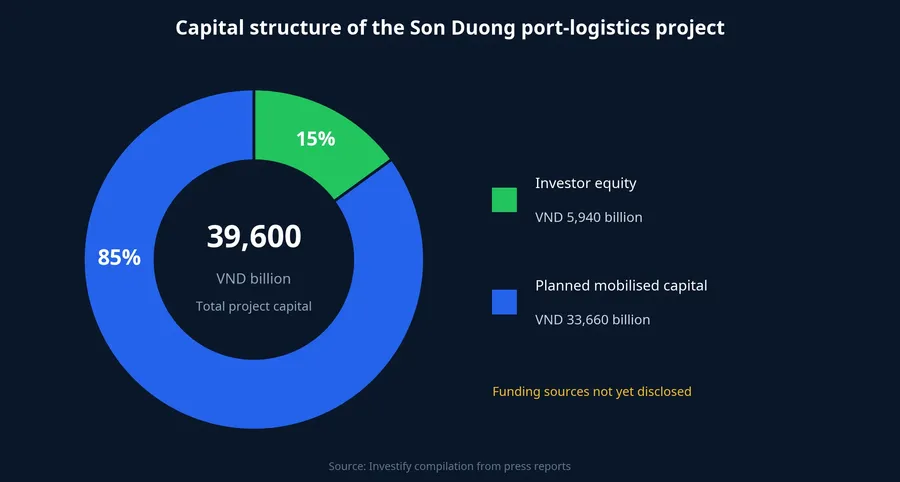
The two pots differ in nature. Equity is the owner's own money, sits in shareholders' equity and takes the first loss if the project underperforms. Mobilised capital is other people's money: bank loans, bond issuance, or partners brought in. If it is debt, it carries interest and a repayment schedule whether or not tenants have arrived.
As the press describes the decision, it only says the remainder will be raised from other sources.Nguoi Quan Sat Which banks will lend, whether bonds will be issued, whether partners will co-invest: no disclosure answers any of this yet. That is the biggest gap in the project, since 85% of the money has no name attached.
Layer two: when money goes out, and when it comes in
The project runs in three phases. Putting them side by side shows which way the cash flows.
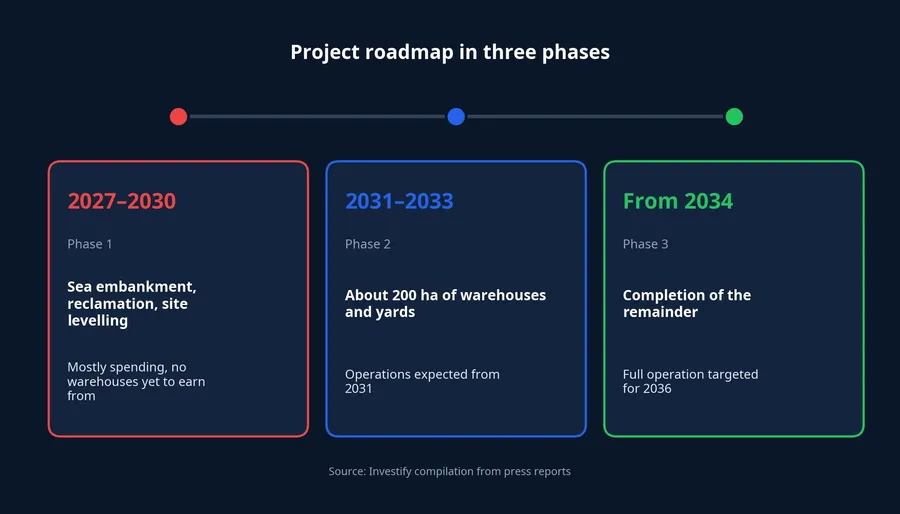
Phase 1 (2027–2030) covers dikes, reclamation, site levelling and core technical infrastructure across the whole project area.Nguoi Quan Sat These four years produce land, not warehouses to lease. For a project with 158.2 ha reclaimed from the sea, this is usually the costliest and least predictable part.
Phase 2 (2031–2033) builds about 200 ha of warehouses, yards and port-logistics services, with operations expected from 2031.CafeF That is roughly 42% of the 472.63 ha total and the first component able to earn revenue on the registered timeline. Phase 3 (from 2034) completes the rest, with the aim of putting the whole project into operation in 2036.CafeF
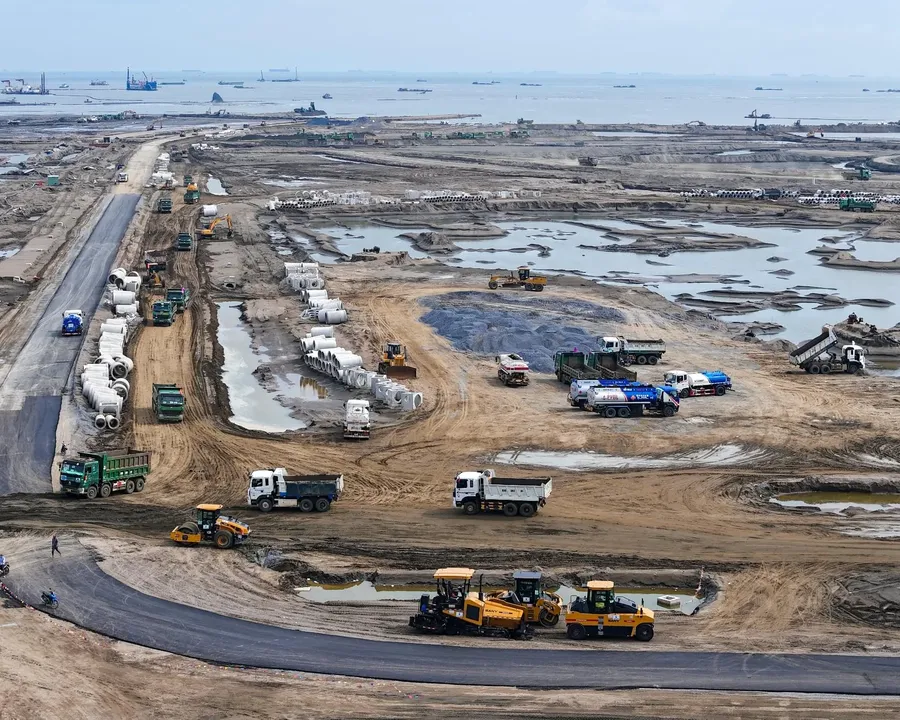
Combining the layers, the mechanism is clear. The VND 5,940 billion of equity is likely spent early, along with part of the mobilised capital, on four years of reclamation and levelling. Over those years the project has no warehouse income. If the mobilised portion is debt, interest runs before the first dong of revenue. This is typical of reclamation infrastructure, not unique to this project. A shareholder should therefore read it as a long-term capital commitment, not an upcoming income stream.
The 2031 and 2036 dates are the investor's registered plan, not settled outcomes. Reclamation projects can slip on sea-area procedures, environmental assessment or construction conditions, and each delay adds to accumulated interest cost.
The unanswered question: where does the cargo come from
The 50 million tonne figure is a design capacity. The decision names no customer committed to leasing space and no expected cargo volume for the early years. A port-logistics center earns on tonnes that actually pass through its gates, not on capacity written on paper.
The most plausible hypothesis is the industrial projects next door. The same company is developer of the Vinhomes Vung Ang Industrial Park, 964.84 ha, whose investment policy the Prime Minister approved in Decision 639/QD-TTg of July 13, 2024.Nguoi Quan Sat In the park's 500 ha first phase, land recovery and compensation are complete for 487.7 ha, with 12.3 ha of residential land not yet compensated, and the developer is leveling the cleared areas.
The expected chain is therefore: the industrial park generates cargo, the port moves it in and out, the back-of-port center stores and distributes it. That reading is reasonable, but rests on an untested assumption: the park must fill with factories, and the factories must run near capacity, before the warehouses have customers. Two other explanations exist for investing early. One is reserving coastal land in an economic zone with room to grow. The other is capturing investment incentives, since the project falls in a preferred sector and is being considered for policies applying to areas with especially difficult socio-economic conditions.Chuyen Dong Thi Truong Public information does not show which carries more weight.
Where VHM holders will see this project
The company's name carries "Vinhomes", and the October 25 reports describe it as part of Vingroup.CafeF Public sources give no consistent figure for the stake Vinhomes (VHM) holds directly after its recent capital increases. So the full VND 5,940 billion of equity, or the VND 33,660 billion of mobilised capital, should not be treated as Vinhomes' obligation alone.
The check lies in the consolidated financial statements. If Vinhomes controls the company, it will be listed among subsidiaries in the notes, with ownership and voting percentages. Any loans the project company raises would then add to Vinhomes' consolidated debt, and construction in progress would appear in long-term assets. If the company sits under Vingroup without passing through Vinhomes, these items would show on Vingroup's balance sheet instead.
Conclusion: a long-term commitment, not yet income
On the published timeline, no component operates before 2031, and the first four years are reclamation, levelling and core infrastructure. For a VHM shareholder, the Son Duong project is therefore a long-term capital commitment. What it ultimately contributes depends on the cargo that actually flows through the Vung Ang and Son Duong area, and on the cost of the mobilised capital.
Three sources of information will answer what remains open. Vinhomes' consolidated financial statements will show whether the project company belongs to Vinhomes and at what stake. Disclosures on credit agreements or bond issues by the project company will show where the VND 33,660 billion comes from and at what cost. And the pace at which Vinhomes Vung Ang Industrial Park fills up in the coming years is the earliest indicator of the cargo the Son Duong warehouses can expect from 2031.