
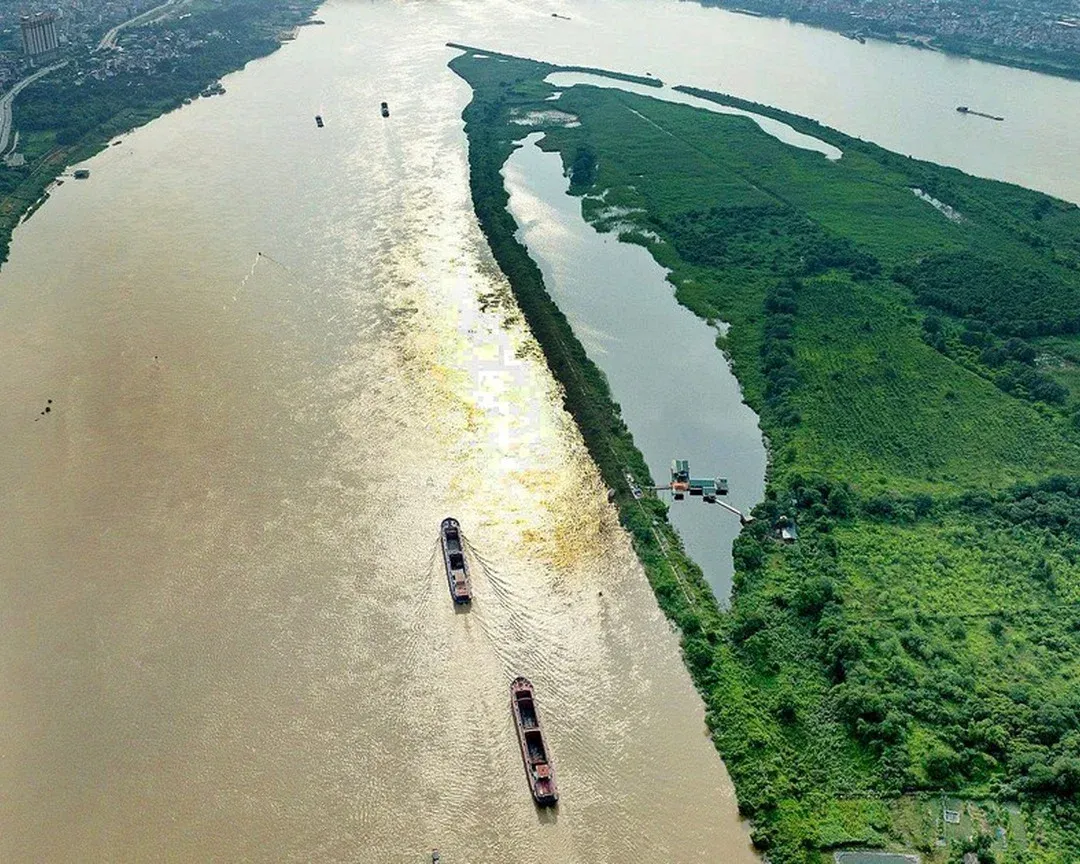

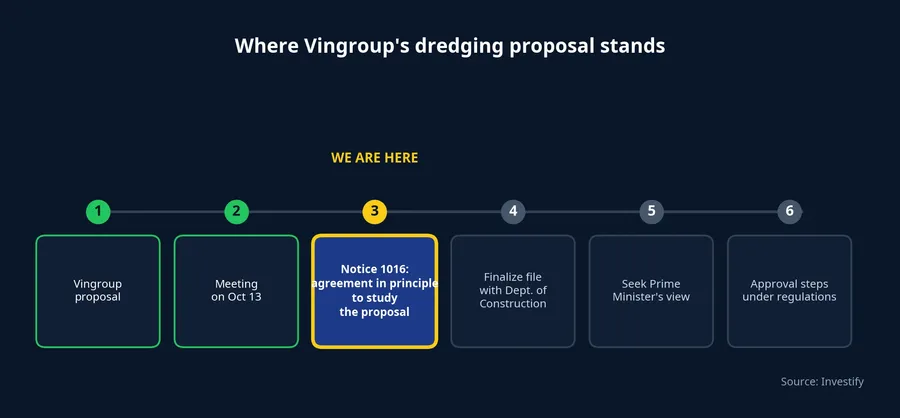
Vingroup's proposal to dredge the Red and Da rivers through Hanoi has cleared its first step. That step is much narrower than "Hanoi approved it." According to Tuoi Tre, the Hanoi People's Committee Office issued Notice No. 1016, relaying the conclusions of Committee Chairman Vu Dai Thang at an October 13 meeting. The notice says the city "basically agrees on the policy of studying" a plan to improve the riverbed while recovering usable material.Tuổi Trẻ
"Study" is the word that matters. It means Vingroup may keep preparing its file. There is no project yet, no investment decision, and certainly no right to the sand and soil that would be dug up. Read closely, the notice places its heaviest conditions on exactly that material.
What the proposal is aiming at
Vingroup's plan targets better flow, a stable channel, stronger flood drainage, and safety for dikes and inland waterway transport. It also aims to create a supply of fill material for the city's key projects.CafeF
The two goals travel together for a simple reason: dredging costs money, and what comes out of the river has value. If the material is usable on construction projects, it can offset part of the cost. That is also why Hanoi treats the job as one funded through "socialization," meaning private money rather than the state budget for the works themselves.
So far, press reports give no total capital, no length of river stretch, and no planned dredging volume. Without those numbers, nobody can say whether the proposal is large or small relative to Vingroup's size.
Condition one: the river has to stay safe
The longest part of the notice is technical. Vingroup and its consultant must update geological, topographic and hydrological surveys, then build dredging scenarios for the flood season, the dry season, and the joint operation of upstream reservoirs.Tuổi Trẻ
The plan must also assess the impact on dikes, embankments, road and rail bridges, pumping stations and water intakes along the route. The assessment extends upstream, downstream and into neighboring provinces. The notice asks Hanoi to take on board the views of Phu Tho and Hung Yen, the provinces the Red River passes through before and after the capital.
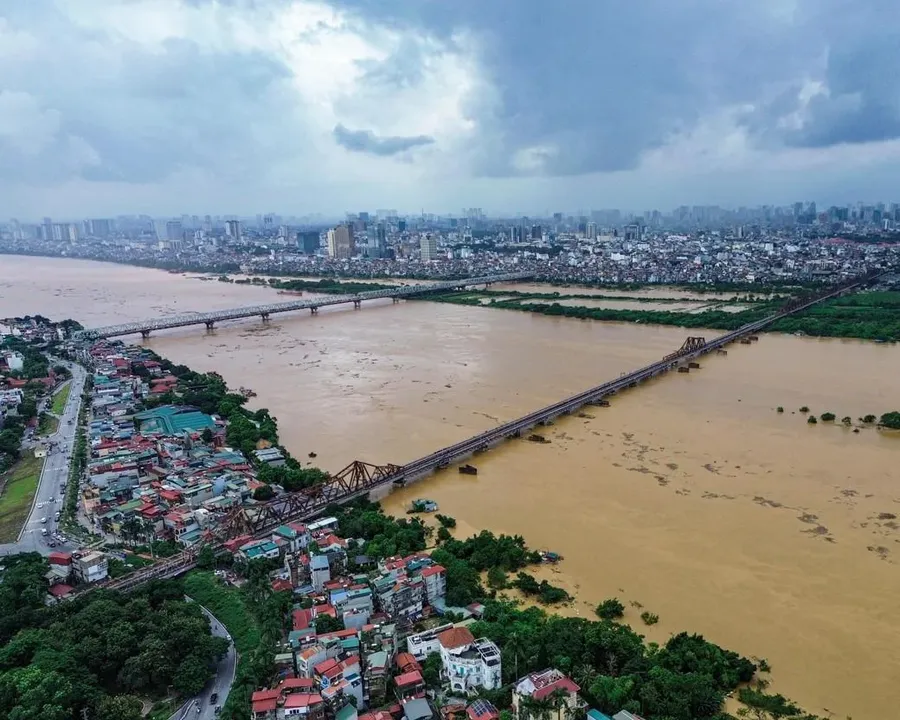
The logic is straightforward: removing material from one stretch can change the flow in another. A technically sound dredging plan has to start from the need to clear the channel, not from wherever the sand happens to be thick.
Condition two: no rules exist for this model
The second layer is legal. The notice states plainly that funding the work through socialized capital "currently has no specific regulation, guidance or precedent."Tuổi Trẻ The Committee Chairman also noted that the task falls under several sector laws and under the authority of both central and local agencies.
Vietnam does have rules on dredging combined with product recovery. Decree 57/2024/ND-CP devotes a chapter to it, but its scope is seaport waters and inland waterways. Vingroup's proposal is broader: it combines flood drainage, dike safety, riverbed improvement and a fill supply for city projects, across two rivers that run through several provinces. That is our reading of where the plan snags. The notice does not say which provision leaves the gap.
So the Department of Construction has been asked to review the legal basis, the investment form, the mechanism for managing dredged material, and the split of authority between central government and the city. On that basis it will advise the city to report to the Prime Minister and seek guidance on policy, mechanism, authority, sequence and procedure.
Condition three, the heaviest: who keeps the material
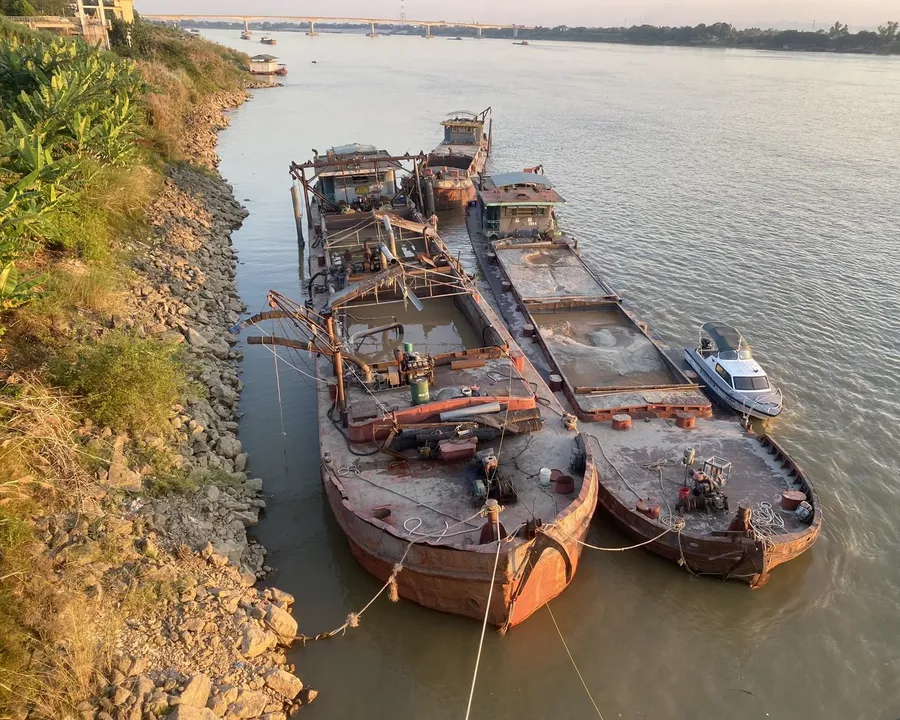
This is where Hanoi wrote most tightly. Vingroup must specify the location, volume and type of material it expects to recover, along with demand, stockpile sites and a management plan. The mechanism for controlling the volume and value of the product must be public and transparent, so that neither resources nor budget revenue leak away.CafeF
The notice adds two more constraints. All recovered minerals must be stockpiled, managed and used under a plan approved by the city, contributing to budget revenue. And the plan must clearly separate dredging from mineral extraction, so that no one uses dredging as cover for extraction that breaks the rules.
Why the separation? River sand and gravel are minerals, and mining them requires its own license and its own financial obligations. Dredging is done for the sake of the flow. The line between the two is volume: material removed within the approved dredging design is a dredging product, while anything dug beyond that design is no longer dredging. Requiring the location, volume and type up front is meant to draw that line before work begins.
Hanoi also asked the Department of Finance to study a mechanism and management plan for revenue from recovered material, and to assess the economic return for each party.CafeF In other words, the city itself does not yet have an answer on how the money from the material will be divided.
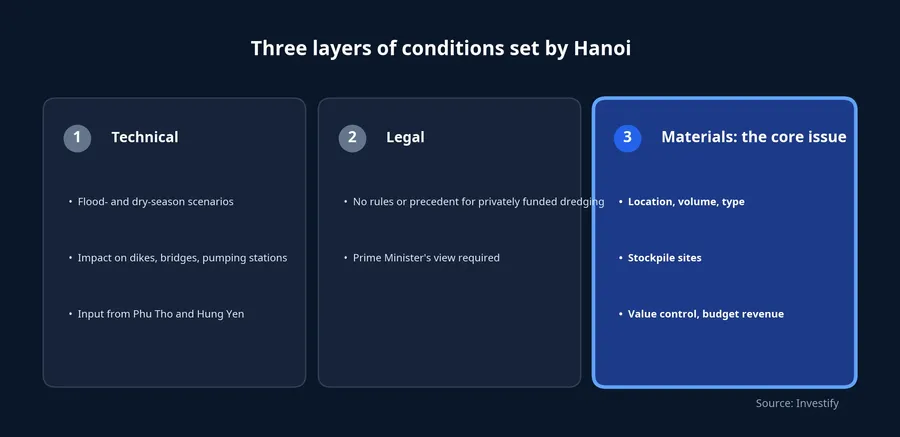
Why the materials condition decides the proposal's value
For a company paying for the dredging, the economics come down to how the material is used or priced. If the material goes to the company to offset costs, the proposal can pay for itself. If most of it must go to the budget, or can only be used at a price the city sets, Vingroup's role looks more like an infrastructure contribution than a business line.
Both outcomes remain open because the management mechanism does not exist. Three things are unknown: who keeps the recovered material, how it is priced, and how much must be handed to the budget.
The materials condition is not the only exit point, though. If the technical scenarios show that dredging would cause erosion or hurt water supply downstream, the proposal could stop at the first layer. And if the Prime Minister does not agree on the policy, the question of materials never needs to be asked. The materials condition is heaviest in the sense that it decides whether the proposal has economic value. The first two decide whether it gets done at all.
What VIC's share price says
VIC closed at VND 236,500 on October 23, up 10% from the October 16 session. Most of the gain came in two sessions, October 21 and 22, at 6.99% and 4.16%. Press coverage of Notice 1016 began on October 24, after the October 23 close. That makes it hard to attribute the rally to the dredging proposal, and price data cannot reveal the real cause.
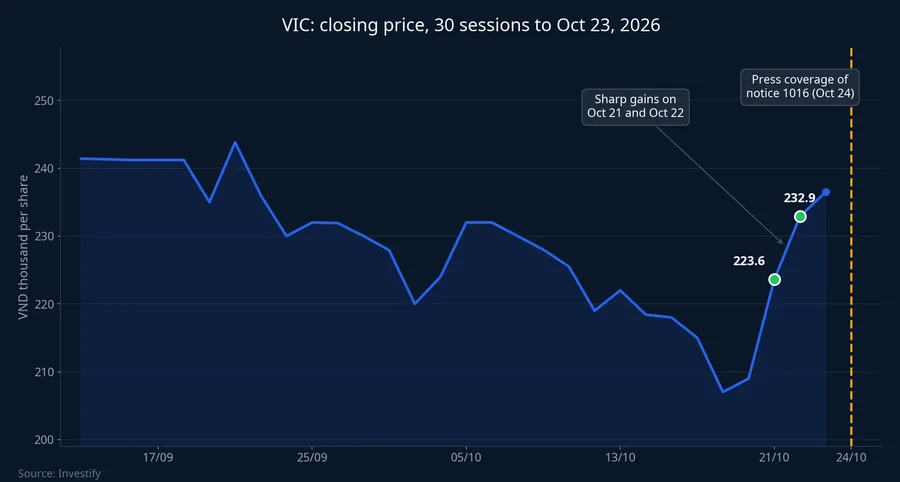
For VIC holders, this is a new line of work that cannot yet be measured in money. There is no volume, no capital figure, and no mechanism for sharing the value of the material. Any valuation right now rests on assumptions.
Next step and signals to watch
The deadline for agencies to complete their assigned tasks is before October 25, 2026.CafeF As of writing, no outlet has reported that the file has gone to the Prime Minister.
The expected sequence is that Vingroup completes its file under the Department of Construction's guidance, the city seeks the Prime Minister's view, and only then do the formal approval steps follow. The clearest signal will be the Prime Minister's written opinion on the mechanism. If it allows a pilot of the socialized model and assigns a mechanism for managing material, the proposal has a path forward. If it requires the ordinary mineral procedures, the value of the material to Vingroup shrinks considerably.
Until then, the number worth waiting for is the volume of material Vingroup must list in its file. It will be the first time this proposal has a figure to calculate with.