
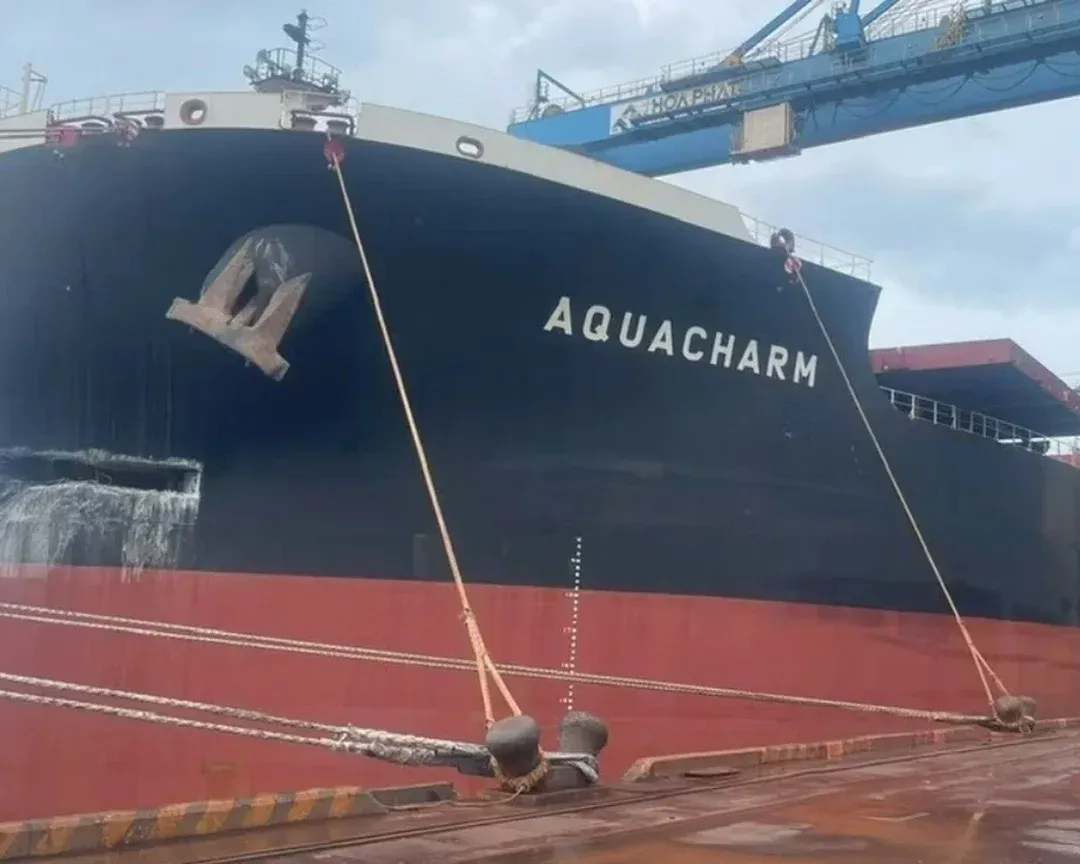

On the morning of October 24, the Aquacharm, an ore carrier bringing Australian iron ore to Hòa Phát, left its anchorage at Dung Quất and headed for a repair yard. It started moving at 8:15 and reached the yard at 10:50.CafeF But a repaired bow does not mean a free ship. A court order still holds the vessel as security for the cost of fixing the pier, and nobody yet knows how large that cost is.
If you hold HPG shares, the question that matters is who pays for the damaged section of the pier: the shipowner, the owner's insurer, or Hòa Phát itself. This piece walks through the milestones from the evening of October 18 to October 24, explains what "arresting" a ship actually does, and spells out what is still unknown.
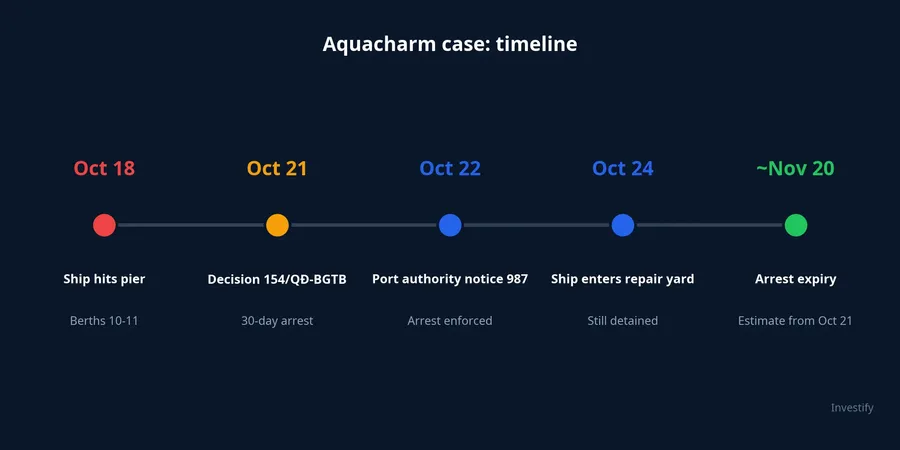
October 18: A hit on an unopened section of the pier
At about 5:45 pm on October 18, the Aquacharm was being maneuvered into berth 10 of the dedicated port at Hòa Phát's Dung Quất steel complex when it struck a section of pier still under construction. The ship is Marshall Islands-flagged, 292 m long, 182,309 deadweight tons, and was carrying 170,856 tons of iron ore from Australia.CafeF The registered owner is Wealth Line Inc, a Panama entity, and its agent in Vietnam is S&A Maritime JSC.
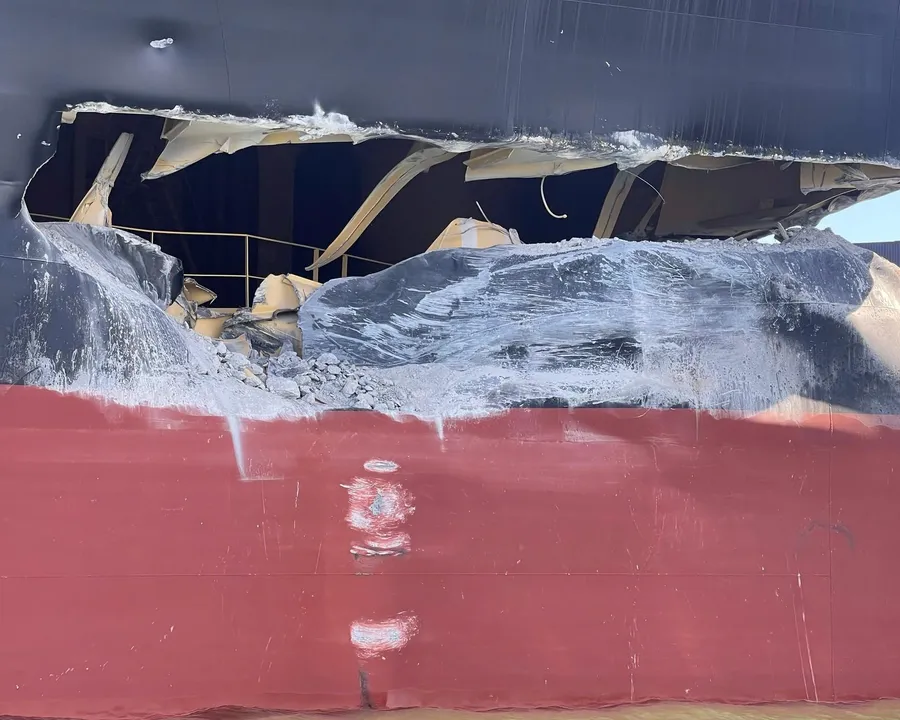
The damaged stretch links berths 10 and 11 and is about 50 m long. It was finished but had not been announced as open for operation. According to the Dung Quất port border guard's report, the bow was torn open by about 5 m, part of the pier was damaged, all 22 crew were safe, and no oil spill had been recorded.CafeF
There is no official cause yet. Initial information the border guard took from the agent and the captain suggests the pilot may have lost control of the ship's speed because of a communication error. The pilotage company has suspended the person who was directly guiding the ship while the case is investigated, and the Quảng Ngãi Maritime Port Authority has set up a team to investigate the accident. This is preliminary, not a finding of responsibility.
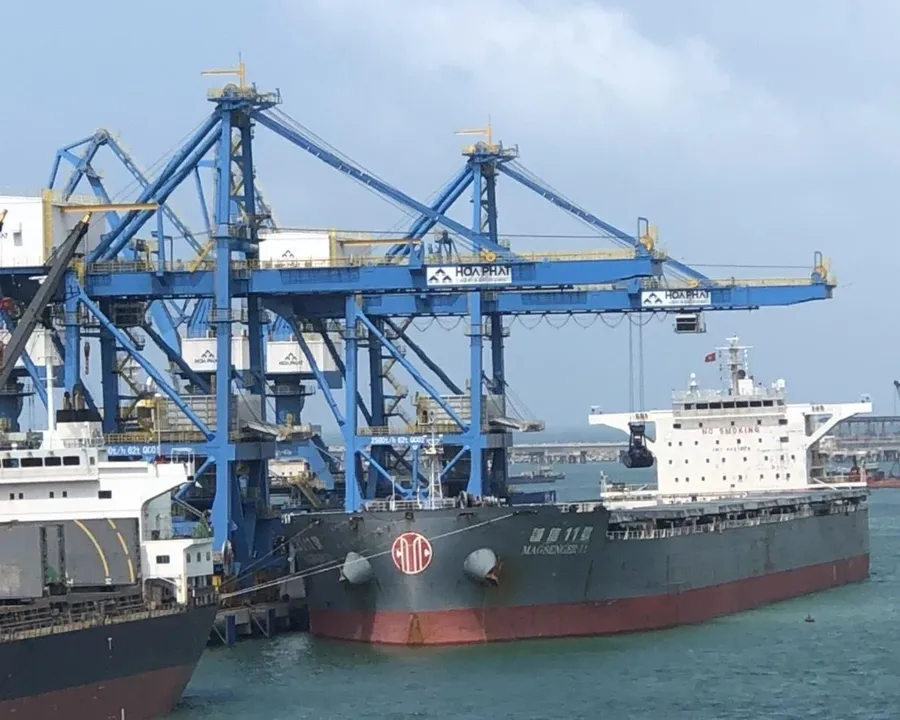
For an HPG holder, the key detail is that the struck section was still being built, not a working berth. According to a port authority official cited by CafeF on October 24, the incident did not disrupt the port area, and operating berths continue to receive ships and handle cargo as normal.CafeF The port takes ships of up to 200,000 tons and is the entry point for the complex's iron ore and coal, so if raw-material inflows were hit, the story would change entirely. The sources available suggest that has not happened.
October 21 and 22: The court rules, the port authority enforces
Hòa Phát Dung Quất Steel JSC, the subsidiary that owns the struck structure, filed a request asking the court to arrest the ship to secure the handling of its compensation claim. On October 21, the Quảng Ngãi Regional People's Court No. 2 issued Decision No. 154/QĐ-BGTB, arresting the Aquacharm for 30 days.CafeF The next day the Quảng Ngãi Maritime Port Authority issued Notice No. 987/TB-CVHHQNg to carry out the decision. While under arrest, the ship may not leave the port waters under the authority's management and must stay at its assigned anchorage, and the captain must keep a full crew and maintain watch duty.
What ship arrest really is
For newcomers, the word "arrest" suggests a criminal case. In fact it is a civil procedure in maritime law: the court bars the ship from moving, or restricts its movement, to secure the resolution of a maritime claim.The reason the tool exists is practical. The owner is in Panama, the ship flies the Marshall Islands flag, and once it leaves Vietnamese waters, collecting money becomes much harder. Holding the ship keeps a valuable asset within reach so the claim has something to attach to.
Nor is arrest free for the requesting party. Under Article 132 of the Maritime Code, the applicant must post a bank guarantee or deposit money or valuable papers in a blocked account. In other words, Hòa Phát Dung Quất has to put money behind its request, and must compensate if the request is later found to be wrong. The amount of security in this case has not been reported.
October 24: The ship goes to the yard, the arrest stays
On October 24, the port authority notified the court of the change of anchorage so the ship could enter the repair facility of PetroVietnam's ship-building and mechanical engineering company. Repairing the bow and releasing the ship are separate matters: per CafeF, the ship remains under the 30-day arrest and may not leave the port waters on its own, and the repair yard lies inside that area.CafeF
The same day, Hòa Phát Dung Quất said its preliminary count showed 12 port items affected or damaged. It has asked the owner, the captain and related parties to propose compensation, and has invited an independent surveyor to assess how the collision affected the pier structure. The two sides have not yet agreed on compensation.Người Quan Sát The figure of 12 items shows the damage is more than a single impact point, but says nothing about its value in money. No source has stated the value of the damage.
Who hull insurance pays
Press reports mention that the ship carries hull insurance and that the insurer joined the survey. It is easy to assume the insurer will pay for the pier. By convention, hull insurance mainly covers physical loss to the ship itself, meaning the torn bow. An owner's liability for third-party property such as a pier usually falls under a different cover, protection and indemnity (P&I) liability insurance supplied by the owner's mutual clubs. Some hull policies include a collision-liability clause, so no firm conclusion is possible without reading the contract.
What is clear is that the scope and value of the hull cover are still undetermined, and there is no information on the owner's liability insurer.CafeF On Hòa Phát's side, if the section under construction carries construction insurance, that insurer could pay first and then recover from the shipowner. No source confirms whether Hòa Phát has such a contract.
Within 30 days: What gets the ship released
Under Article 142 of the Maritime Code, three routes stand out in this case.
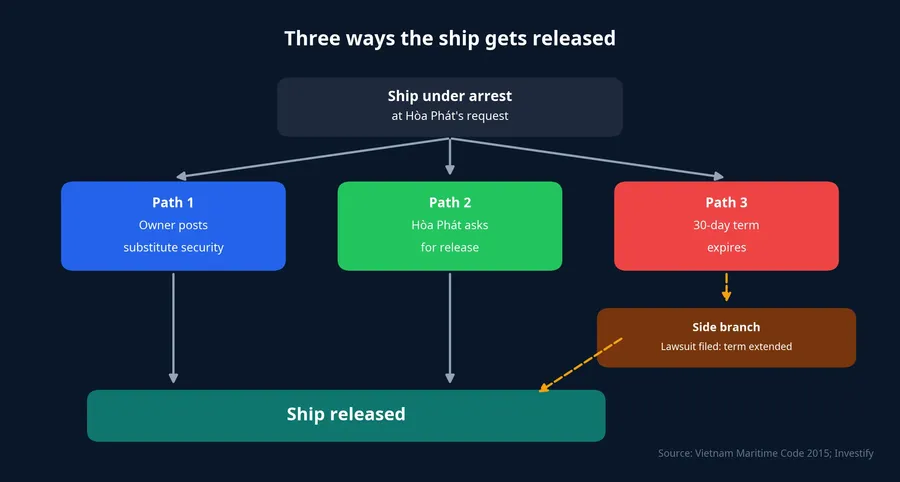
The owner posts substitute security or pays the claim in full. This is the most common route in shipping. The owner does not need to wait for a final compensation figure, only to put up a large enough guarantee in place of the ship. The law also accepts a letter of undertaking from a reputable insurer on a list notified by the Ministry of Finance. The amount is agreed between the parties; failing that, the court sets it, capped at the value of the ship or of the claim.
Hòa Phát Dung Quất itself asks for release. This usually happens once the two sides have settled on compensation, or Hòa Phát has received security it accepts.
The arrest period ends. Article 141 sets a maximum of 30 days from the date of arrest. Counting from the October 21 decision, the deadline falls around November 20. The exact date depends on the arrest time written in the decision, and the original has not been published. Also under Article 141, if Hòa Phát files suit or goes to arbitration within that period and keeps asking to hold the ship, the arrest continues until the court decides whether to apply an interim measure.
One thing follows from these three routes. The security figure the owner offers, or the figure the court sets, will be the first time Hòa Phát's claim takes the shape of a number. It is not the final compensation, but it tells outsiders what level the two sides are talking at.
What an HPG holder knows and does not know
Known. The struck section links berths 10 and 11, built but not yet in use. Operating berths continue to handle cargo as normal, per the port authority. Hòa Phát Dung Quất is the party that requested the arrest and is holding the ship as security for its claim. Preliminary damage spans 12 items.
Unknown. The value of the damage. The security Hòa Phát posted to obtain the arrest. Which of the owner's insurance policies will pay for the pier, and its limit. The official cause of the collision, and whether the repairs will delay bringing berth 10 into operation. Within the sources checked, Hòa Phát Group has not made an official exchange disclosure about the incident.
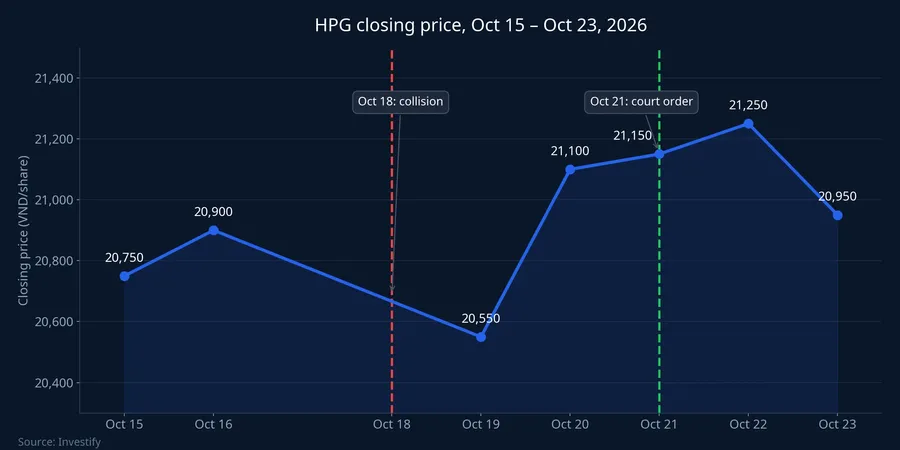
The share price is not a good yardstick for this case. HPG closed at VND 20,950 on October 23, nearly level with VND 20,900 on October 16, before the incident. Plenty of other news hit steel stocks that week, so this flat reading cannot be taken as the market having priced in the damage.
For a group with a market capitalization of about VND 176,900 billion, an incident on one unopened pier section is most likely a localized cost, not something that changes the business picture. That view holds as long as two conditions do: operating berths see no disruption, and the repair bill is borne by the shipowner or insurers. The checkpoint is before about November 20. If the owner posts security and the ship is released, the claim has an asset behind it. If the ship stays held and Hòa Phát sues, the dispute will drag on, and the pier repair cost could sit on Hòa Phát's books longer before it is recovered.