

The headline figure of more than VND 174,900 billion is the combined investment cost of two projects in Ho Chi Minh City. It is roughly six times NCB's own charter capital, and not a single dong of it has been booked as an NCB loan. Readers who hold the stock may be tempted to read it as lending about to hit the balance sheet. The documents actually signed tell a different story.
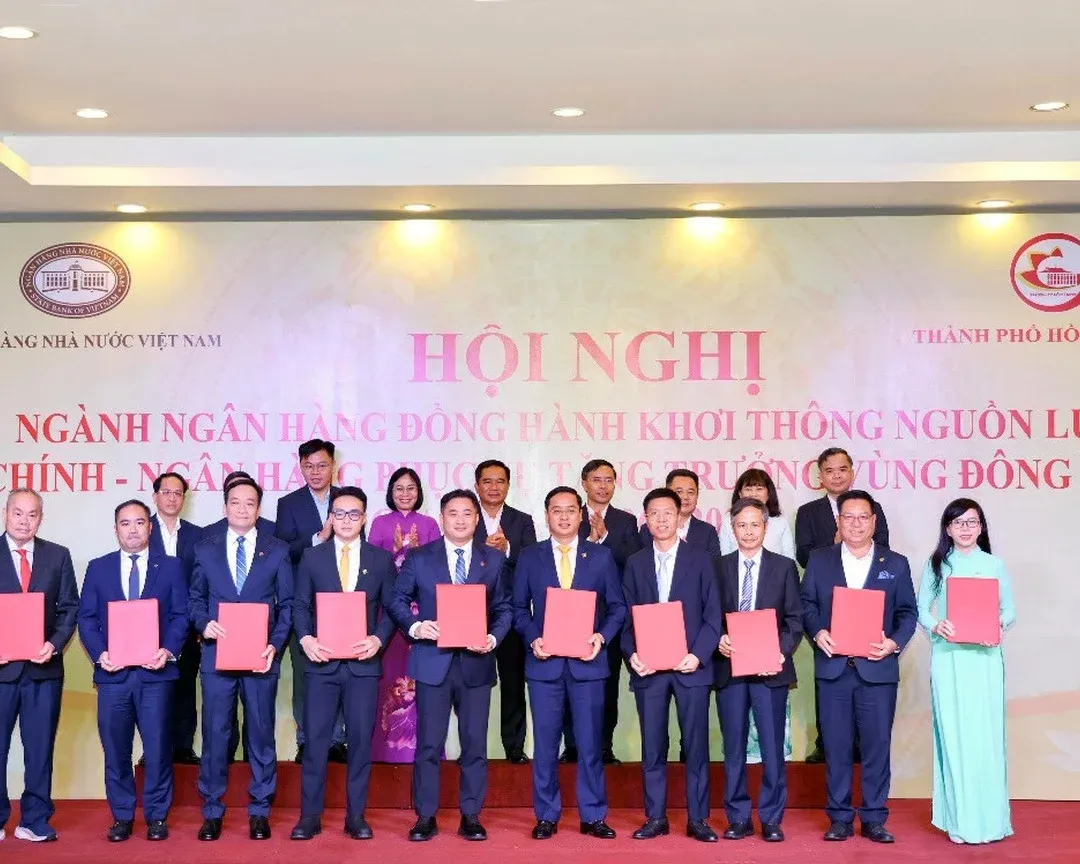
On October 23, 2026, National Citizen Bank (NCB, ticker NVB on HNX) signed two documents for two flagship city projects. The signing took place at a conference on how the banking sector can support growth in the Southeast region for 2026-2030, organized by the State Bank of Vietnam together with the Ho Chi Minh City People's Committee. The conference was co-chaired by Pham Duc An, Governor of the State Bank of Vietnam, and Nguyen Van Duoc, Chairman of the Ho Chi Minh City People's Committee.Người Quan Sát
Ben Nha Rong: NCB as service bank
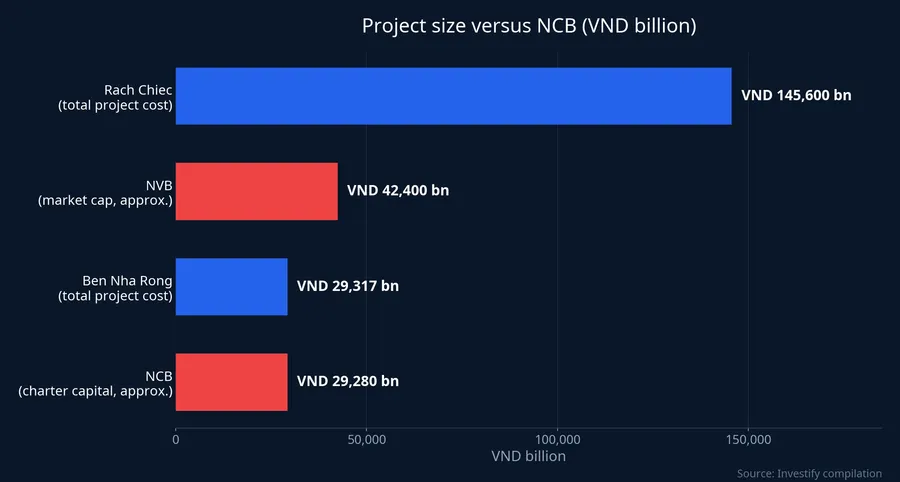
For the Ben Nha Rong - Khanh Hoi Cultural Park and the Bach Dang public greenery project, NCB signed a strategic cooperation agreement with Ben Nha Rong Tourism Services Co., Ltd. The scope is financing and capital arrangement. The project has a preliminary investment of about VND 29,317 billion across roughly 73.3 hectares of land and water surface.CafeF

Per CafeF, NCB will provide guarantees, trade finance, domestic and international payments, and cash-flow management for the developer and contractors during construction. That is the role of a service bank rather than a large creditor.
Rach Chiec: NCB alongside VietinBank
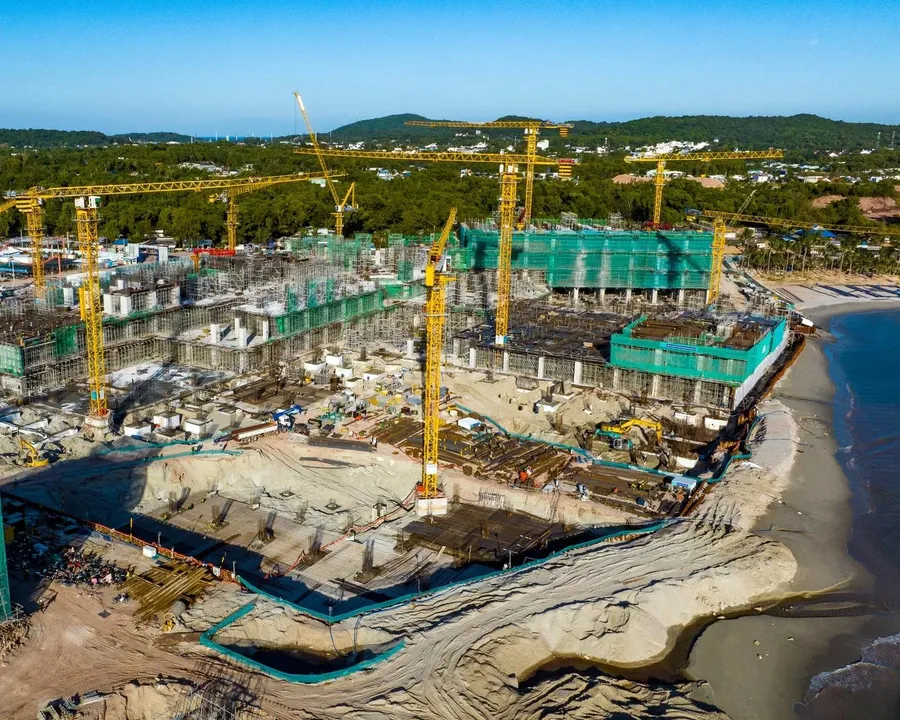
For the Rach Chiec National Sports Complex, the document is a three-party memorandum of understanding among NCB, VietinBank (CTG) and Mat Troi Vung Tau Co., Ltd. The two banks are to coordinate capital arrangement for a site of more than 186 hectares in Binh Trung ward, with total investment above VND 145,600 billion.Người Quan Sát Mat Troi Vung Tau is a member company of Sun Group, the project's investor.Mekong ASEAN

The parties said they will proceed "according to schedule and actual needs" at each stage, from investment preparation and capital arrangement to construction, acceptance and operation. None of the press coverage states how much NCB has committed to lend, how the loan is split with VietinBank, or what the disbursement conditions are.
Agreement, MoU and credit contract
These three kinds of document carry different weight, and readers tend to blur them. A strategic cooperation agreement and a memorandum of understanding record an intent to work together: who serves whom, in which line of business. They do not fix an amount, interest rate, collateral or disbursement schedule.
A credit contract is the document that creates an outstanding loan on the bank's balance sheet, and it is signed only after the bank has appraised the borrower's plan. Until NCB discloses a specific credit contract, the VND 174,900 billion tells us the scale of the two projects. It does not tell us the size of the loan NCB will hold.
Setting VND 174,900 billion against NCB's own size
The State Bank has just approved a VND 33,000 billion private share placement for NCB. If completed, charter capital is expected to reach nearly VND 62,280 billion, up 112.7% from today.CafeF By subtraction, current charter capital is about VND 29,280 billion. The VND 33,000 billion placement is still a plan, not capital that has arrived.
Against charter capital of about VND 29,280 billion, Rach Chiec is roughly five times larger. Ben Nha Rong is almost exactly equal to it. Together the two projects are about six times larger. On the exchange, NCB had a market capitalization of about VND 42,400 billion after the October 23 session, so the combined project cost is still more than four times the market value of the whole bank.
The lending cap: why projects this size need several banks
The 2024 Law on Credit Institutions limits total credit extended to one customer as a share of the bank's own capital, and the share steps down each year. In 2026 the cap is 13% of own capital for one customer and 21% for one customer plus related persons. From January 1, 2027 these fall to 12% and 19%.LSVN
Own capital is calculated under separate State Bank rules and often differs from charter capital. NCB has not given that figure in the coverage of the October 23 event. To get a sense of scale, here is an illustrative calculation: if own capital equaled charter capital of about VND 29,280 billion, the 13% cap would be about VND 3,800 billion for one customer, and the 21% cap about VND 6,150 billion including related persons.
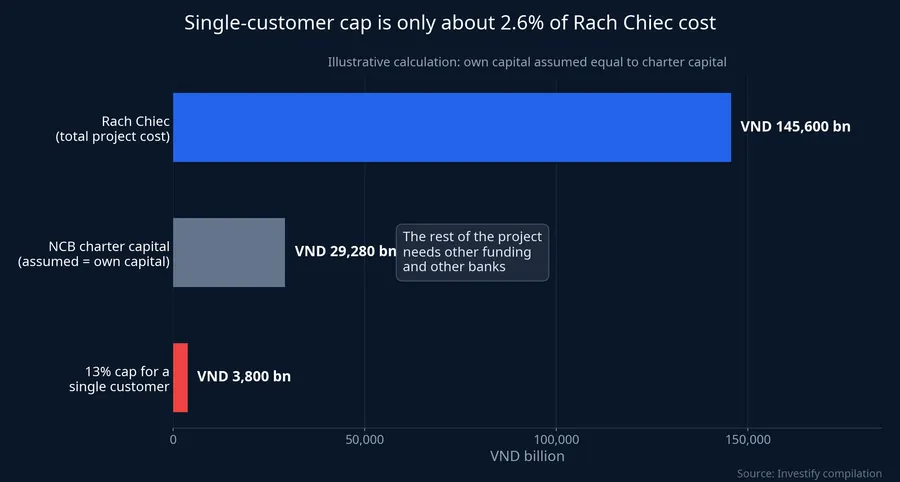
About VND 3,800 billion is only around 2.6% of the total Rach Chiec cost. Even if the capital increase to VND 62,280 billion is completed, the same calculation gives a single-customer cap of only about VND 8,100 billion, and the 13% ratio will no longer apply because the cap drops to 12% in 2027. This is why a project above VND 145,600 billion usually needs a syndicate, and why the "coordinated capital arrangement" with VietinBank deserves more attention than the headline number. A syndicate splits the loan among banks. It does not raise any single bank's cap.
It also bears saying that an infrastructure project is not funded by loans alone. The developer has equity and other fundraising channels. The share that must come from banks is therefore smaller than total investment, but how much smaller has not been disclosed.
Two roles, two kinds of income
At Ben Nha Rong, the service-bank role mainly earns fees: guarantee fees, payment fees, trade-finance fees, plus transaction deposits from managing the cash flows of the developer and contractors. This line consumes less capital than medium and long-term lending. Even so, a guarantee is an off-balance-sheet obligation. If a contractor fails to perform, the bank pays on its behalf, and that amount also counts toward the credit limit.
At Rach Chiec, the co-arranger role is tied to lending income. If the MoU progresses to a syndicated credit contract, NCB would earn interest on the portion it holds, plus arrangement fees. In return it takes on a long-tenor loan tied to the pace of a complex of more than 186 hectares that will move through several stages, from investment preparation to operation.
Which customers NCB is leaning toward
The two projects signed on October 23 do not stand alone. Per CafeF, NCB also provides financial solutions to contractors on the Central Square and Administrative Center project in Thu Thiem. In Hanoi, it serves the developer and contractors on the Tran Hung Dao bridge and the road linking Gia Binh airport with Hanoi. In Phu Quoc, as a strategic partner of Sun Group, it supports the general contractor and construction contractors on five projects for APEC 2027, including the APEC Convention and Exhibition Center and the Phu Quoc International Airport expansion.CafeF
The list shows NCB concentrating on infrastructure contractors and developers, plus the Sun Group project ecosystem. Rach Chiec adds one more link to the second group. This is also where concentration risk needs watching. The 21% cap applies to one customer plus related persons. If companies within one group count as related persons of each other, all NCB credit to Sun Group entities would sit under a single limit. Independent contractors fall outside that group, but their cash flow still depends on the developer paying on time.
What is known and what is not
On the share price, NVB rose 5.84% to VND 14,500 in the October 23 session, the day of the signing. However, detailed reports on the content of the documents were published from the evening of October 23, and in the 10 sessions before that the stock had already swung sharply, including a 9.7% drop on October 13. The VND 33,000 billion capital raise and the broader move in bank stocks may both have contributed, so there is not enough basis to attribute the October 23 gain to this agreement.
What is firmly known: NCB signed a strategic cooperation agreement at Ben Nha Rong as service bank, and a three-party MoU at Rach Chiec as co-arranger alongside VietinBank. Our conclusion is that the two documents open a relatively capital-light fee stream at Ben Nha Rong and a long-term credit opportunity at Rach Chiec. They do not guarantee any figure for outstanding loans.
What is not known: how much money actually reaches NCB's books. That question is answered only when the parties sign specific credit contracts and when the coming quarterly financial statements record loan balances, guarantee commitments and net service income. Two signals are worth watching: the portion of the Rach Chiec syndicated loan that NCB keeps on its own books, and the share of Sun Group entities in total loans relative to the 21% own-capital cap.