

Anyone still holding BAF shares at the close of Monday, Oct 26 will be on the Oct 28 record list and receive rights to buy new shares at VND 15,000 each.Fili That is less than half the Oct 23 closing price of VND 31,500. The rights are a real asset in your account, but they expire: you have to sell them by Nov 20 or pay for the new shares by Nov 25. Miss both dates and the rights become worthless.
This piece follows the calendar from a holder's point of view, works through the numbers for an account with 900 shares, and then asks where the money the company raises will actually go.
What the offering involves
BAF Vietnam Agriculture JSC (HOSE: BAF) is offering 40.54 million shares to existing shareholders at a 9:1 ratio. Each share held earns one right, and nine rights buy one new share. If fully subscribed, the company raises roughly VND 608 billion.Fili
BAF currently has 364,824,906 shares outstanding. If everything is placed, the total rises to about 405.36 million, and the new shares make up 10% of the post-offering count.
Separately, BAF is collecting payment for an 8 million-share issue to board members, management and key staff at VND 10,000 per share. Payment runs from Oct 12 to 30 and is expected to raise VND 80 billion in working capital.Fili That tranche is separate and not open to ordinary shareholders.
The dates on a holder's calendar
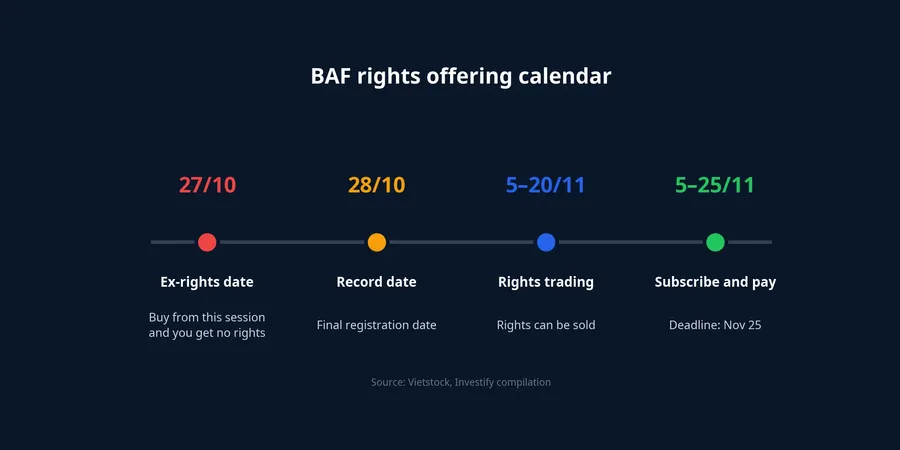
Tuesday, Oct 27: the reference price drops
This is the ex-rights date. Anyone buying BAF from this session onward gets no rights. Because shares bought on the exchange settle two business days later, Monday, Oct 26 is the last session in which a purchase still makes the record list.
In the Oct 27 session the exchange also lowers BAF's reference price to strip out the value that has moved into the rights. The commonly used formula is: new reference price = (prior close + subscription price × ratio) / (1 + ratio), where the ratio here is 1/9.Finhay
Suppose BAF closes on Oct 26 exactly where it did on Oct 23, at VND 31,500. The Oct 27 reference price would be (31,500 × 9 + 15,000) / 10 = VND 29,850, which is VND 1,650 lower. The actual figure will follow the real Oct 26 close.
The board shows a lower price, but rights holders have not lost that value. The VND 1,650 per share sits inside the right itself: in theory each right is worth (29,850 − 15,000) / 9 = VND 1,650, exactly the amount deducted.
Wednesday, Oct 28: the record date
This is the final registration date. The depository compiles the list of holders, and rights are allocated in proportion to shares held. Someone who sells from the Oct 27 session onward keeps the rights, because they were already attached before the sale.
Nov 5 to 20: rights can be sold
This is the trading window for rights. Holders who do not want to put in more cash can sell their rights to others through the brokerage where they hold their account. The price is negotiated between the parties and need not match the theoretical VND 1,650. After Nov 20, rights can no longer be sold.
Wednesday, Nov 25: subscription and payment deadline
Subscription and payment run from Nov 5 to 25. The payment deadline falls five days after the selling window closes, so anyone still weighing options should remember that the sell option disappears first.
The math for a 900-share account
With 900 shares you receive 900 rights and can buy 100 new shares. The cost is 100 × VND 15,000 = VND 1,500,000, due by Nov 25.
Before the ex-rights date, at VND 31,500 the account is worth VND 28,350,000. At the assumed reference price of VND 29,850, the 900 shares are worth VND 26,865,000. The VND 1,485,000 gap is the theoretical value of the 900 rights (900 × VND 1,650). Three ways of handling the rights lead to three different outcomes:
- Pay for new shares: put in another VND 1,500,000 and receive 100 new shares. You then hold 1,000 shares, and your ownership percentage stays what it was before the offering.
- Sell the rights between Nov 5 and 20: no extra cash, and you receive whatever the rights fetch. Your ownership percentage falls by about a tenth, because the total share count rises while yours stays flat.
- Do nothing: the rights lapse after Nov 25 and lose their value. Your stake dilutes just as in the sale case, with no cash to offset it. On the assumed price, the loss is about VND 1,485,000, or roughly 5.2% of the value of 900 shares before the ex-rights date.
These calculations use the Oct 23 close as an assumption. If BAF's price moves before or after Oct 27, the value of the rights moves with it.
Where unsold shares end up
Shares that shareholders do not subscribe for or pay for are redistributed by the company. Under Article 42 of Decree 155/2020, terms offered to other investors for the leftover shares cannot be more favorable than those given to existing shareholders. In practice the price cannot be below VND 15,000 unless the general meeting approves otherwise.Hệ thống pháp luật Redistributed shares are restricted from transfer for at least one year, and the list of recipients is set by the general meeting or the board.
For a holder, this means the rights you let go are not lost to the company. They may end up with another investor at the same VND 15,000 price.
Who gets the roughly VND 608 billion
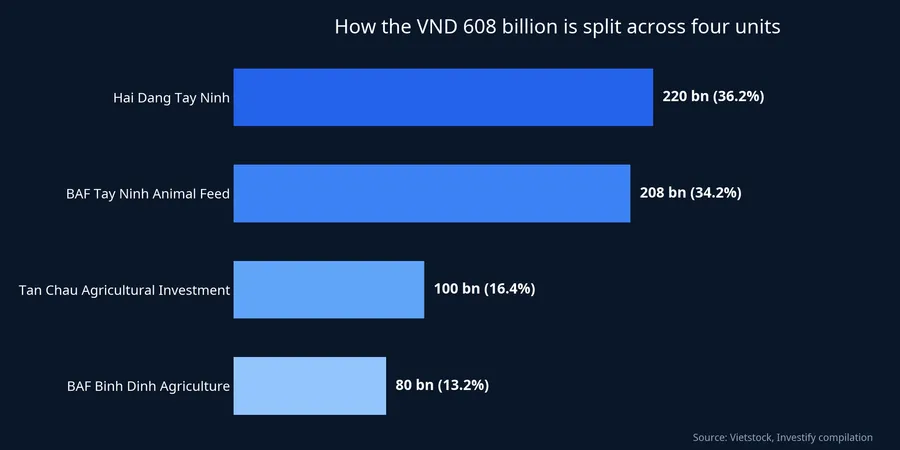
Under the offering plan, the full roughly VND 608 billion is to be disbursed from Q4 2026 to Q2 2027 to pay down payables to suppliers of feed, breeding pigs and raw materials.Fili The money is split among four entities:
- Hai Dang Tay Ninh High-Tech Livestock JSC: VND 220 billion; BAF owns 99.82%.
- BAF Tay Ninh Animal Feed Co.: VND 208 billion; BAF owns 100%.
- Tan Chau Agricultural Investment Co.: VND 100 billion; BAF owns 99.95%.
- BAF Binh Dinh Agriculture: VND 80 billion; BAF owns 100%. The legal form of this entity is recorded inconsistently between the news report and company data, so only the short name is used here.
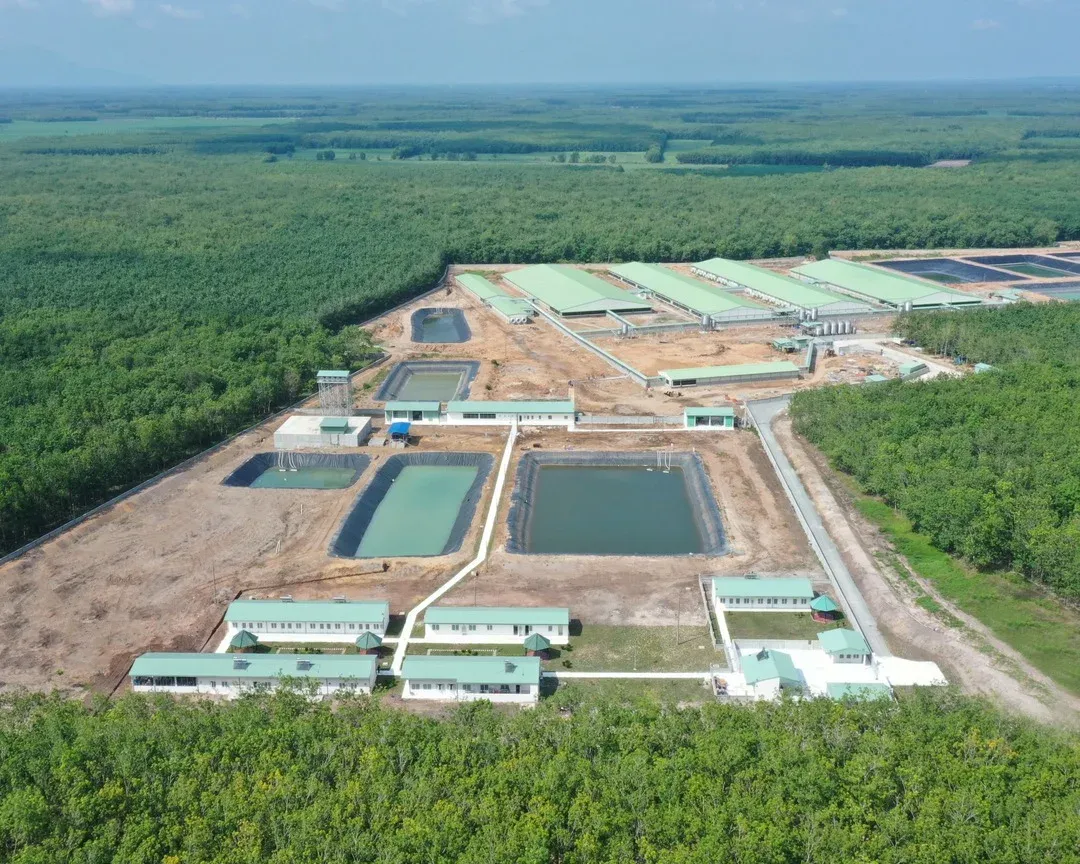
All four are subsidiaries in which BAF holds nearly all the equity. So the "feed and breeding-pig suppliers" are links in BAF's own livestock chain: the feed mill in Tay Ninh and the farm clusters in Tay Ninh and Binh Dinh. Shareholders' money moves from parent to subsidiaries, not into new farms.
That has a technical consequence. In consolidated accounts, balances between parent and subsidiary are eliminated, so paying VND 608 billion to these four does not automatically cut consolidated liabilities by VND 608 billion. The real reduction depends on whether the subsidiaries use the cash to pay outside suppliers, repay bank loans, or keep it as working capital.
Why BAF needs cash now
In the first half of 2026, per reviewed consolidated statements, BAF posted net revenue of VND 3,889 billion, up 55% year on year, but net profit after tax fell 10% to VND 310 billion.Fili Against a full-year profit target of VND 793 billion, the company has covered about 39% after six months.DN Kinh tế xanh
Most of the slippage sits in Q2. Q2 2026 revenue was VND 2,127 billion, up 53.33% year on year, while parent-company net profit was only VND 103.46 billion, down 50.75%. Gross margin slid from 22.81% to 16.52%. The company sold more, but kept less profit from each dong of revenue. Live hog prices are an obvious factor: as of Oct 20, purchase prices across most of northern Vietnam were only about VND 51,000 to 52,000 per kg after a week of declines.Báo Văn hóa Interest costs rising with debt also played a part, and the available data cannot separate the contributions.
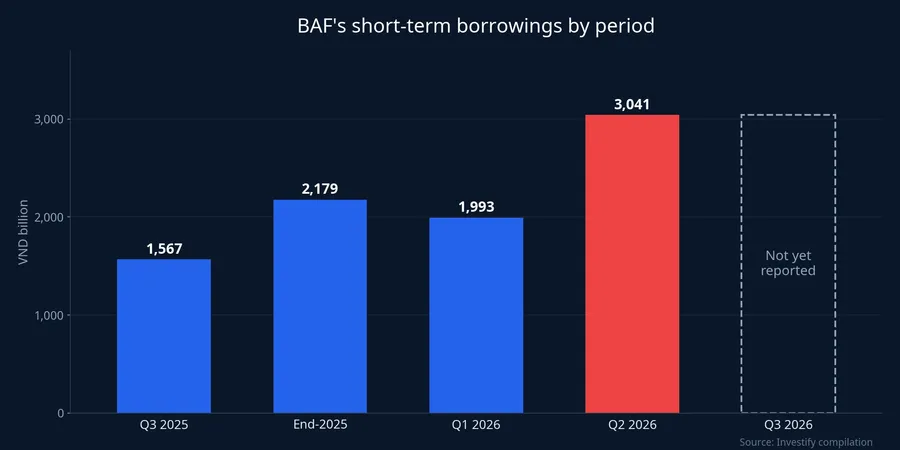
On the funding side, liabilities at the end of Q2 were VND 9,138 billion, up 36% from the start of the year, against total assets of VND 13,512 billion.Fili Total borrowings reached VND 6,237 billion, of which short-term loans were VND 3,041 billion. Liabilities stood at 2.09 times equity, up from 1.65 times at end-2025. The current ratio was just 1.04: short-term assets barely cover short-term debt.
Set against those figures, VND 608 billion equals roughly 6.65% of liabilities at the end of Q2. It eases payment pressure along the chain, but is not enough to change the company's debt structure.
What to watch next
BAF had not published its Q3 2026 financial statements as of Oct 24. When it does, two lines are worth setting beside the end-Q2 figures: short-term borrowings (VND 3,041 billion) and gross margin (16.52%). If short-term debt falls and margin holds, the pressure to settle payables in the chain is easing. If short-term debt keeps rising while margin slips further, VND 608 billion covers only part of the funding need.
The second checkpoint is the allocation result after Nov 25. The share of existing shareholders who pay shows how much confidence current holders have, and the number of shares that must be offered to other investors shows how much more money the company has to find beyond its own shareholders.
For holders, the one certain task in the coming month is to mark Nov 20 and Nov 25. Whether to pay or sell depends on how large BAF is in your portfolio and how much cash you have on hand. Only letting the rights lapse is certain to forfeit their value.