

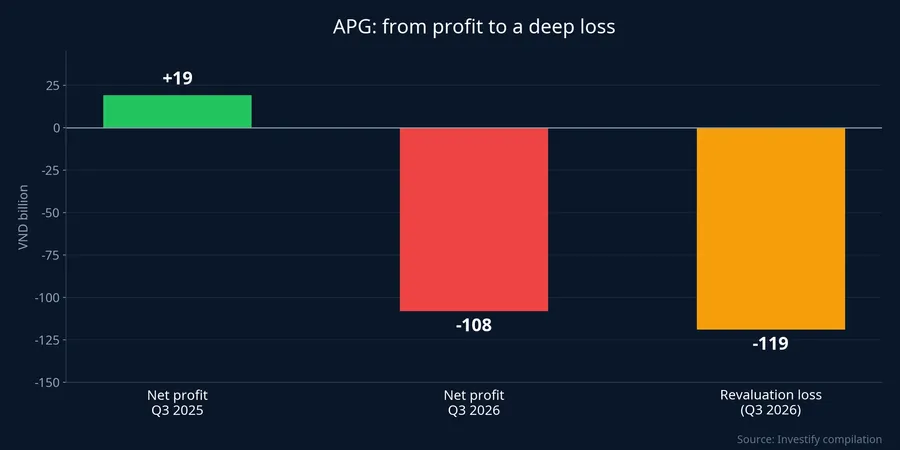
In the third quarter of 2026, APG Securities (HoSE: APG) reported a net loss of nearly VND 108 billion, against a profit of more than VND 19 billion a year earlier. According to MarketTimes, that is the largest loss among brokerages that have published Q3 results.MarketTimes Most of it did not come from selling shares at a loss. It came from having to restate the portfolio at market prices on the last day of the quarter.
The question is less "what did APG sell" than "where does the portfolio sit". This post walks through the financial statements, the accounting for a proprietary book, and why the loss may not stop at Q3.
Where the loss comes from
APG's Q3 operating revenue was nearly VND 70 billion, down 21% year on year. The main income lines were VND 42.5 billion from held-to-maturity investments and VND 23.2 billion from margin lending and receivables. Brokerage barely contributed: revenue was just over VND 400 million against brokerage costs of nearly VND 3 billion.Fili
The real weight sits in the loss on financial assets at fair value through profit or loss, nearly VND 120 billion, of which VND 119 billion is a revaluation decline.Fili The VND 119 billion alone exceeds the net loss of nearly VND 108 billion. Put differently, without the revaluation line the rest of APG's businesses still made money in the quarter.
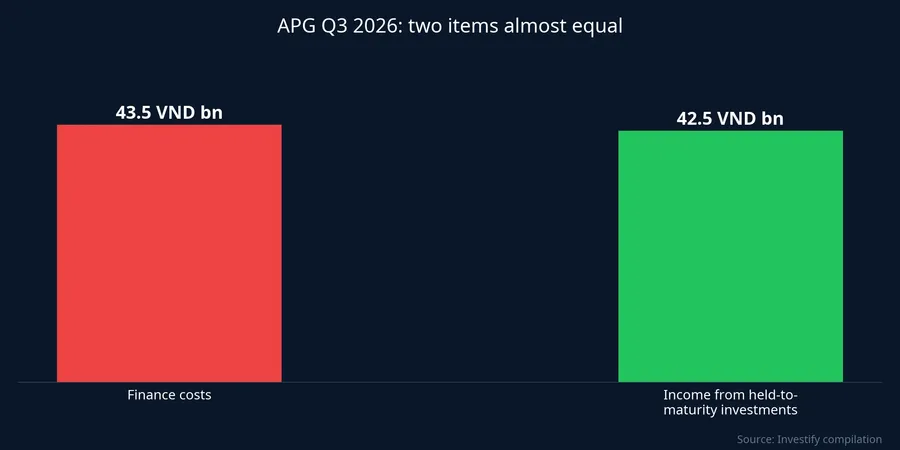
That profit is thin. Q3 finance costs were VND 43.5 billion, up almost 33% year on year and mostly interest expense.MarketTimes This is close to the whole VND 42.5 billion earned on held-to-maturity holdings. The largest investment bucket, more than VND 2,772 billion of total assets above VND 5,507 billion, therefore does little more than cover the interest on the borrowings behind it. The remainder cannot absorb a share-price drop on the order of VND 100 billion.
Over nine months, APG's pre-tax loss was nearly VND 105 billion, against a profit of more than VND 28 billion a year earlier. The 2026 plan calls for VND 20 billion in pre-tax profit.MarketTimes
Why an unsold loss still reaches the report
Brokerages classify most proprietary shares as financial assets at fair value through profit or loss. For these, the firm must reprice every holding at market at the end of each reporting period. The difference from the prior period goes straight into earnings, even if not a single share has been sold.
The mechanism runs both ways. When prices rise, the firm books a revaluation gain before any cash arrives. When prices fall, it books a loss without having sold. A "paper" loss is still real to shareholders: it reduces profit and then equity.
At APG the effect is already on the balance sheet. Equity fell from more than VND 2,382 billion at the start of the year to about VND 2,277 billion at the end of September, and the company carries accumulated losses of more than VND 29 billion.MarketTimes Negative retained earnings mean there is, for now, no accumulated profit left to distribute to shareholders.
Where the portfolio is concentrated
As of 30 September 2026, APG's portfolio of financial assets at fair value through profit or loss was worth nearly VND 330 billion. Of that, listed shares had a cost of nearly VND 230 billion and a market value of just over VND 100 billion.Fili MarketTimes is more specific: cost of more than VND 227 billion, fair value of about VND 100 billion, meaning the listed portfolio is sitting on an unrealized loss of about VND 127 billion.MarketTimes
The Q3 report does not itemize which stocks make up this portfolio. Linking the loss to KOS shares of Kosy JSC is the press's cross-reference. According to Vietstock, the half-year report showed APG's listed portfolio at a cost of nearly VND 230 billion, the same as its KOS investment, then worth VND 220 billion at market prices.Fili Nhịp sống Kinh doanh reports that in mid-2026 APG disclosed holding more than 5 million KOS shares.Nhịp sống Kinh doanh APG has not confirmed that the Q3 loss comes from KOS.
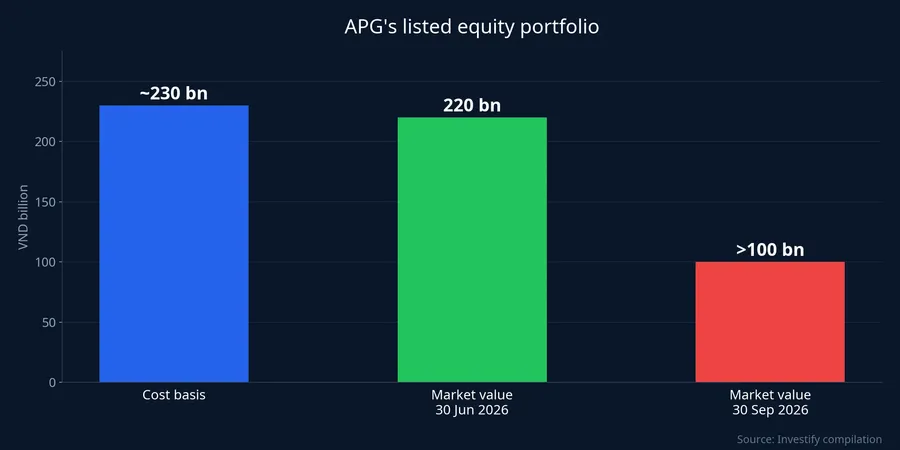
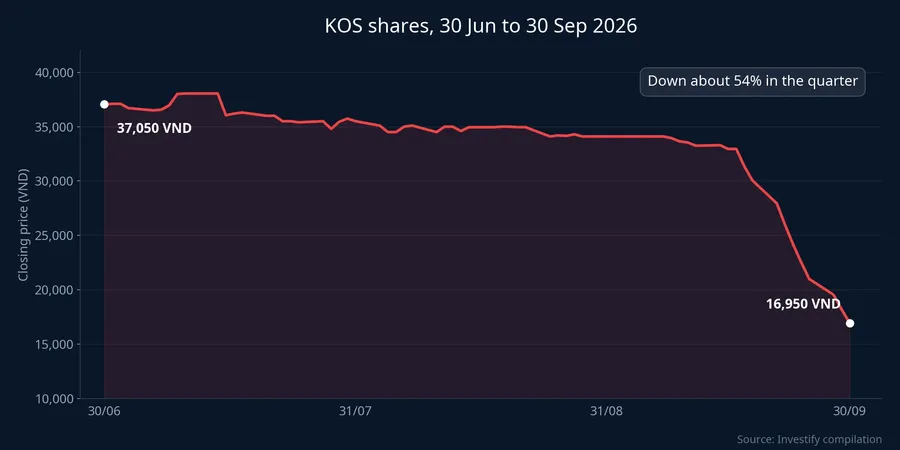
The price data make the cross-reference a good fit. KOS closed at VND 37,050 on 30 June and VND 16,950 on 30 September, a fall of about 54% in Q3. APG's listed portfolio went from VND 220 billion to just over VND 100 billion over the same period, also a drop of roughly 54%. Cost stayed near VND 230 billion across both reports, so the company probably did not sell a meaningful part of it during the quarter. Two near-identical declines and an unchanged cost basis are the strongest evidence, short of official confirmation, that the portfolio is still KOS.
Secondary factors deserve separating out. Higher interest expense and a brokerage loss of about VND 2.5 billion deepened the result, but they amount to a few billion to a few tens of billions of dong. The VND 119 billion revaluation decides the quarter.
KOS's limit-down streak and the Q4 burden
KOS's limit-down streak began on 21 September. CafeF counts 25 consecutive limit-down sessions.CafeF On 23 October KOS fell to the floor again, at VND 5,050, with more than 93 million shares left unsold at the floor price.Nhịp sống Kinh doanh
In an explanatory filing dated 16 October, Kosy said momentum-driven market declines created selling pressure, that brokerages cut margin ratios on KOS and liquidated positions en masse, pushing the price down session after session. The company states that its real estate, renewable energy and project operations continue as planned.Fili That is the company's view. This post does not judge it, only records it so readers can set it against the price action.
The point to get right is timing: most of the streak falls in October, which is Q4. APG's Q3 report reflects KOS only through 30 September, at VND 16,950. From then to the 23 October session, KOS lost another 70% or so. If APG still held the same shares at year-end and the price did not recover, the portfolio now worth just over VND 100 billion would be worth about VND 30 billion at today's price. That is another roughly VND 70 billion of revaluation loss that could flow into Q4. This is a hypothetical calculation, not a forecast: KOS could rebound, and APG may have sold some shares after 30 September.
Selling is not easy at the moment either. With more than 93 million shares queued at the floor, a holder trying to exit more than 5 million shares stands behind a very long line of other sell orders. Concentration risk therefore has two layers: falling prices erode profit, and a drained market makes it hard to cut losses even if the company wants to.
Who bears the loss
The loss does not fall only on investors who borrowed on margin to buy KOS. It also falls on APG shareholders, who may never have bought a KOS share but still absorb the decline through the company's equity. Against equity of about VND 2,277 billion, the Q3 loss does not threaten the company's survival. It has, however, pushed nine-month results into the red, turned retained earnings negative and put the VND 20 billion profit plan for 2026 out of reach.
The broader lesson is for holders of any brokerage with a proprietary book. When reading a report, the note on financial assets at fair value through profit or loss deserves as much attention as the profit line. A portfolio spread across many stocks turns one limit-down stock into a scratch. A portfolio concentrated in a single stock sends that stock's streak straight into the brokerage's books.
The missing piece is APG's Q4 report, due around 20 January 2027. The cost line for listed shares will show whether APG still held KOS after 30 September, and the revaluation line will show how much more the October limit-down streak took from equity.