
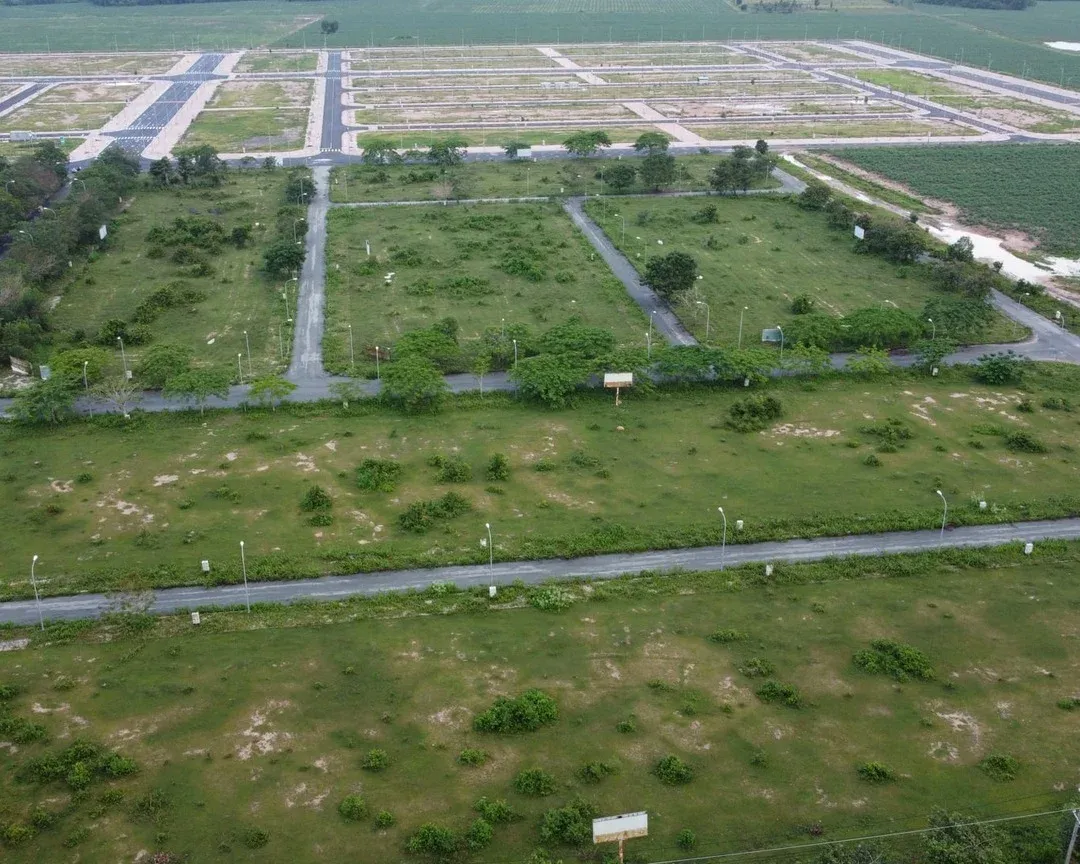

On the morning of October 23, Finance Minister Ngô Văn Tuấn, acting on the Prime Minister's authorization, presented the National Assembly with a draft law amending the Corporate Income Tax Law, the Non-Agricultural Land Use Tax Law and the Personal Income Tax Law.FireAnt The part drawing the most attention is a proposed 0.2% annual tax on abandoned land, land not put into use and land put into use late, with no quota applied.VnExpress
Many outlets describe the rate as "nearly seven times higher". The comparison is accurate, but only against the lowest existing bracket. To see who actually pays more, three questions matter: where 0.2% sits on the current tax scale, what counts as abandoned land, and whether this tax stacks on top of other land-related payments. One point first: this is a draft that has been submitted, not a law. No article has been put to a vote.
Where 0.2% sits on the current scale
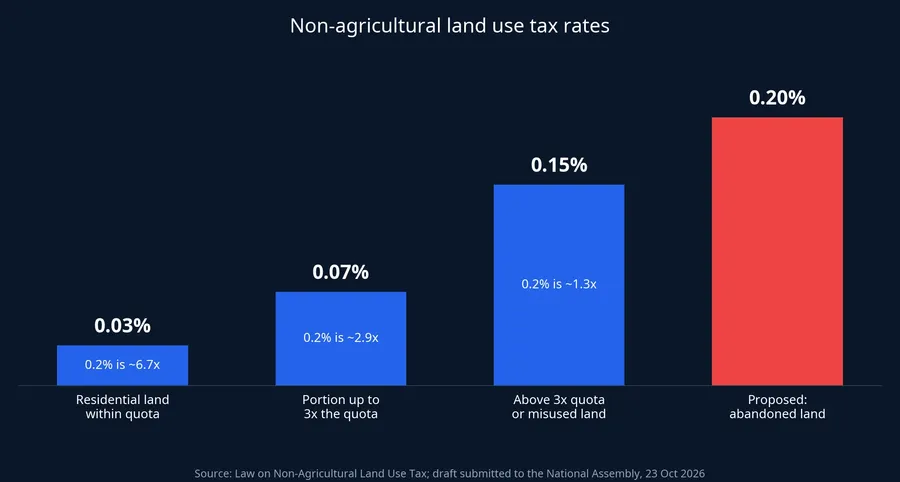
Under the Non-Agricultural Land Use Tax Law now in force, residential land is taxed in progressive tiers. Area within the quota is taxed at 0.03%, the portion up to three times the quota at 0.07%, and the portion beyond that at 0.15%. Land used for the wrong purpose is also taxed at 0.15%, while encroached land is taxed at 0.2% with no quota.Người Quan Sát
Set against each tier, the gap varies widely:
| Current tier | Rate | 0.2% is higher by |
|---|---|---|
| Residential land within quota | 0.03% | about 6.7x |
| Portion up to 3x the quota | 0.07% | about 2.9x |
| Portion above 3x the quota, misused land | 0.15% | about 1.3x |
| Encroached land | 0.2% | equal |
Ratios calculated by Investify from the rates reported by Người Quan Sát.
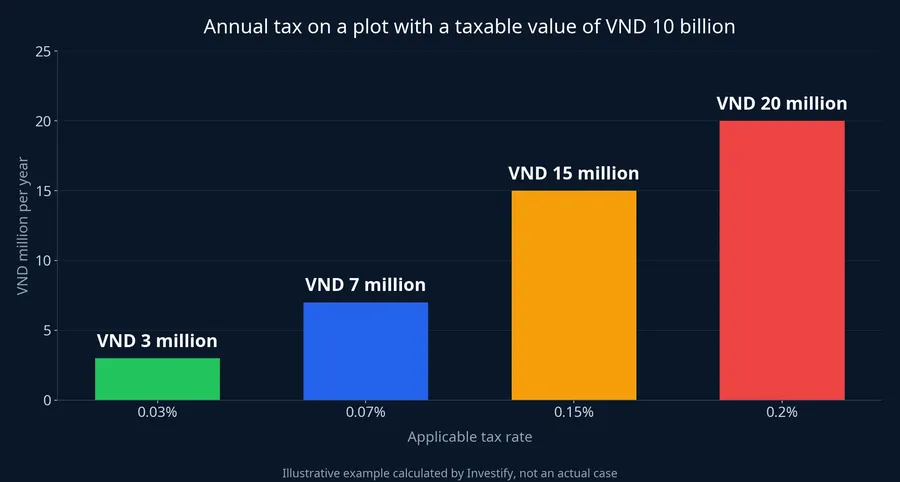
Tax equals taxable area times the land price in the official price table, times the rate. Take a plot with a taxable value of VND 10 billion (an illustrative calculation, not a real case): the annual tax is VND 3 million within the quota, VND 15 million at 0.15% and VND 20 million at the proposed 0.2%.
"No quota" means the whole area is taxed at one rate. Today, owners of large plots pay the low rate on the first slice and move into higher tiers only on the excess. If a plot is classed as abandoned, that concession disappears.
So the near-sevenfold jump applies only to land currently taxed in the lowest tier. For land already paying 0.15% for not being used as required, the new rate is only about a third higher. Dr. Nguyễn Đức Kiên, former head of the Prime Minister's economic advisory group, argues that 0.2% is not enough to make land hoarders think twice and calls for a steeper rate.Người Quan Sát
What counts as abandoned land
This question decides who pays, and it has no complete answer yet. The draft tax law does not define the three categories itself; they are to be identified under land legislation.FireAnt The draft amended Land Law introduces a concept of abandoned land for the first time, broadly land allocated or leased by the State that is not put into continuous use for a set period.VnExpress The draft does not say how long that period is.
The National Assembly's Economic and Finance Committee flagged a further gap in its review report. The tax bill cross-refers to land law for all three cases, yet the draft Land Law defines only abandoned land and the cases in which it can be reclaimed. The committee said a cross-reference like that has no basis for application.VnExpress
For someone holding an unbuilt residential plot, that means nobody can say for certain whether the plot falls under the 0.2% rate. The draft concept revolves around land "allocated or leased", closer to project land than to a lot bought on the open market. The real scope will be set by the final Land Law definition and its implementing rules.
Where project land could be charged twice
Phan Văn Mãi, chairman of the National Assembly's Economic and Finance Committee, presented the review report. The committee broadly supports the proposal, which implements Resolution 21-NQ/TW, but notes that provisions in the draft are contradictory, inconsistent and lack clear grounds.Người Quan Sát The three most notable points all touch project land.

Two rates for one area. Current law already applies 0.15% to unused land, which is in essence land not used or used late. The draft adds a new clause 8 at 0.2% but leaves clause 6 untouched, so the same area could be read as falling under two different rates.Người Quan Sát
Overlap with surcharges. The draft Land Law provides that project land left unused or used late is charged, on top of land use fees and rent, an additional land use fee and additional rent calculated progressively each year. If an investor still has not put the land to use after 60 months, the State reclaims it.Người Quan Sát Layer a 0.2% tax on the same area and a single delay triggers two obligations. The committee asked for the relationship between the two to be clarified, so that obligations do not overlap but also do not shrink for cases already paying 0.15%.
No carve-out for causes beyond the owner's control. The draft does not exclude force majeure periods or approved phased-investment projects. According to the committee, that could mean taxing land left idle for objective reasons, such as a project stuck in site clearance or planning changes.VnExpress
Each fix would ease the load on a different group. Merging clauses 6 and 8 tells current 0.15% payers which rate applies. An anti-overlap mechanism with the additional land fees spares a delayed project from paying twice for the same delay. Excluding force majeure and phased projects keeps developers tangled in procedures from being treated as land hoarders.
Why project land is the group to watch
For a household, the difference from the 0.2% rate runs from a few million to a few tens of millions of dong a year, and whether they are covered at all is still unclear. For real estate developers with large land banks, the story is one of scale. The tax applies to the entire area with no preferential quota. If the bill passes as drafted with no anti-overlap mechanism, delayed project land could face both the new tax and the progressive additional land fees under the amended Land Law.
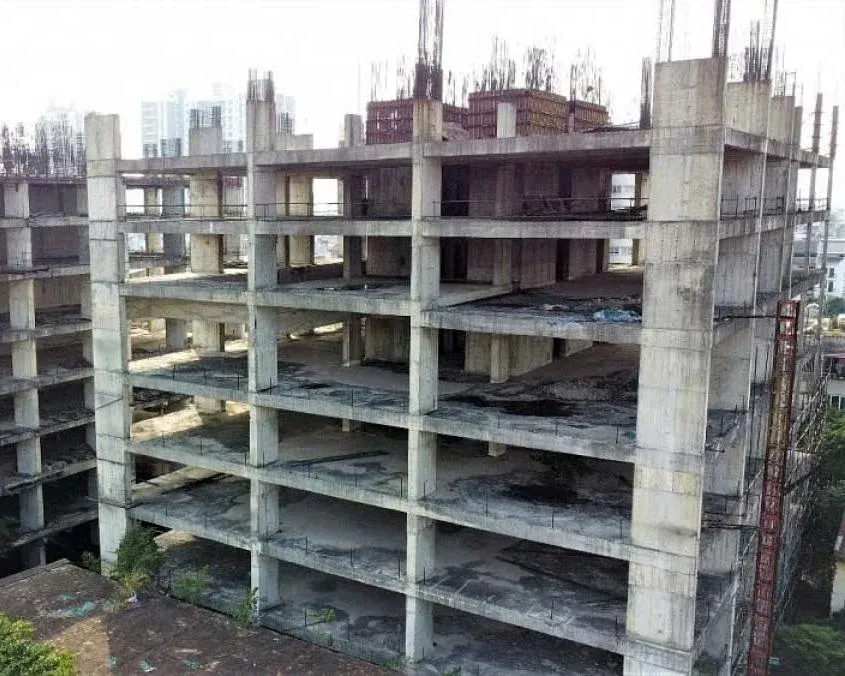
For investors holding developer stocks, the share of undeveloped land in the total land bank is worth checking, along with how much of it is stalled for legal reasons.
The legislative calendar
The bill has four articles and was submitted for consideration and passage at the second session of the 16th National Assembly, with effect expected from January 1, 2027.FireAnt The session opened on October 17 and is scheduled to close on November 21.FireAnt The dates for debate and a vote on this bill have not been published in available sources. Even on schedule, tax can be collected only once it is clear which plots count as abandoned, and that depends on the amended Land Law being reviewed in parallel.
Takeaway
The direction of the proposal is clear: if the law passes as drafted, holding land idle will cost more. The largest increase in percentage terms falls on land now taxed at 0.03%. The largest increase in money, along with the risk of overlapping obligations, falls on developers with delayed project land.
The final burden hinges on two points the Assembly will weigh. First, whether the 0.2% tax is designed so that it does not stack on the progressive additional land fees. Second, whether force majeure periods and phased projects are excluded. Together with the definition of abandoned land in the amended Land Law, those provisions will show who actually pays, and from when.