

On October 22, the board of Southeast Asia Commercial Joint Stock Bank (SeABank, ticker SSB) approved two items in a single sitting: a lower 2026 profit plan and a new Chairwoman. The profit figure drew most of the attention. The part worth reading more carefully is what the bank did not touch.

What changed and what stayed
According to a SeABank release issued on the afternoon of October 23, the 2026 pre-tax profit plan was cut 15%, from VND 7,068 billion to VND 6,008 billion.VnExpress The amount removed is roughly VND 1,060 billion.CafeBiz The VND 7,068 billion figure is the one shareholders approved at the April annual general meeting.
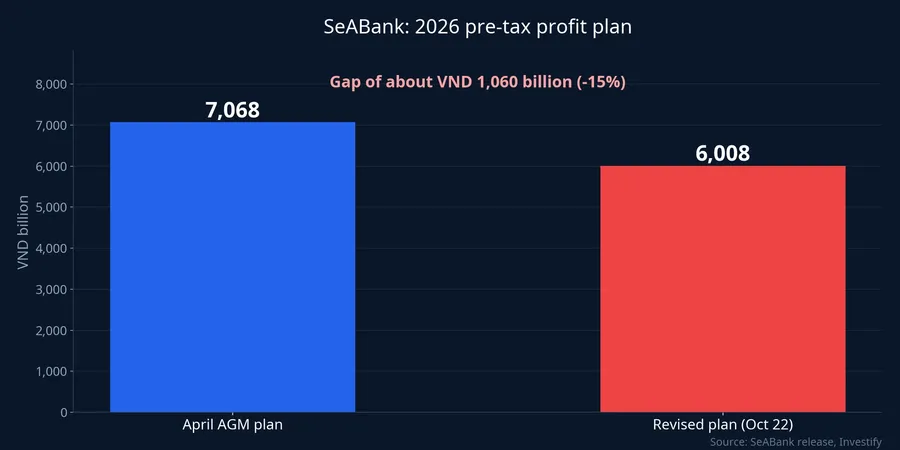
At the same time, the bank has not changed its targets for total assets (+10%), funding (+23%) and outstanding credit (+17%).VnExpress In other words, SeABank still intends to lend as much as it planned at the start of the year. What changed is the profit it expects to earn on that lending. Management called the voluntary cut a "proactive, prudent but necessary step," citing the push to lower interest rates and ease conditions for businesses and households in line with State Bank of Vietnam (SBV) guidance.VnExpress
Where the profit went: the bank's account and the gap in it
Per Báo Đầu tư Chứng khoán, SeABank said it has cut deposit rates by 0.5-0.7 percentage points a year on tenors of six months and longer, creating room to lower lending rates for individuals and companies. Priority groups are production and business, small and medium-sized enterprises, and green projects.Báo Đầu tư Chứng khoán
Borrowers, or would-be borrowers, should read two points correctly. First, the 0.5-0.7 point figure is a cut to deposit rates, not lending rates. As of October 23, SeABank had not announced a named loan-relief package with a specific size and rate reduction. Second, the deposit cut sits close to the industry-wide requirement. According to Người Quan Sát, at an October 19 meeting with commercial banks the SBV set a direction of cutting lending rates by 1.5-2% a year for production, business and priority sectors, and asked for deposit rates on tenors of six months or more to fall by at least 0.5% a year.Người Quan Sát SeABank describes itself as a "pioneer," yet its funding-cost cut stays within that range.
So the direction is clear: the bank pays depositors less and promises to charge borrowers less. What borrowers will actually get is not yet quantified.
A rough check: lower loan rates do not explain all of VND 1,060 billion
Taken at the bank's word, VND 1,060 billion is the price of cheaper lending. A back-of-envelope calculation tests that reading. At the end of Q2 2026, SeABank's net customer loans stood at about VND 250,063 billion, call it VND 250,000 billion. From October 22 to year-end there are roughly 70 days. To lose the full VND 1,060 billion purely from lower lending rates over those 70 days, the bank would need to cut rates by an average of about 2.2 percentage points a year across the entire loan book.
That is above the top of the SBV's 1.5-2% guidance, which targets only production, business and priority loans, not every loan. The calculation also ignores the funding cost the bank saves by paying depositors less. It is only an estimate: year-end loans will be larger than at Q2, and the bank may be counting effects that spill into next year. Even so, it suggests the VND 1,060 billion likely carries more than the October rate cut. SeABank's own release points to other items: it said it will set aside full provisions and direct resources to digital technology and governance infrastructure, "not chasing hot growth at any cost."Báo Tin tức
Margins were thinning before October
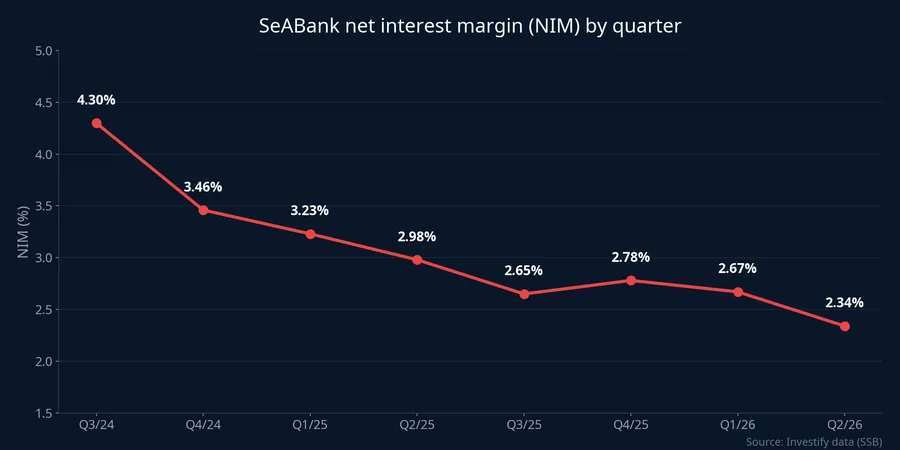
Look at the bank's own quarterly numbers. Net interest margin (NIM) fell from 4.30% in Q3 2024 to 2.34% in Q2 2026, a loss of about 1.96 percentage points over seven quarters, before October's rate cuts. Over the same period, net customer loans rose from VND 235,093 billion at the end of Q1 2026 to VND 250,063 billion at the end of Q2 2026. The bank is lending more, but each dong lent earns less.
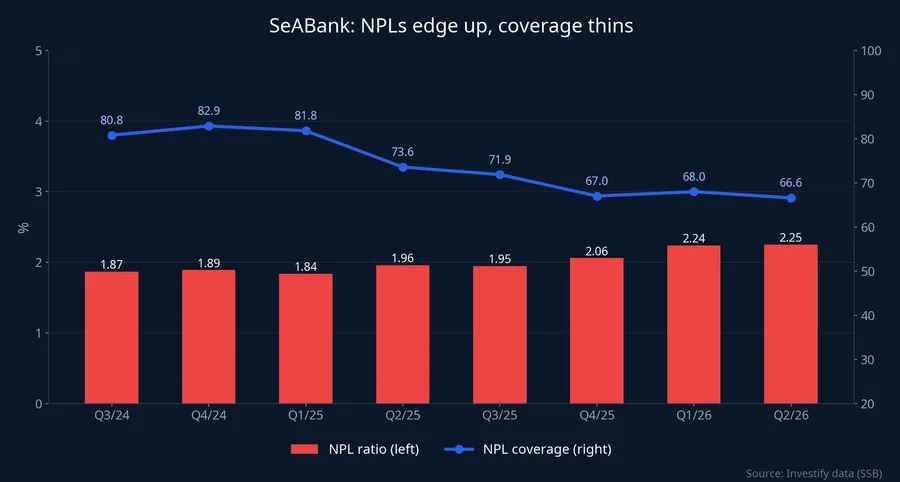
Asset quality moves the same way. The NPL ratio rose from 1.87% in Q3 2024 to 2.25% in Q2 2026, while NPL coverage fell from 80.81% to 66.59%. The provision balance did grow, to VND 3,797 billion at the end of Q2 2026, but not as fast as bad debt. When the buffer thins, a pledge to "set aside full provisions" usually means higher provisioning costs in coming quarters, and those costs come straight out of pre-tax profit.
With the public data available, it is hard to separate how much of the VND 1,060 billion comes from the narrower margin, how much from possibly higher provisioning, and how much from October's rate cut. The bank's explanation centers on the rate cut, while data through Q2 shows thin margins and a weak provision buffer were already in place. A more plausible reading is that the VND 7,068 billion plan set in April was already hard to reach, and the rate cut gave the bank an occasion to move the plan closer to reality. That is an inference from the numbers, not something SeABank has said.
No Q3 results yet, so progress cannot be measured
As of October 23, SeABank had not published Q3 2026 results, so it is not possible to say how much of the old or new plan has been delivered. For reference, Q3 2025 pre-tax profit alone was VND 956 billion. Nine-month 2025 results should not be divided into the 2026 plan to infer progress, because the profit mix differs between the two years.
On the market, SSB closed at VND 16,650 on October 23, the day the news came out, up 3.74%. One session is not enough to conclude how the market read the resolution.
The leadership seats are rearranged
In the same resolution, the board accepted the resignation of Mr. Lê Văn Tần as Chairman and elected Ms. Trần Thị Thanh Thủy, a board member, as Chairwoman for the 2023-2028 term effective October 22, 2026.Báo Đầu tư Chứng khoán Ms. Thủy, born in 1965, has more than 26 years at Vietcombank, joined SeABank in 2015 as Deputy CEO and was elected to the board on April 17, 2024.
Mr. Tần is not leaving the leadership. SeABank is finalizing a filing for SBV approval to appoint him CEO, replacing Mr. Lê Quốc Long, whose three-year term (November 2023 to November 2026) is about to end.Báo Tin tức According to Người Quan Sát, the appointment was not yet effective at the time of the announcement.Người Quan Sát Until the SBV signs off, the new team is only half in place: the Chair is set, the CEO is not. Whoever runs the bank toward the VND 6,008 billion plan in the final months of the year will be a CEO awaiting approval, alongside a Chairwoman who has just taken her seat.

Who gains, who shares the cost
When a bank keeps its lending volume but lowers its profit plan, borrowers are in principle the beneficiaries and shareholders share the cost. At SeABank, the first half of that sentence is not yet backed by numbers, because the bank has not said how much borrowers will save. The second half is clear: shareholders voted for VND 7,068 billion and now receive a plan about VND 1,060 billion lower.
Our reading is that VND 6,008 billion should be treated as the new baseline, not a surprise already absorbed. Two signals will show whether the new plan is conservative or still stretched. One is the Q3 2026 financial statements: if cumulative profit already exceeds about three quarters of VND 6,008 billion, the new plan is a safe one. The other is Q3 NIM and NPL coverage: if NIM keeps falling below Q2's 2.34% while coverage thins further, the VND 1,060 billion cut may not be the last adjustment.
For borrowers, the questions to put to the bank are whether their loan falls in a priority group for rate cuts, by how many percentage points, and whether the cut applies to new loans or existing ones.