

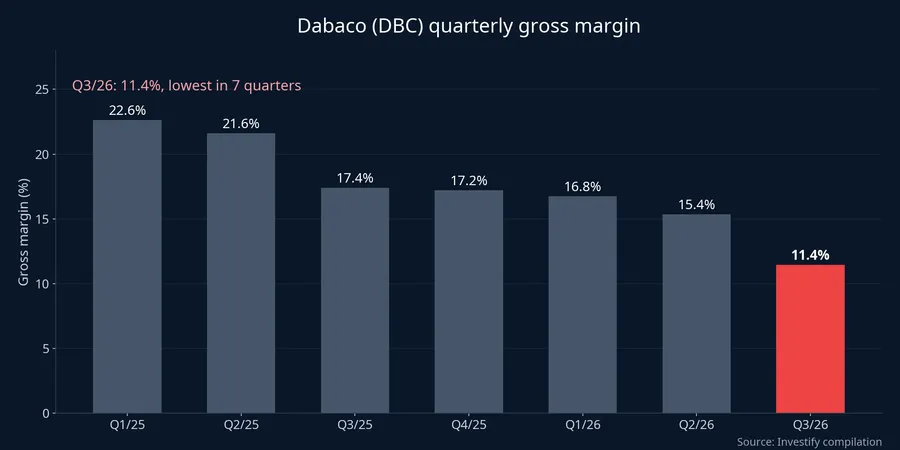
In the third quarter of 2026, for every VND 100 of goods sold, Dabaco (HoSE: DBC) kept just VND 11.4 as gross profit. A year earlier it kept VND 17.4. That VND 6 gap per VND 100 of revenue is where most of the quarter's profit went, according to the consolidated financial statements as relayed by Markettimes.Markettimes
The bottom line: Q3 net profit came to nearly VND 200.2 billion, down 41.6% year on year, while net revenue topped VND 5,138 billion. Per Vietstock, this is the fourth straight quarter in which Dabaco's profit has fallen against the same period a year earlier.Vietstock
The question worth asking is whether the lost profit sits in live hog prices or in the interest cost of the debt funding new farms and plants. This piece separates the two, then works out what Q4 must deliver for Dabaco to meet its full-year plan.
Where the lost profit sits
Pre-tax profit in Q3/2026 fell from VND 365.56 billion to VND 241.27 billion, a shortfall of about VND 124.3 billion. Of that, profit from core operations (gross profit minus selling and administrative expenses) dropped from VND 407.54 billion to VND 295.78 billion, roughly VND 111.8 billion. That is about 90% of the decline. Net financial items (financial income minus financial expense) added only about VND 13.3 billion, around 11%, while other profit barely moved.
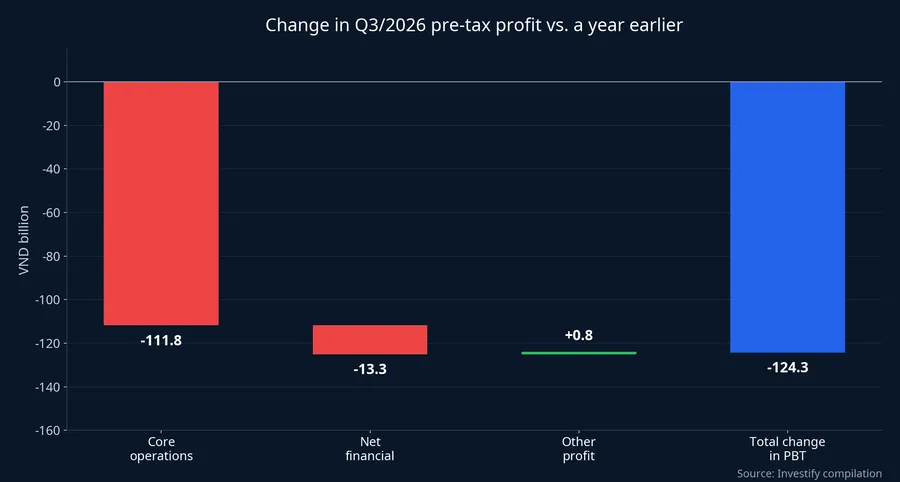
Put differently, interest costs rose and do add pressure, but most of the lost profit comes from Dabaco keeping less of what it sells.
Cost of goods rose faster than revenue
Net revenue in Q3 grew 37.4% year on year. Cost of goods sold grew 47%, to more than VND 4,550 billion.Vietstock Because costs ran ahead of sales, gross profit fell 9.9% to just over VND 587.7 billion, even though volumes sold were much higher.Markettimes
Against the previous quarter, the gross margin also fell: in Q2/2026 Dabaco kept about VND 15.4 per VND 100 of revenue, and in Q3 only VND 11.4. Across the quarters shown in the chart below, covering the start of 2025 onward, this is the lowest reading.
Below gross profit, expenses rose as well. Selling expenses climbed to more than VND 150.1 billion, up 17.4%. Administrative expenses went from over VND 116.8 billion to nearly VND 141.8 billion.Markettimes
Hog prices: the main cause, but not the only one
Dabaco explained that lower live hog prices in Q3 pulled down revenue and profit at livestock companies compared with a year earlier.Markettimes Market data show the drop happened mostly this year. According to Thương Trường, the nationwide average live hog price in Q3/2026 was about VND 56,100 per kg, down 11.2% from Q2. In the North, where Dabaco is headquartered and runs many of its livestock projects, the price fell 14.6% from Q2.Thương Trường
Yet the same source says the Q3 nationwide average was still about 1.4% above the same quarter of 2025. So if one compares only hog prices between the two third quarters, it is hard to explain why Dabaco's gross margin lost a full 6 percentage points. At least two other forces are at work.
The first is revenue mix. In the explanation relayed by Vietstock, feed sales volume rose, while vegetable oil revenue grew 303% and that segment's profit grew 320%.Vietstock Dabaco does not publish margins by segment. If feed and vegetable oil carry lower margins than hog farming did when prices were still good, the growth of those two segments also helps pull the blended margin down.
The second is depreciation. Gross fixed assets rose 18% to more than VND 10,000 billion as Dabaco brought the phase 2 oil-pressing plant, the vaccine plant and the Hiệp Quang line expansion into operation. Accumulated depreciation on the breeding herd also rose to VND 154 billion, from VND 5.9 billion at the start of the year.Vietstock These charges flow into cost of goods whether hog prices rise or fall.
Weighing all three forces, the data still point to hog prices as the largest factor. The company names it itself, prices fell most in the North among the three regions, and the vegetable oil segment is growing profit rather than losing it. Revenue mix and depreciation make things worse, but they do not explain the whole margin squeeze.
Debt sitting inside farms and plants
As of September 30, 2026, Dabaco's borrowings and finance lease liabilities were more than VND 7,622 billion, 77.7% of total liabilities,Markettimes up about 31.2% year on year. Most of it is still short-term borrowing, around VND 5,763 billion.
The money is going into projects that do not yet generate revenue. Construction in progress reached more than VND 1,302.6 billion. The two largest items are the Dabaco Quảng Ninh hog project at nearly VND 360.2 billion and the Nutreco Hà Tĩnh feed plant at nearly VND 266.6 billion. The rest belongs to the Ngọc Lặc high-tech hog complex (Thanh Hóa) and other projects.Markettimes The Quảng Ninh balance differs between outlets: Người Quan Sát reports VND 388 billion.Người Quan Sát The Q3 report does not give start-up dates for these projects.
Interest expense in Q3 was VND 100.37 billion, against VND 62.48 billion a year earlier, an increase of about 60.6%. Including other items, financial expense rose to nearly VND 102.2 billion, up 63.3%. Part of it was offset: financial income reached more than VND 43.2 billion, 2.5 times the prior-year level, mainly thanks to large cash deposits.Markettimes
That is Dabaco's counterweight: it borrows heavily but also holds a lot of cash. At the end of Q3, it had more than VND 1,192 billion in cash and equivalents plus more than VND 3,100.5 billion in term deposits, about VND 4,292.5 billion combined. Net of these, net debt is about VND 3,300 billion, by Vietstock's calculation.Vietstock
Can operating cash flow carry the interest bill
Profit is down, yet cash collected from operations is up. Net operating cash flow for the nine months reached nearly VND 1,518 billion, up 45.5%.Markettimes For comparison, interest expense for Q2 and Q3 combined was about VND 185.6 billion. Operating cash flow currently covers interest with a wide margin of safety.
The picture changes once investing outflows are included. Over nine months, Dabaco spent more than VND 1,100 billion on fixed assets, double the prior-year level.Người Quan Sát After that spending, only about VND 400 billion of operating cash flow remains. Rising borrowings during the year suggest the rest of the investment plan is being funded with debt. While the new farms have yet to sell any hogs, the interest on that debt will keep running ahead of their revenue.
What Q4 has to deliver
After nine months, Dabaco's net profit stood at more than VND 863.3 billion, down 36.4%, about 77.3% of the full-year plan of VND 1,117 billion.Markettimes The remaining gap is about VND 253.7 billion. To reach the plan, Q4 profit must be about 27% above Q3 and roughly 1.7 times the VND 148.6 billion earned in Q4/2025.
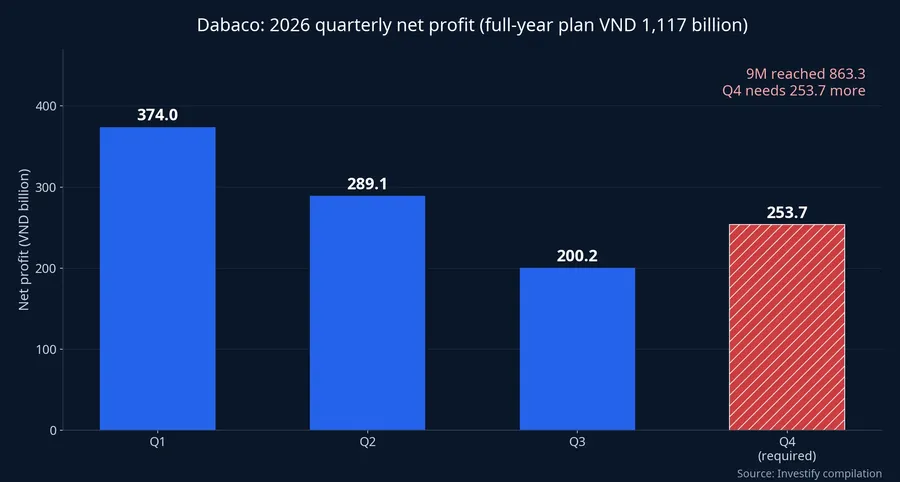
Q4 also starts from a lower hog price base. According to Thanh Niên, on October 23 live hog prices in the North were just VND 47,000 to 48,000 per kg, with a nationwide average of VND 47,500 per kg.Thanh Niên That average is about 15% below the Q3 average of VND 56,100 per kg. Thương Trường, citing the Southeast Livestock Association, reports prices have fallen to their lowest in nearly two years.Thương Trường
Pressure comes from both supply and demand. The national herd at the end of September 2026 was up 5.4% year on year, and imported pork over eight months rose 18.8% at an average of about VND 45,000 per kg, below domestic prices. On the supportive side, meat demand usually rises from the eleventh lunar month through the run-up to Tết, so prices are expected to recover toward year-end. How much they recover is not yet known.
Dabaco's profit is following hog prices
The Q3 results show Dabaco's current structure: revenue can grow on feed and vegetable oil, but profit follows live hog prices. About 90% of the lost profit sits in core operations, while interest expense accounts for a small share. For anyone holding DBC shares, the biggest near-term risk is therefore hog prices, and only then the debt.
Debt is the risk of a later stage. Operating cash flow covers interest comfortably today, and large deposits keep net debt moderate. Pressure rises only if low hog prices persist just as the Quảng Ninh and Thanh Hóa farms have yet to deliver output, because then interest climbs while the means to pay it weaken.
Two signals will show whether margins recover. The first is North hog prices in November and December, when Tết demand begins. The second is the Q4/2026 financial report, expected around the end of January 2027. If the gross margin returns above Q3's 11.4%, Q3 was likely the bottom of this squeeze. If it keeps narrowing, the VND 1,117 billion plan will be hard to reach.