
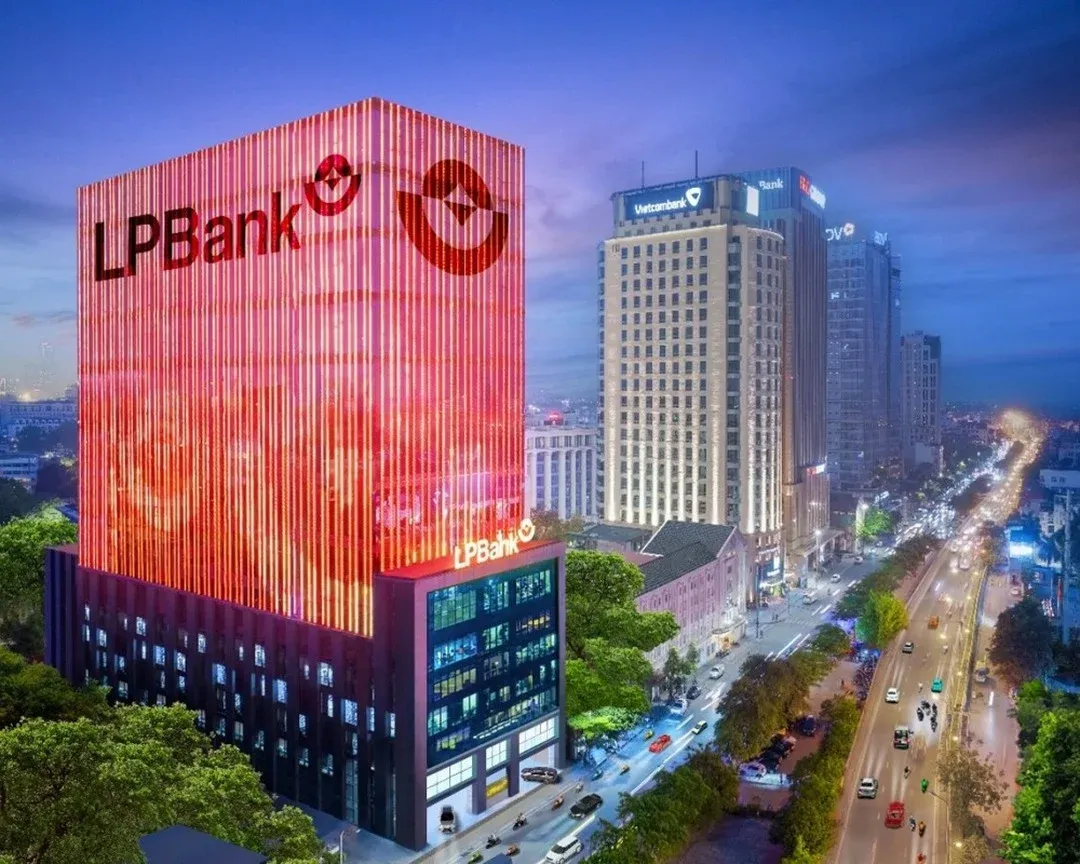

In Q3 2026, LPBank (LPB) reported pre-tax profit of nearly VND 4,448 billion, up 29% year on year. Post-tax profit came to nearly VND 3,562 billion, up about 28.9%.Mekong Asean
The headline looks strong. Break it into income lines, though, and the picture changes. What the bank earns from lending, after paying depositors, was lower than a year earlier. Almost all of the extra profit came from fee income, and most of that sits in a line the bank does not itemize. This post walks through funding costs, the fee offset, the loan mix, and what the bank had to set aside against risk.
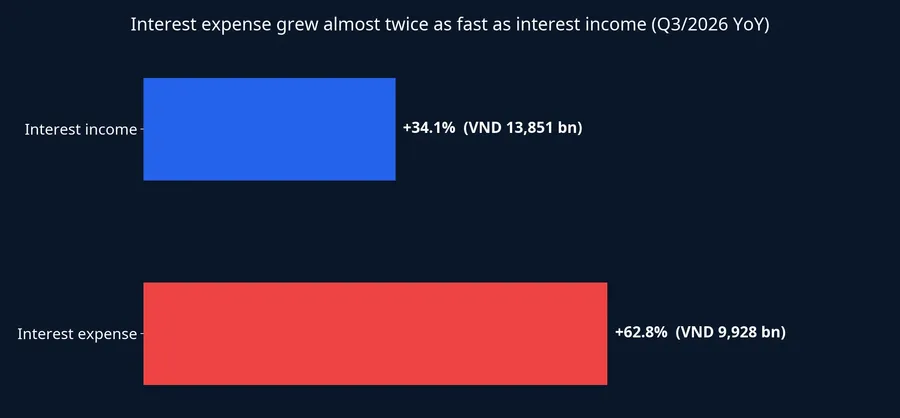
Interest expense grew almost twice as fast as interest income
In Q3, LPBank's interest and similar income rose 34.1% year on year to VND 13,851 billion. Interest expense rose 62.8% to VND 9,928 billion. Net interest income, the gap between interest earned and interest paid, fell 7.4% to just under VND 3,923 billion.Mekong Asean The bank lent more, but kept less on each dong lent.
Funding explains most of this. At 30 September, customer loans stood at VND 481,570 billion, up 22.9% from the start of the year, while customer deposits reached VND 421,831 billion, up 25%. Term deposits made up 93.4% of the total, and demand deposits were only about VND 27,625.8 billion, slightly lower.Thị trường Tài chính Tiền tệ Term deposits are the funding the bank pays more for. In Q3 alone, deposits grew by more than VND 68,300 billion from end-June.Bloomberg Businessweek VN
Valuable papers issued by the bank reached VND 99,145 billion, up 54.7% year to date, mainly 12-month to 5-year certificates of deposit and bonds with maturities above five years.Thị trường Tài chính Tiền tệ Longer tenors usually carry higher rates. When costly funding grows faster than lending, a decline in net interest income is no surprise.
The pressure may not ease in Q4. From 19 October to year-end, LPBank cut short-term lending rates by up to 1.6 to 2 percentage points a year, while deposit rates at many tenors fell only 0.5 to 0.6 points.Bloomberg Businessweek VN With lending rates falling faster than deposit rates, the margin has little room to widen in the near term.
The offset: fee income nearly quadrupled
Net fee and service income in Q3 reached nearly VND 3,395 billion, against VND 853 billion a year earlier.Mekong Asean Total operating income was about VND 7,966 billion, up 49.6%. Working backwards, total operating income rose by about VND 2,640 billion, and fee income alone rose by about VND 2,540 billion. Fees carried almost all of the quarter's added income.
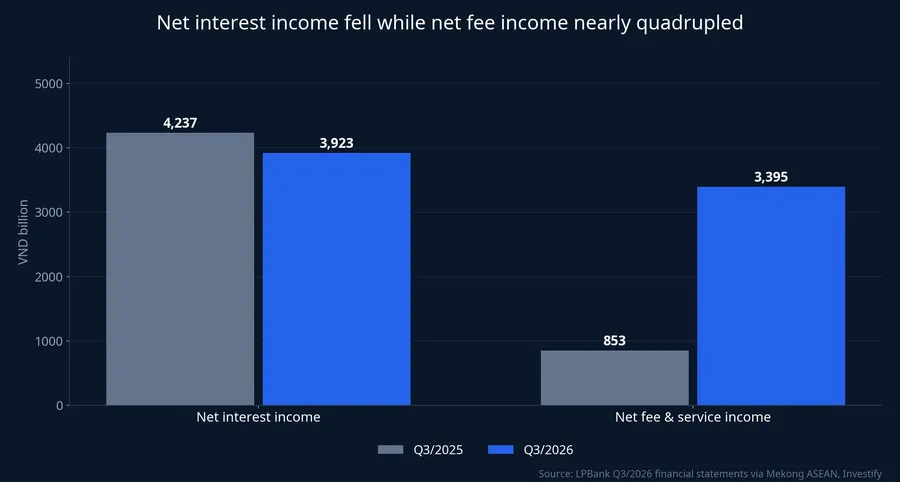
Non-interest income made up about 51% of operating income, the highest in the last eight quarters.Bloomberg Businessweek VN Foreign exchange trading added nearly VND 433 billion, 5.5 times a year earlier, mainly from currency derivatives. It remains small next to fees.
Where do the fees come from? The notes to the financial statements put income from services at VND 6,252 billion, of which the "other services" line accounts for nearly VND 5,690 billion, about 91%.Mekong Asean The period matters here. According to Bloomberg Businessweek Vietnam, the VND 5,690 billion is a nine-month cumulative figure, against VND 2,160 billion in the first nine months of 2025, and the bank does not itemize the line.Bloomberg Businessweek VN It is not a Q3-only number.
Cumulative nine-month net fee income was VND 5,976.9 billion, up 136%.Thị trường Tài chính Tiền tệ The "other services" line rose by about VND 3,530 billion year on year, more than the entire increase in net fee income. The named fee lines did not grow: income from trust, advisory and insurance agency services fell 16% to VND 366 billion.Bloomberg Businessweek VN
The report does not say what "other services" are, which customers they come from, or whether they hinge on a single transaction. For shareholders this is the core issue. A named income source such as card, payment or insurance fees can be tracked quarter by quarter. An unnamed one gives no basis yet to treat it as a stable earnings base.
The loan mix has tilted toward businesses
In Q3, LPBank's outstanding loans grew by more than VND 52,100 billion.Bloomberg Businessweek VN Over the same period, personal lending fell from VND 165,938 billion at the start of the year to VND 141,820 billion, and its share dropped from 42.4% to 29.5%. Lending to private organizations reached VND 337,365 billion, up 52.7%, or 70.1% of the book.Mekong Asean LPBank is shifting from a bank with nearly half its loans in personal lending to one that mainly lends to businesses.
This shift may help explain the margin, since large corporate loans usually carry lower rates than personal loans. But the report does not disclose average rates by customer group, so this is an inference from the mix, not a direct measurement. Costlier funding remains the main force with the clearest numbers behind it.
The bill: provisions up 4.4 times, groups 3 and 4 debt rising
Before provisions, LPBank earned VND 6,316 billion, up 63%. Credit risk provisions were more than VND 1,868 billion, 4.4 times a year earlier.Mekong Asean That is also 2.4 times the Q2 figure.Bloomberg Businessweek VN This is why pre-tax profit rose only 29% while profit before provisions rose 63%.
Bad debt (groups 3 to 5) rose to about VND 9,009 billion, up 36.5% from the start of the year, lifting the bad debt ratio from 1.68% to 1.87%.Mekong Asean Group 3 (substandard) debt rose from VND 953 billion to VND 2,749 billion, nearly tripling. Group 4 (doubtful) rose from VND 1,390 billion to VND 2,611 billion. Group 5 (loss) debt, by contrast, fell from VND 4,255 billion to VND 3,650 billion.
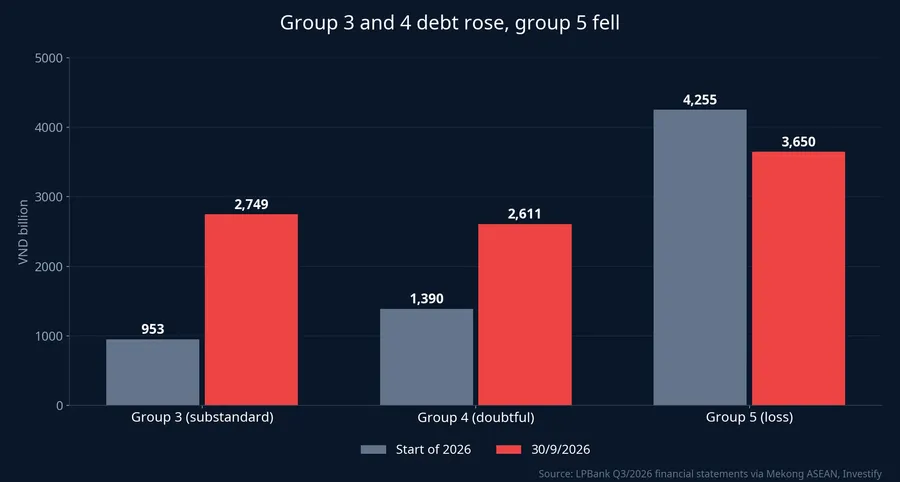
The drop in group 5 may reflect the bank resolving some old debt. More notable is the fast growth of newer debt in groups 3 and 4. Ahead of bad debt, group 2 (special mention) debt also rose 82.7% to VND 6,614 billion. Loan loss provisions cover only about 62.8% of bad debt: for every VND 100 of bad debt, the bank has set aside roughly VND 63.Bloomberg Businessweek VN
The full-year plan and the question for Q4
For the first nine months, LPBank's pre-tax profit was VND 10,420.9 billion, up 8.4%, about 70% of the nearly VND 15,000 billion pre-tax target approved by shareholders in April. That leaves about VND 4,600 billion for Q4, roughly the Q3 level.Thị trường Tài chính Tiền tệ
On paper, LPBank only needs to repeat Q3 to hit the target. But Q3 was the quarter in which net interest income fell, and the increase came from a service line that has not been named. If that income does not recur, Q4 must rely on lending, the very segment squeezed by funding costs and just cut in price for customers. Provisions will also struggle to fall quickly while groups 2, 3 and 4 debt keeps rising.
There are two ways to read this. The optimistic one is that LPBank has opened a new fee stream large enough to offset a thinner interest margin. The cautious one is that Q3 contained a one-off, arriving just as the bank raised provisioning. The available data cannot settle it, because the report does not disclose what "other services" are.
What can be said is that Q3 profit leaned more on fees than on lending income. The deciding variable is whether net fee income holds near VND 3,400 billion a quarter, and the Q4 report will answer that. If it holds, the annual plan has a basis and the new income deserves to count as part of the earnings base. If it drops back toward the VND 853 billion of Q3 2025, then Q3 2026 was a one-off quarter, and LPBank's real story is a thinning margin and rising bad debt.