


DatViet VAC Group Holdings (DatVietVAC) will start trading as DVV on the Ho Chi Minh City Stock Exchange (HoSE) on November 2, 2026, with a reference price of VND 54,800, exactly the IPO offer price. Before that date, the most useful question for both IPO buyers and prospective investors is when in the year the company actually earns its money. DatVietVAC is the business behind Rap Việt, Anh trai say hi and Ca sĩ mặt nạ. In the first half of 2026, its revenue fell while profit jumped, yet the profit booked so far equals only about a third of the full-year plan.
DVV starts trading on November 2
HoSE approved the listing of 111.4 million DVV shares in a decision dated October 20. According to the company's plan, trading begins on November 2, 2026. At the VND 54,800 reference price, the expected market capitalization is about VND 6,106 billion, and the listed value at par is just over VND 1,114 billion.Tuổi Trẻ
DatVietVAC produces Rap Việt, Anh trai say hi, Em xinh say hi, Ca sĩ mặt nạ and 2 ngày 1 đêm.Kinh tế Chứng khoán This is a first listing after a public offering, not a transfer from another exchange. The IPO offered 11.15 million shares, and subscriptions reached 106.6% of the offered volume.Tuổi Trẻ The IPO tranche is only about 10% of all listed shares; the rest belongs to shareholders who held stakes before the offering.
Revenue down, profit up: the answer is in costs and segment mix
According to the half-year financial statements as relayed by Tuổi Trẻ, DatVietVAC posted net revenue of VND 1,366 billion in the first six months of 2026, down almost 15% year on year. Net profit came to nearly VND 135 billion, about 5.8 times the same period of 2025.Tuổi Trẻ
The two opposing moves are explained on the cost side. Cost of goods sold fell almost 21% to VND 1,076 billion, faster than revenue. Consolidated gross margin rose from 19.8% to 21.2% as a result.Tuổi Trẻ Behind the margin is a shift between two business lines.
Media services brought in VND 763 billion in revenue, down 12%. Most of that came from media planning, advertising airtime and outdoor advertising (VND 666 billion), while influencer marketing alone reached VND 97 billion, up 185%. The content segment earned VND 687 billion, up 1%, and within it artist management and commercial exploitation grew fastest at VND 311 billion, up 44%. Event organization and ticketing contributed VND 151 billion, and intellectual property exploitation and related products VND 95 billion.Tuổi Trẻ
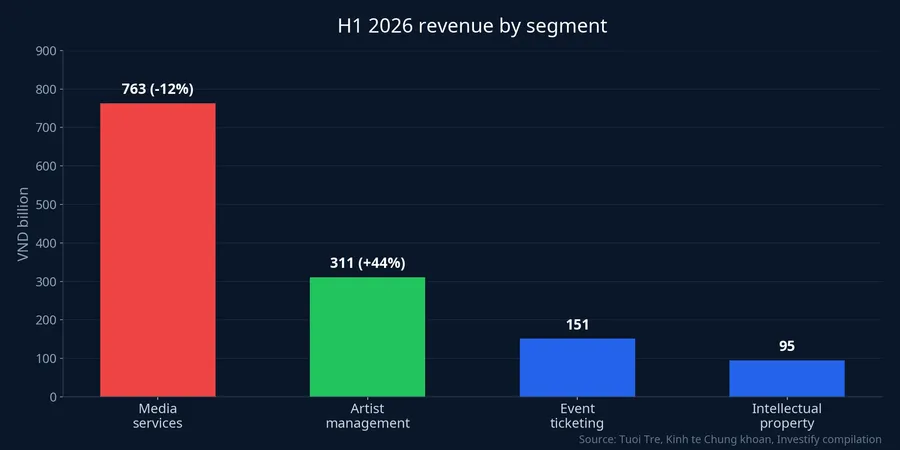
The content segment is where the company earns most of its profit. For full-year 2025 it generated VND 1,727 billion in revenue and about 90% of the group's operating profit.Kinh tế Chứng khoán As advertising shrinks and artist management grows, total revenue falls, but the revenue that remains carries a higher margin.
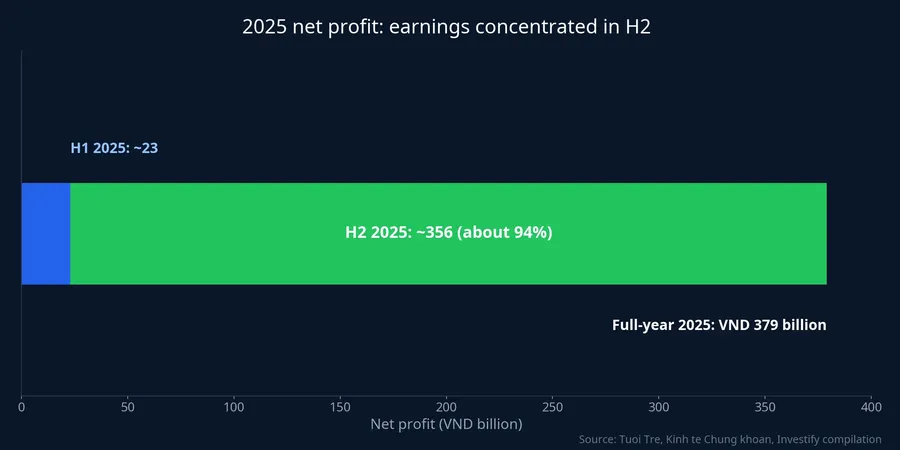
The 5.8x jump also needs to be read against its base. From the two figures Tuổi Trẻ reports (VND 135 billion, about 5.8 times), first-half 2025 profit was only around VND 23 billion. A low base explains a large part of the multiplier. The change in segment mix is therefore the more durable explanation, while "5.8 times" mostly reflects a very thin first half last year.
The VND 420 billion plan and the seasonality question
DatVietVAC targets 2026 revenue of VND 3,382 billion and net profit of VND 420 billion.Tuổi Trẻ Against 2025 net profit of VND 379 billion, the plan implies profit growth of about 10.8%.Kinh tế Chứng khoán Nearly VND 135 billion after six months is about 32% of the plan. The second half must deliver roughly VND 285 billion more, about 2.1 times the first half.
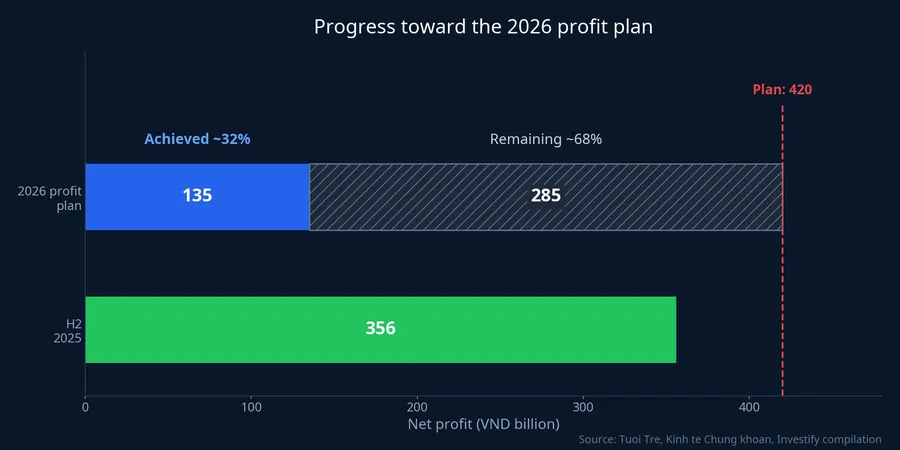
Read in isolation, 32% sounds slow. Set against 2025, the picture changes. If first-half 2025 profit was about VND 23 billion out of VND 379 billion for the year, then the second half of 2025 delivered roughly VND 356 billion, or about 94% of the year's profit (Investify's calculation from the Tuổi Trẻ and Kinh tế Chứng khoán figures). Measured against that, the roughly VND 285 billion needed in the second half of 2026 is about 20% lower.
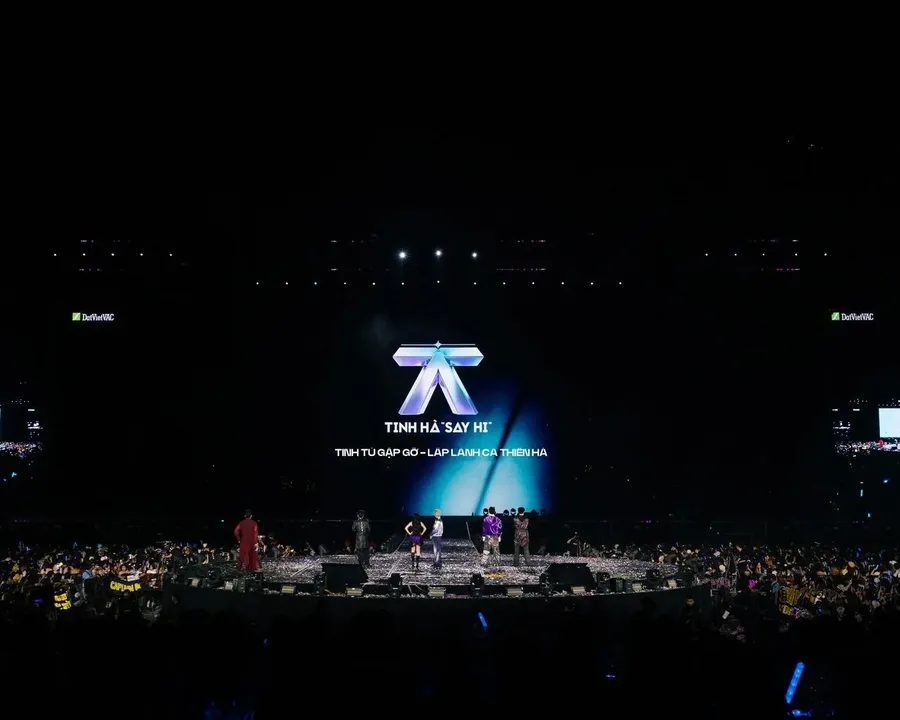
The company itself explains this through seasonality. According to DatVietVAC, most revenue and profit in entertainment concentrate in the second half, when shows air and concerts are staged. For the second half of 2026 it plans at least 6 large concerts, including four Tinh Hà Say Hi nights already announced for October and November.Tuổi Trẻ It is also bringing the Vũ Trụ Say Hi concert back to Las Vegas in November under a licensing model.Báo Pháp luật
The comparison with 2025 has limits. It rests on a rounded multiplier, and no quarterly profit series has been published to cross-check it. First-half revenue this year also fell almost 15%, so there is no basis to assume the second half will repeat last year's scale. What the comparison does show is this: 32% after six months is not enough to conclude that the annual plan is hard or easy to reach.
Where the IPO money goes and what the balance sheet shows
Under the use-of-proceeds plan, the capital raised goes mainly to subsidiaries: about VND 528.5 billion to DatViet VAC Media and VND 36.5 billion to DatViet VAC Entertainment.Tuổi Trẻ Most of the new money therefore flows into the media arm, the very segment whose revenue fell in the first half. The press sources do not yet detail spending items inside each subsidiary.
Even before the IPO proceeds, the balance sheet was cash-rich. At the end of June 2026, DatVietVAC had total assets of VND 2,185 billion, of which cash, cash equivalents and term deposits were VND 1,256 billion. Short-term borrowings stood at VND 491 billion, with no long-term debt.Tuổi Trẻ Cash is about 2.6 times borrowings.
The company plans a cash dividend of VND 2,500 per share in December 2026, about 4.6% of the IPO price.Báo Pháp luật This remains a company plan, and the record date has not been announced in the press sources. Over the longer term, DatVietVAC targets about VND 5,000 billion in revenue and VND 780 billion in net profit by 2030,Tuổi Trẻ with roughly 20-30% of revenue coming directly from end users through tickets, artist merchandise and brand licensing.Kinh tế Chứng khoán
What IPO buyers will see from the November 2 session
For anyone who paid for shares in the IPO, November 2 is the first time those shares have a trading price on the exchange. The first-session reference price equals exactly VND 54,800, the price they paid, so the profit-and-loss on their account starts at zero. From then on, the price each session is set by supply and demand. The first-session price band will follow HoSE's official announcement before the trading date.
One point on liquidity: the IPO tranche is only about 10% of listed shares, and most of the rest sits with existing shareholders. How many shares are actually available in the first sessions depends on whether those shareholders sell, and no data on that has been published.
This article makes no forecast of DVV's price. The next figure to watch is the Q3 2026 financial statement, the first reporting period to reflect the second-half season of shows and concerts. If Q3 and Q4 profit together approach the roughly VND 285 billion mark, the VND 420 billion plan has a basis. If Q3 profit stays at the first-half pace, the burden falls almost entirely on Q4, and the 2025 seasonal pattern is no longer a firm anchor.