


A bank that trims its counter rate but still adds a bonus for large depositors on its app has cut the posted rate, not necessarily the interest it actually writes into contracts. Official Letter 9736/NHNN-CSTT, dated October 21, 2026, targets exactly that gap. What the State Bank of Vietnam (SBV) tracks is the average rate each bank actually pays on new deposits with tenors of six months or longer, across every sales channel, measured against that same bank's own level during October 11–20.
Three days earlier, Letter 9608 of October 18 had already asked banks to cut posted rates. The new letter does not add another cut. It changes the yardstick, and the new yardstick is much harder to game.
What Letter 9736 requires
According to FireAnt's account of the October 21 document, the SBV told commercial banks to ensure a genuine cut in deposit and lending rates "across the whole system, on all sales channels". The instruction builds on the Governor's directive at the October 19 meeting and on Letter 9608.FireAnt
The most specific part: banks must cut the average deposit rate on newly originated transactions by at least 0.5% a year, for tenors of six months and above, during the closing months of 2026. The baseline is the bank's own rate in the reporting window of October 11–20, 2026.FireAnt
That sentence has three parts: the yardstick, the baseline and the scope. Each one closes a loophole that posted rates leave open.
The yardstick: from the board to interest actually paid
A posted rate is the number a bank puts on its counter board or website. The average rate on new transactions is the mean of what the bank actually books into deposit contracts opened during the period. One is the sticker price, the other is the price on the receipt, and the two can sit far apart.
Not every depositor gets the board rate. Apps often carry their own, higher schedule. Large deposits may earn a top-up. Some customers negotiate individually. On October 21 alone, SeABank cut its schedule yet still added 0.2 percentage points for deposits of VND 100 million or more at 6, 12 and 13 months. MBV kept its online rate for 7–36 months at 7% a year, while its counter rate for 6 to under 12 months fell to 6–6.5% a year.VietNamNet
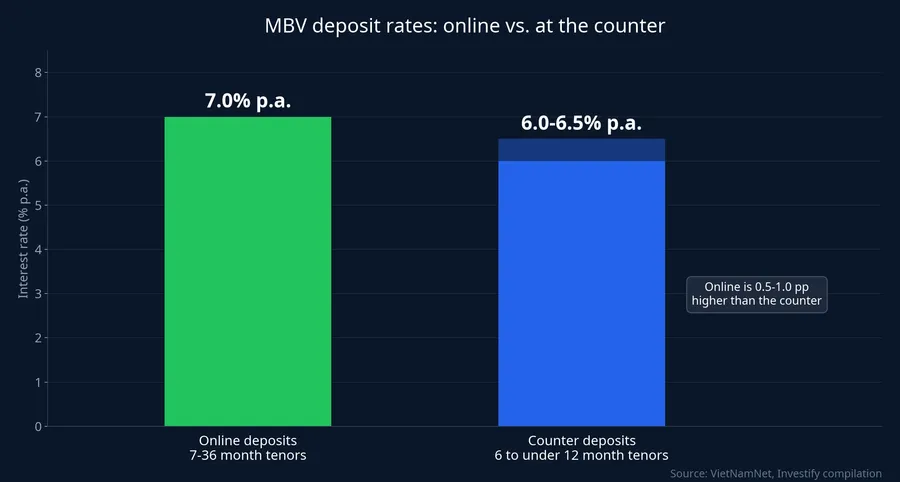
That gap is what Nguyễn Hưng, General Director of Tien Phong Commercial Joint Stock Bank (TPBank), pointed to at the October 19 meeting with the Governor. He said adjusting posted rates is necessary, but what matters more is whether banks' actual funding costs fall. The report also noted that in recent months many banks have drawn deposits with bonus or negotiated rates, pushing what depositors actually received close to 10% a year.FireAnt If posted rates fall while off-board perks stay, funding costs are unlikely to fall in step.
Measured by average rate actually paid, all of those perks count: cutting the counter rate while still paying more through the app leaves the average too high.
The baseline: each bank's own earlier level
The letter sets no single system-wide ceiling. Each bank compares itself with its own October 11–20 window. A bank already paying high must cut from its high level and cannot argue that its rate was already under some threshold.
Most of that window fell before the large banks changed their schedules: Vietcombank and Agribank from October 20, BIDV and VietinBank from October 21.CafeF So the baseline reflects rates before the cuts had largely taken place. A 0.5-point cut from the old level still leaves differences between banks, only with the overall level lower than before.
The scope: every channel, tracked through statistical reports
The phrase "on all sales channels" puts online deposits into the same measurement as counter deposits. A bank cannot cut in one channel, hold in another and still hit the average.
Monitoring does not rely on rates posted on websites. According to FireAnt, the SBV will track average rates on new transactions during the closing months of the year through the statistical reporting system under Letter 6194/NHNN-DBTK of August 7, 2023.FireAnt That reporting channel has existed since 2023, so the data is compiled from actual deposits, not from posted schedules.
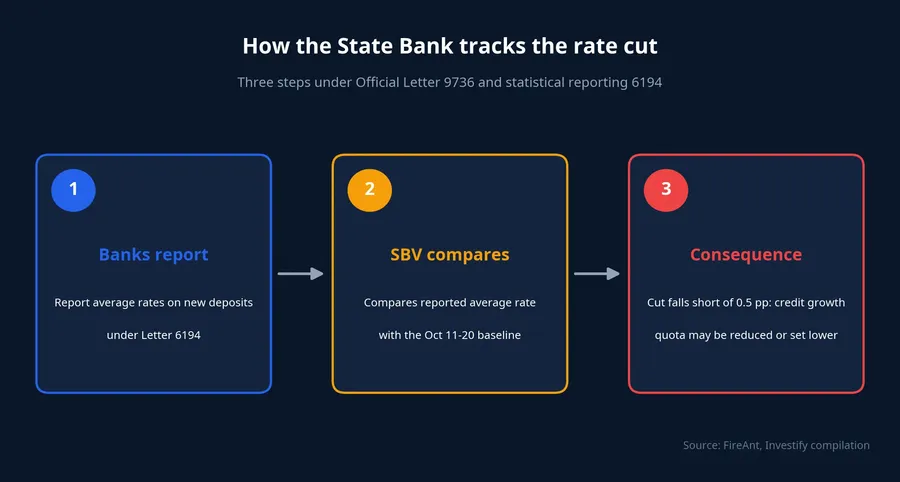
The consequence is also spelled out. Banks are made responsible "before the law, before the Governor of the State Bank and competent authorities" for lowering the general rate level. If they fail to comply, the SBV will deal with them strictly, "including considering reducing or assigning lower credit growth targets".FireAnt
A credit growth target decides how much more a bank can lend for the rest of the year, so compliance ties directly to lending headroom, not just to funding costs.
Counter rates have moved first
On posted rates, the large banks have already cut. BIDV and VietinBank each lowered counter deposit rates by 0.5 percentage points for tenors of six months and above. At BIDV, the 6- and 9-month rate is now 3% a year, from 3.5%. The 12–18 month rate is 5.4%, from 5.9%. The 24- and 36-month rate is 5.5%, from 6%. VietinBank moved to the same levels for the corresponding tenor groups.CafeF
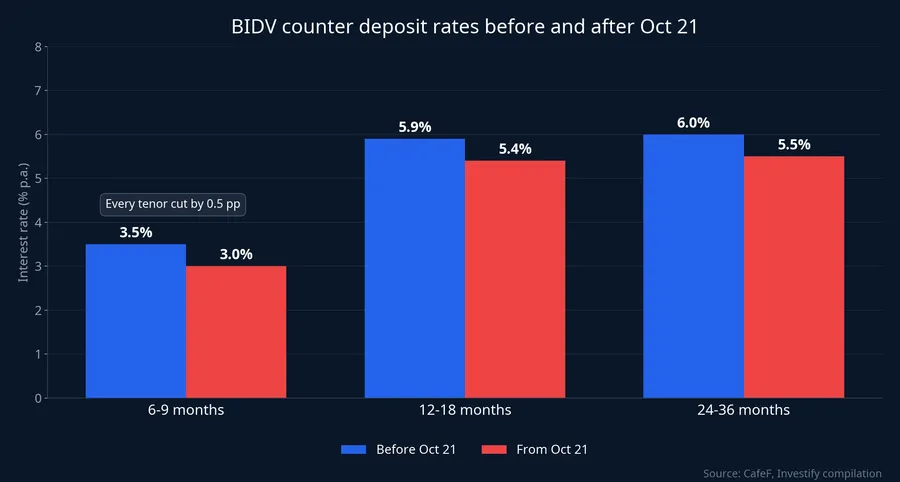
Tenors under six months, outside the letter's scope, were left unchanged by both banks: 2.1% a year for 1–2 months and 2.4% for 3 to under 6 months.CafeF
Whether app rates, bonuses and negotiated deals have fallen too, the counter board cannot say. That is the part Letter 9736 puts into the measurement.
Limits of the new yardstick
Taken together, the familiar workarounds are blocked: cut the board but keep the bonus, and the average stays high; cut at the counter but hold on the app, and both channels still count together.
There are limits. This is an average, so a bank can cut deeply for one customer group and lightly for another as long as the overall mean falls 0.5 points. The letter only says "the closing months of 2026", and the press accounts do not mention monthly milestones. Which bank cut in which channel, and what the November average really looks like, is not yet known.
Where depositors are affected
The measure applies to newly originated transactions. Someone holding a term deposit of six months or more that has not matured falls outside it, because that deposit follows the terms agreed when it was opened.

Those affected are people opening new deposits or rolling over from late October, with tenors of six months or more. For this group, the average rate each bank pays on new deposits must sit at least 0.5 percentage points a year below that bank's own level in October 11–20, whether the deposit is made at the counter or online. Any off-board bonus that remains counts in the calculation too. Customers used to depositing online or in large sums are the likeliest to notice a difference, since the premium above the board rate is exactly what the old yardstick could not see.
On the other side, borrowers financing production and business may benefit: if banks' funding costs truly fall, there is more room to lower new lending rates.
Letter 9736 makes it harder for rate cuts to stop at the posted board, even if averaging leaves some slack. The real size of the cuts will only show once average-rate data on new transactions for the closing months of the year is available. At that point, the figure to hold against the October 11–20 baseline is the interest actually paid, not the rate on the board.