

On October 21, FPT reported its nine-month 2026 results: revenue of VND 40,023 billion, up 12.4%, and pre-tax profit of VND 8,770 billion, up 17%.CafeF Profit after tax attributable to the parent's shareholders reached VND 7,778 billion, up 13.3%, and earnings per share (EPS) came to VND 4,142, up 12.8%.Dân trí
Profit growing faster than revenue is usually read as a company running more efficiently. For FPT this year, the answer is more nuanced. Broken down by business line, the software and IT services segment serving overseas clients, which generates most of the revenue, accounts for only about a third of the extra profit. The rest comes from a much smaller domestic business and from companies in which FPT holds only a minority stake.
What the 17% Is Measured Against
Before reading any FPT growth figure for 2026, you need to know about a change in accounting. This year FPT began recording FPT Telecom under the equity method, which is used for associates and joint ventures.CafeF The group no longer adds all of FPT Telecom's revenue and costs into its consolidated statements. It books only the share of profit matching its ownership stake.
The direct result is that consolidated revenue is noticeably smaller than in prior years. To keep comparisons fair, FPT restated its 2025 figures using the same method.Dân trí Every growth rate in this article is measured against the restated 2025 base. Put VND 8,770 billion next to the nine-month 2025 figure originally reported on the old consolidated basis and you would see a decline that does not exist, because the two numbers cover different scopes of the business.
Working back from the 17% increase, restated nine-month 2025 pre-tax profit comes to roughly VND 7,496 billion. FPT therefore earned about VND 1,274 billion more than a year earlier. The remaining question is where that money came from.
Nearly Half the Extra Profit Came From the Segment With Falling Revenue
FPT splits its operations into two blocks. The Technology block, covering IT services at home and abroad, posted revenue of VND 35,515 billion, up 14.8%, and pre-tax profit of VND 5,052 billion, up 16.6%. It makes up 89% of revenue but only about 58% of group pre-tax profit.CafeF
The other block is Education, Investment and Other. Its revenue fell 3.1% to VND 4,508 billion, yet pre-tax profit rose 17.6% to VND 3,719 billion. According to FPT, this was mainly due to double-digit profit growth at its associates and joint ventures. FPT Telecom sits in this group since the accounting change.CafeF
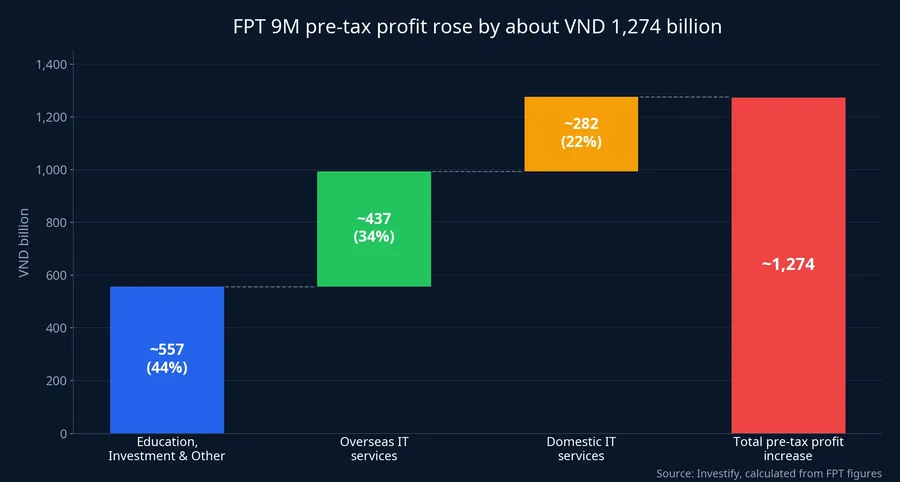
Working back from the growth rates FPT disclosed, the Technology block added about VND 719 billion, and Education, Investment and Other added about VND 557 billion. Together they add up to the roughly VND 1,274 billion total. Put differently, about 44% of the extra profit came from the block whose revenue went backwards, and much of that is profit shared from companies FPT does not fully run itself.
That does not make the profit any less real. Earnings from associates still belong to FPT shareholders in proportion to ownership. But they follow the business rhythm of those companies, such as FPT Telecom's internet and TV operations, rather than the rhythm of FPT's software contract wins.
Domestic IT: A Small Segment With Profit Doubling
Within the Technology block, the domestic segment is where profit grew fastest. Revenue reached VND 6,977 billion, up 29.8%, and pre-tax profit reached VND 542 billion, up 108.5%.CafeF Backing out the prior-year base, the segment earned about VND 260 billion a year earlier, so it added about VND 282 billion this year.

The domestic segment is only about 17% of group revenue yet contributes about 22% of the extra profit (calculated from FPT's figures). FPT attributes the result to large-scale digital transformation projects for government and enterprise clients, plus better operating efficiency and project mix.Dân trí
The doubling can be read two ways. One is that FPT is winning more public-sector projects with better margins as government digitization accelerates. The other is that part of the jump comes from a low base: this year's domestic pre-tax margin is about 7.8%, only half that of the overseas segment (calculated from FPT's figures). The available data cannot separate the two. What seems clear is that the domestic segment will struggle to sustain profit growth above 100% next year, since the comparison base has doubled.
Overseas: Slowest Profit Growth, Fastest-Growing New Contracts
The overseas IT services segment is FPT's largest. Nine-month revenue reached VND 28,538 billion, up 11.6%, more than seven-tenths of group revenue.CafeF FPT does not report this segment's profit separately. Subtracting the domestic segment's profit from the Technology block's leaves overseas profit of about VND 4,510 billion, up roughly 10.7% year on year. That is the slowest growth among the segments and clearly below the group's 17%.
At the other end, new contracts signed in the overseas segment totaled VND 36,137 billion, up 23.1%. Over the nine months FPT won 16 projects each worth more than USD 10 million. New signings were about 1.27 times recognized revenue and growing twice as fast.CafeF
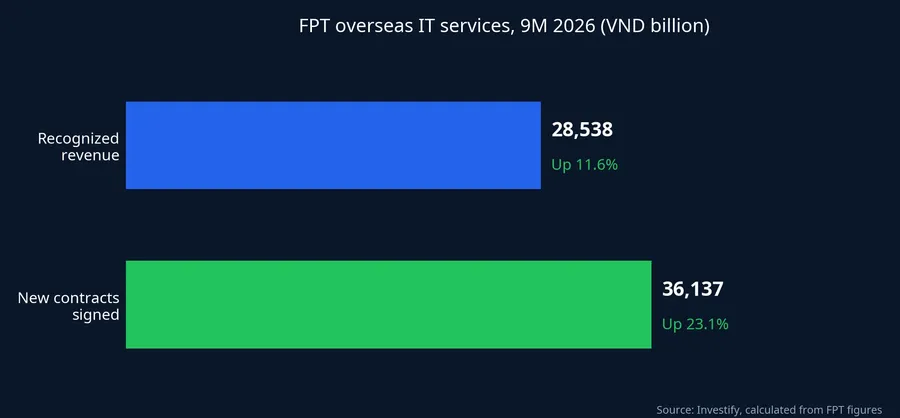
New signings are contract value just signed, not revenue. A large contract is usually recognized over several quarters, sometimes years. So the gap between 23.1% and 11.6% shows that contracted workload is building up faster than FPT converts it into revenue. It does not say whether that workload will be recognized in the fourth quarter or spread into 2027 and 2028.
Within the overseas segment, newer services are growing faster than the average. Overseas digital transformation revenue reached VND 14,411 billion, up 16.3%. AI and data analytics alone reached VND 2,915 billion, up 55%, though that is still only about a tenth of overseas revenue.CafeF
Japan Grows Strongly, but the Exchange Rate Takes a Cut
Japan remains the lead market. Revenue from Japan rose 17.2% in Vietnamese dong terms, equal to 25.2% in yen terms.CafeF The gap of about 8 percentage points is what the exchange rate took away. Japanese clients paid FPT more yen, but each yen bought fewer dong than a year earlier, so growth shrank once translated into the reported figures. For a company earning most of its revenue abroad, this is outside management's control: the workload really grew, but the reported number also depends on the exchange rate.
What This Means for FPT Shareholders
The 17% growth is real on the restated base. But the largest segment, overseas IT services, grew profit only about 10.7%. What lifted the group figure to 17% was the domestic segment's doubling and profit shared from associates. Both are genuine sources, but both are hard to repeat at the same pace: the domestic segment because its base is now higher, the associates because they follow another company's cycle.
The foundation for the coming years therefore rests on overseas new signings, up 23.1%. If that workload converts steadily into revenue, overseas revenue growth would need to edge up from 11.6%. The fourth quarter and full-year 2026 results are the first test.
Results have not yet shown up in the share price. On October 21, as the VN-Index rose 2.76% to 1,738.67 points, FPT closed at VND 57,400, about 33% below its last session of 2025 on an adjusted basis. Since the start of the year, foreign investors have net sold about 180 million FPT shares, worth more than VND 14,700 billion.VietTimes
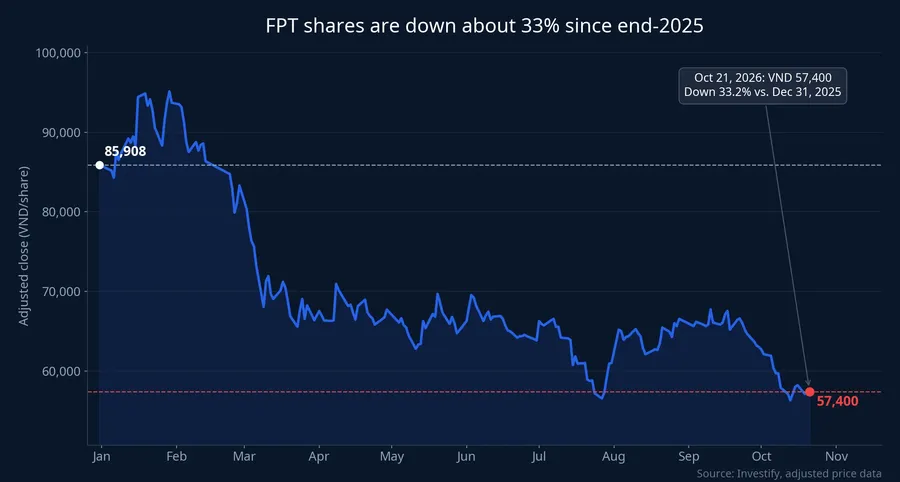
The decline could stem from several reasons at once: foreign capital leaving the broader market, lower valuations across global IT services peers, or concerns about FPT's own growth rate. The data in this article cannot determine which weighs most, and the article offers no view on price.
For anyone holding FPT, or a fund with FPT in its portfolio, the most useful indicator when full-year results arrive is the growth rate of overseas IT revenue. If it rises above 11.6%, signed contracts are turning into revenue and FPT's profit growth stands on firmer ground. If it stalls or slows, overall growth will keep depending on the domestic segment and on profit from associates.