

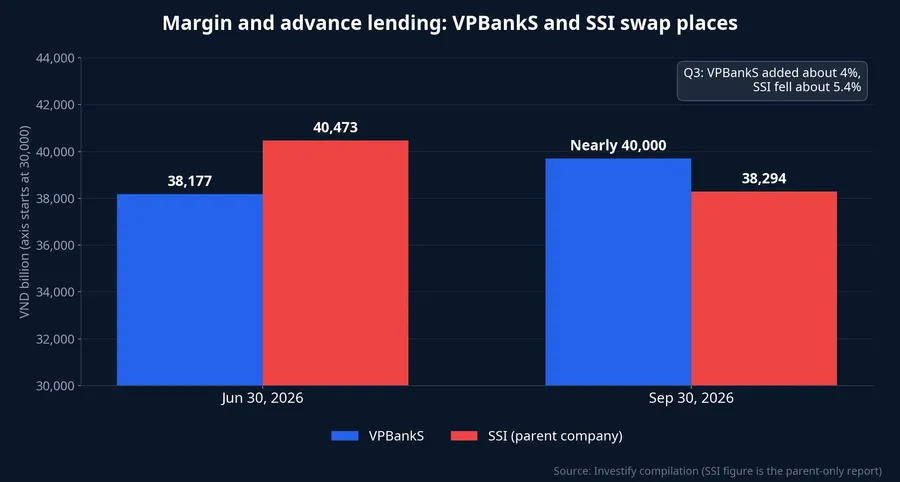
As of September 30, 2026, margin and advance lending at VPBank Securities (VPBankS, ticker VPX) stood at nearly VND 40,000 billion, against VND 38,294 billion at parent-company SSI. Three months earlier the order was reversed: at the end of Q2, SSI had lent VND 40,472.6 billion and VPBankS VND 38,177.2 billion.
The two firms swapped places by moving in opposite directions in a quarter when market liquidity declined. VPBankS added about 4% on Q2. SSI pulled back roughly VND 2,179 billion, or about 5.4% (derived from the two figures above). This piece puts the two side by side on the same measures at September 30: lending relative to equity, revenue sources and profit. The finding is that lending more does not mean earning more.
The comparison holds only on SSI's standalone numbers
The VND 38,294 billion figure comes from SSI's standalone Q3 financial statements, covering the parent company only. SSI has not yet published consolidated Q3 accounts; at group level it has only issued revenue and profit estimates for nine months, per CafeF. Because margin lending sits in the parent brokerage, the gap between standalone and consolidated figures is usually small for this line. Even so, "VPBankS lends more" is true only on this measure, on this date.
Brokerage rank does not tell you who lends more either. In Q3, SSI held an 11.09% share of HOSE brokerage, while VPBankS says only that it is among the top 10 firms by market share. A firm with less brokerage can still lend more if it has the capital and chooses to deploy it into lending.
How much each dong of equity is lent out
VPBankS's equity at the end of Q3 was nearly VND 36,300 billion. SSI parent's equity was VND 38,057 billion, up 22.5% from the start of the year. Dividing loans by equity, VPBankS lends about VND 1.1 per dong of equity and SSI about VND 1. SSI's own release describes its loan book as "roughly equal to the parent company's equity".
Under the State Securities Commission's margin-trading rules, a brokerage's total margin loans may not exceed 200% of equity. VPBankS says its current capital leaves nearly VND 33,000 billion of headroom. That matches twice equity (about VND 72,600 billion) minus the roughly VND 40,000 billion loan book, although the company does not state its method. The real cap may differ slightly because the rules use equity from the latest audited or reviewed statements.
So neither firm has hit the legal ceiling. SSI's decline in Q3 reflects a choice by the company or its borrowers, not a lack of room.
Where the money comes from: two different revenue mixes
At VPBankS, out of nine-month revenue of nearly VND 10,600 billion (almost double a year earlier), margin lending brought in more than VND 3,000 billion, or 28% of the total and 2.5 times the prior year. Issuance advisory contributed more than VND 1,600 billion, up 73%. Brokerage earned only VND 341 billion, up 10%. Among the named lines, margin is the largest, nearly nine times brokerage.
The rest of the total, a little over VND 5,600 billion, is not itemised in the release. In the half-year data, revenue outside margin, advisory, brokerage and proprietary trading was already VND 3,257.6 billion of VND 6,969.1 billion. News coverage has not explained this large block, and readers should keep that in mind.
At SSI parent, Q3 operating revenue was VND 3,079 billion. Investing brought in VND 1,414 billion, about 46% of the quarter. Margin lending earned VND 1,115 billion, up 11% year on year, and brokerage plus advisory VND 382 billion. SSI's portfolio of financial assets at fair value through profit or loss is worth over VND 43,100 billion, nearly 98% of it bonds and certificates of deposit.
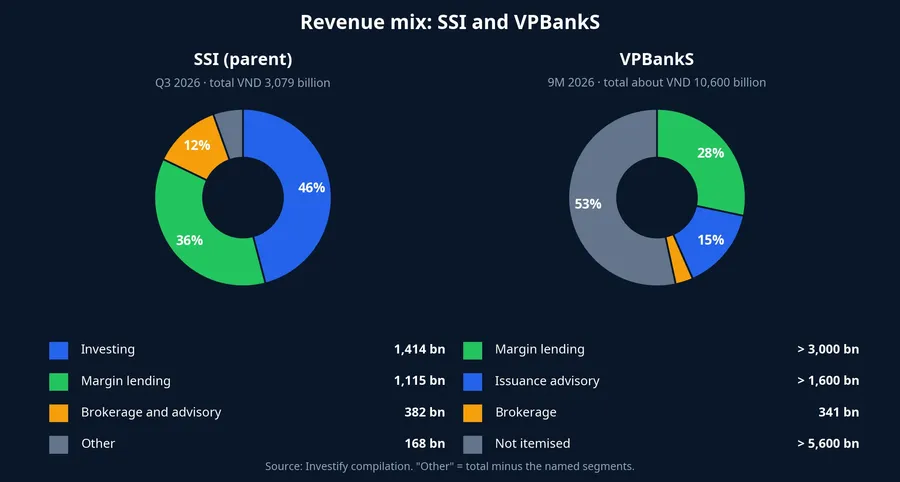
Side by side, Q3 margin interest at the two firms is almost equal, around VND 1,100 billion (VPBankS's figure is nine-month revenue minus the half-year VND 1,904.1 billion). The difference is everything else: SSI has an investing line larger than its margin line, while VPBankS leans on margin and issuance advisory.
Nine-month profit up about 8% at both, Q3 down at both
On paper, nine-month profit growth is nearly identical. VPBankS earned VND 3,516 billion pre-tax, up 8%. SSI parent earned VND 4,268 billion, up 8.2%. On a consolidated basis SSI estimates nine-month pre-tax profit of VND 4,510 billion, up 11% and 77% of its full-year plan.
Isolating Q3 changes the picture. VPBankS's first-half pre-tax profit was VND 2,673.4 billion; subtracting that from VND 3,516 billion leaves about VND 843 billion for Q3, against VND 2,360.1 billion in Q3 2025. That is a drop of about 64% year on year. SSI fell too, but less: per its consolidated estimate, Q3 pre-tax profit was VND 1,388 billion, down 24%. The standalone report shows VND 1,295 billion.
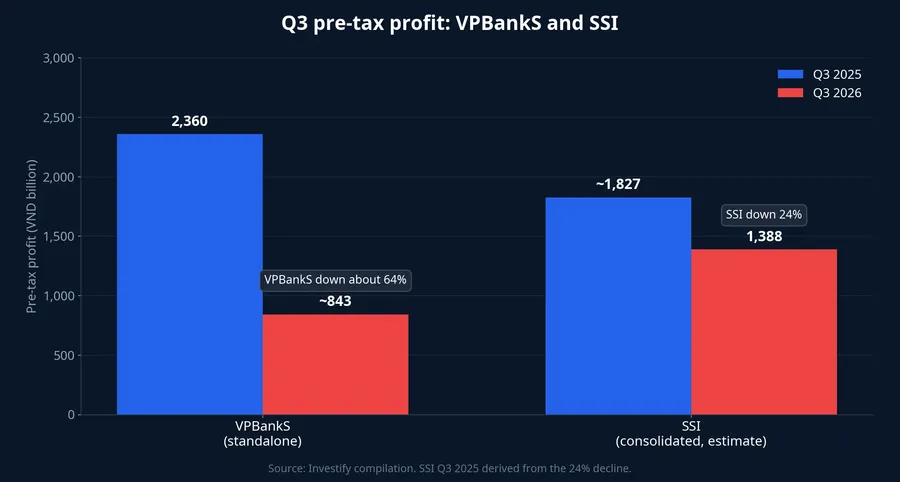
This explains the gap between near-doubled revenue and profit up only 8% at VPBankS. First-half pre-tax profit had already nearly tripled (up 197%). The 8% nine-month gain is what remains after a sharp Q3 decline against a very strong Q3 a year ago.
Which costs ate into Q3 profit has not been itemised in coverage. The half-year report offers one clue: VPBankS's H1 interest expense was VND 1,445 billion, more than 3.2 times the prior year, while margin interest revenue rose about 2.9 times. Borrowing costs have grown faster than interest collected from borrowers.
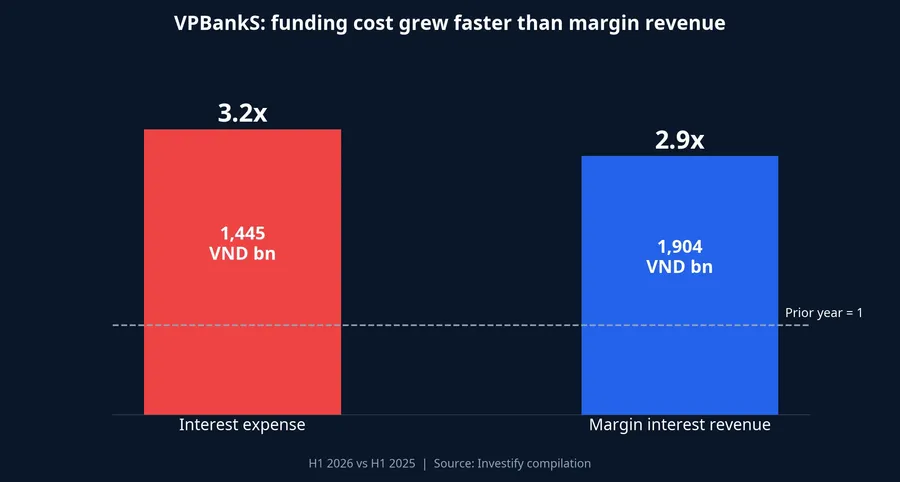
Q3-only interest expense, operating costs and provisions must come from the notes to the financial statements, so the 64% decline cannot yet be pinned on any single cost. There is another plausible reading: Q3 2025 may have been boosted by proprietary trading or one-off income, in which case much of the drop comes from the comparison base rather than funding costs. The available data do not say which explanation weighs more.
Funding the loan book
Lending more than your equity means borrowing. VPBankS raised a USD 200 million international syndicated loan in the first half of 2026. In late September its board approved a further USD 150 million syndicated loan led by SMBC, its strategic shareholder, with an option to upsize. SSI also borrows from banks, financial institutions and capital markets to fund both margin lending and investing; its funding unit booked VND 83 billion of pre-tax profit in Q3, up 33%.
Margin profit therefore depends not only on the rate charged to borrowers but on the spread over what the firm pays its own lenders. A USD loan adds exchange-rate exposure and hedging cost, depending on how the company handles it.
What this means for borrowers and shareholders
For someone borrowing on margin, a brokerage's total lending does not directly change the rate or lending ratio on their account. What matters is that both firms have headroom, so a regulatory cap forcing a near-term squeeze is unlikely. The bigger risk sits in the account itself: when pledged shares fall, borrowers face margin calls, and if many clients are force-sold together, the lender bears credit risk.
For shareholders, the two profit structures differ sharply. At VPBankS, profit follows the size of the margin book and borrowing costs more than brokerage liquidity, since brokerage is a small slice of revenue. At SSI, bond and certificate-of-deposit investing earned more than margin in Q3, so earnings are tied more closely to that portfolio and the interest-rate level.
The thesis: VPBankS's larger margin book is a snapshot at September 30, not proof of better profit. Q4 reports will test it through specific gauges: both firms' margin balances, VPBankS's interest expense against margin interest revenue, and quarterly pre-tax profit. If VPBankS's book keeps growing while interest expense slows, the larger loans are turning into profit. If interest expense keeps outgrowing margin revenue, scale is doing little for shareholders. This article makes no call on the direction of VPX or SSI shares.