

To meet its 2026 profit plan, VIX Securities (HOSE: VIX) needs to earn about VND 2,400 billion after tax in the fourth quarter alone. That is close to Q3/2025, the company's own record quarter, and nearly 14 times the profit it just reported for Q3/2026.
The numbers: on the evening of October 19, VIX published its standalone Q3/2026 financial statements. Net profit came to just under VND 174 billion,Người Quan Sát down 93% from VND 2,449 billion a year earlier.Mekong Asean Over nine months, net profit is VND 388 billion, just under 14% of the VND 2,800 billion plan. The gap is roughly VND 2,412 billion.Mekong Asean
This piece is not about VIX's share price. The question is what the business actually earns money from, and why the full-year result now rests on a single figure: the value of the proprietary portfolio on December 31.
Q3: where the profit came from and where it went
Operating revenue in Q3 was over VND 2,047 billion, down 36% year on year. Pre-tax profit was about VND 192 billion, down 94%.CafeF
Proprietary trading dragged profit down the most. The segment lost VND 87 billion in Q3, against a gain of more than VND 2,700 billion in Q3/2025.Người Quan Sát Once trading expenses of over VND 7 billion are included, Mekong Asean puts the net loss at VND 94 billion.Mekong Asean The two figures differ because of how they are calculated, but they point the same way.
Two things moved inside that loss. Gains from selling proprietary assets fell from VND 1,375 billion to VND 89 billion,Báo Pháp luật meaning the company took very little profit in the quarter. At the same time, marking the portfolio to market at quarter-end produced a revaluation loss of roughly VND 1,363 billion, versus a revaluation gain of about VND 189 billion a year earlier.Báo Pháp luật Most of this is a paper loss: the assets were not sold, but their September 30 prices were lower than at the previous recording date, and the difference flows straight into earnings.
Brokerage fell nearly 60%, with revenue of just over VND 37 billion. After costs, the segment earned about VND 21 billion net.Mekong Asean Weak market liquidity is the explanation the press cites most. Still, the segment is too small to account for a 93% drop in profit.
Margin lending kept quarterly profit in positive territory. Interest from loans and receivables was over VND 337 billion, in line with a year earlier, plus nearly VND 28 billion from held-to-maturity investments. Across nine months, VIX collected VND 1,035 billion in lending interest, up 44% year on year.Mekong Asean
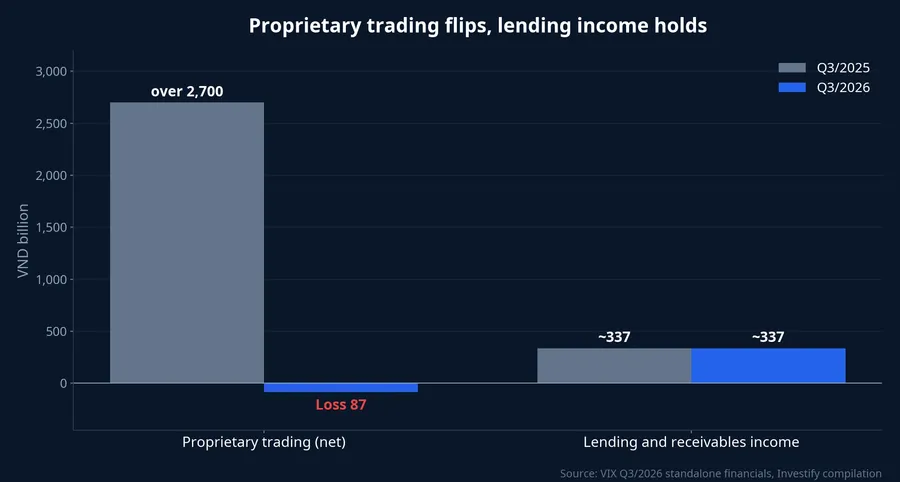
Put side by side, the answer is fairly clear. Brokerage and lending are not the source of the decline. Q3 profit fell almost entirely because proprietary trading reversed, from a segment earning thousands of billions to one posting a loss.
The balance sheet shifts: lending shrinks, proprietary book swells
The balance sheet explains why each quarter's result is increasingly sensitive to share prices. At September 30, 2026, VIX's total assets were nearly VND 39,860 billion, up 17% from the start of the year. The proprietary portfolio had a fair value of VND 23,099 billion, up 58% since the start of the year and about 58% of total assets. Loans made up 31%.Người Quan Sát
Margin and sales-advance loans moved the other way. The balance at end-September was about VND 12,422 billion, down from VND 15,380 billion at the start of the year.Mekong Asean By our own calculation from those two figures, the decline is about 19%. Some reports say "nearly 24%", but that figure comes from dividing the start-of-year balance by the end-of-quarter balance, which runs the calculation backwards.
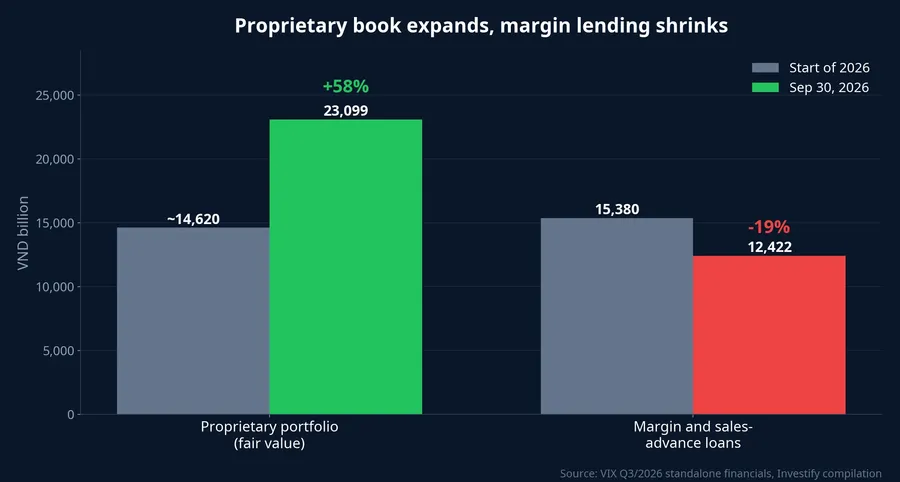
A falling loan balance can come from two sides. Investors borrow less when liquidity is weak, the explanation Người Quan Sát offers. The other is the company itself shifting capital toward proprietary trading. The report does not say how much each side contributes, so it is not possible to conclude that the company deliberately cut lending.
The funding side changed shape too. Equity rose from VND 21,455 billion to nearly VND 32,866 billion, an increase of more than VND 11,400 billion, while total liabilities fell from over VND 12,712 billion to nearly VND 6,995 billion.Mekong Asean In short, VIX used fresh capital to pay down borrowings and expand the proprietary book by roughly VND 8,500 billion, while the loan balance fell by nearly VND 3,000 billion.
The upshot is that company profit leans more on a price-driven segment. Lending interest of about VND 337 billion a quarter is a relatively steady stream. On a portfolio of more than VND 23,000 billion, a 1% move across the board would create a swing of about VND 230 billion, larger than Q3's entire net profit. That is an illustration of sensitivity, not a forecast.
What the portfolio holds
At September 30, the proprietary portfolio had a cost basis of more than VND 19,433 billion, and a fair value about VND 3,666 billion above cost.Mekong Asean That gap is not evenly spread:
- Listed shares: cost over VND 11,741 billion, fair value over VND 12,311 billion, an unrealized gain of about VND 570 billion, under 5% of cost. This is the part whose price changes every session on the trading board.
- Entrusted investments: cost over VND 4,987 billion, fair value about VND 7,603 billion, an unrealized gain of more than VND 2,600 billion. Most of the portfolio's unrealized gain sits here.
- Unlisted shares: cost nearly VND 1,568 billion, fair value over VND 2,049 billion, an unrealized gain of about VND 480 billion.
- Unlisted bonds: cost over VND 1,136 billion.
The Q3 report does not itemize the equity investment portfolio by ticker.Mekong Asean So there is currently no data showing which stocks or sectors hold most of the VND 1,363 billion revaluation loss, and this piece does not speculate.

What stands out is the structure. The listed-share book, the part most sensitive to the market, sits only slightly above cost. The big unrealized gain is in entrusted investments, a line where a reader of the report cannot see what is inside.
The annual plan is loaded onto Q4
For 2026, VIX set a net profit target of VND 2,800 billion, 48% below the record VND 5,410 billion of 2025.Mekong Asean After nine months, just under 14% has been achieved.
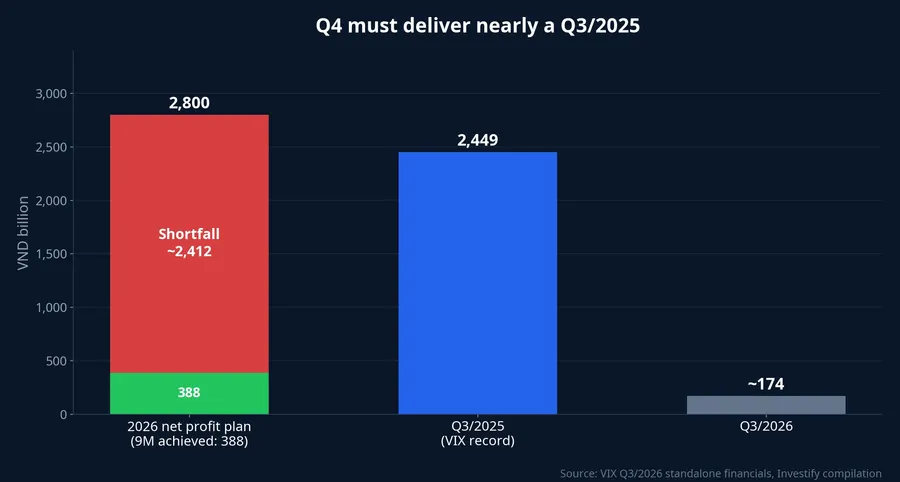
To hit the plan, Q4 has to deliver about VND 2,412 billion in net profit. With lending interest around VND 337 billion a quarter and brokerage shrinking, most of the shortfall would have to come from proprietary trading, through realized gains or a portfolio that is worth more than on September 30. For market context, on October 19, the day VIX reported, the VN-Index closed at 1,689.84, down 0.94%, losing the 1,700 level. One session says little about a whole quarter, and the portfolio's price on December 31 is the number that goes into the books.
The thesis here is simple: VIX's profit this year no longer tracks the number of new accounts or the loan balance, but the price of the proprietary portfolio on December 31. If the portfolio rebounds strongly and the company books gains, Q4 could close most of the gap, as Q3/2025 once delivered over VND 2,400 billion. If portfolio prices stay flat or fall, full-year profit will land well below plan, and the question becomes whether the shareholders' meeting has to revise the target.
The Q4 financial statements, expected in January 2027, will settle it. Two lines to check first: the revaluation gain or loss on proprietary assets, which shows whether Q4 rescued the plan, and the year-end margin loan balance, which shows whether the company keeps tilting toward proprietary trading in 2027.