

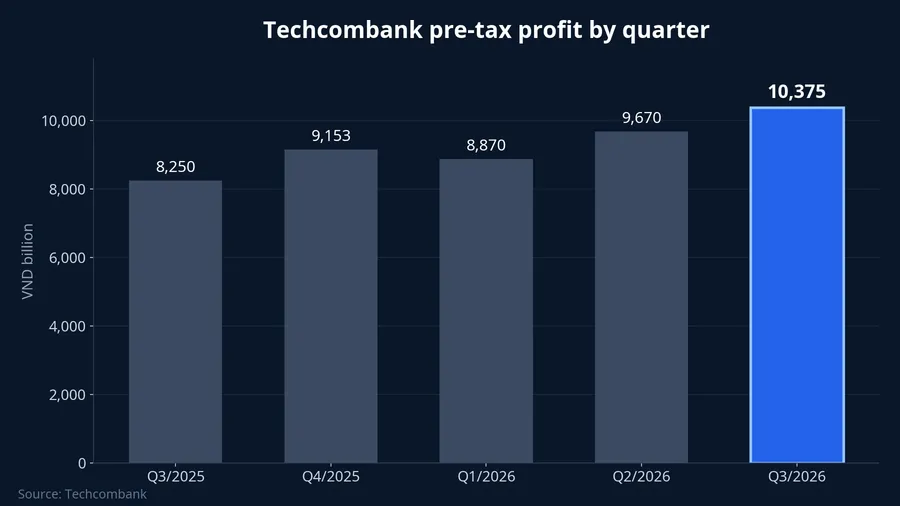
On October 20, Techcombank (TCB) reported Q3 2026 pre-tax profit of VND 10,375 billion, the highest quarterly figure in the bank's history. That is up 25.8% from a year earlier (VND 8,250 billion) and roughly 7.3% above the previous high of VND 9,670 billion set in Q2 2026.Techcombank For the first nine months, pre-tax profit reached VND 28,915 billion, up 23.7%.Techcombank
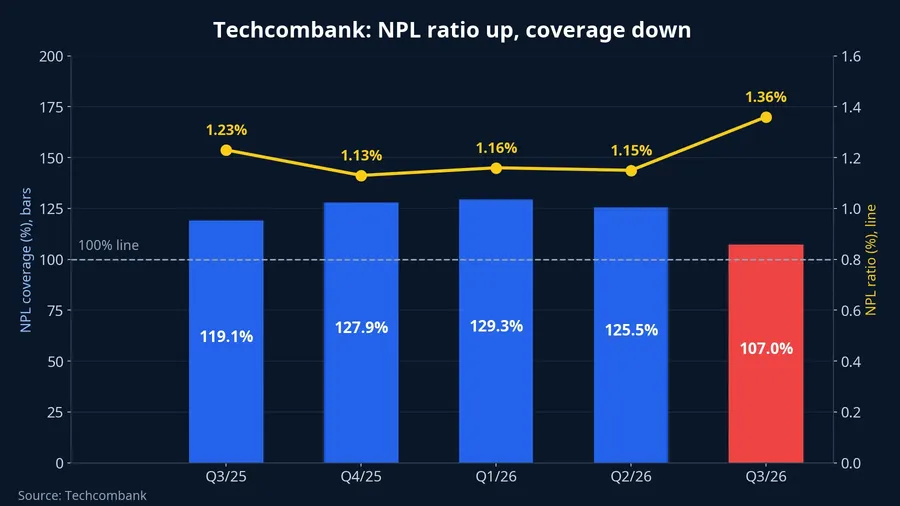
The profit line is only half the story. In the same quarter, the bank's loan-loss reserve coverage of non-performing loans (NPLs) dropped from 125.5% at the end of Q2 to 107.0% at the end of Q3.Techcombank Put the two numbers side by side and the picture is clear: the bank is earning more, but the cushion behind those earnings has thinned.
Where the profit comes from
Net interest income is still the main engine. Over nine months it totaled VND 31,985 billion, about 70.8% of total operating income of VND 45,204 billion.Techcombank Put simply, roughly 7 of every 10 dong of income still comes from the gap between what the bank charges borrowers and what it pays depositors.
The quarterly net interest margin (NIM) edged up to 3.5% from 3.4% in Q2.VnEconomy According to the earnings release, the bank held its margin by adjusting rates and shifting the loan book toward higher-yielding loans. Cost pressure is real: the cost of funds rose to 5.1% in Q3 from 3.4% a year earlier.Techcombank Funding is much more expensive than it was a year ago, and the bank has kept its margin only by charging borrowers more.
Fee income grew fastest. In Q3 alone it reached VND 4.2 trillion, up 44.6% year on year. For nine months it came to VND 11.8 trillion, up 40.0%.VnEconomy Its share of total income rose to 26.2% from 21.9%.Techcombank The strongest lines are trade finance and insurance:
- Letters of credit, cash and payments: VND 4.9 trillion, up 136.6% over nine months. This is the largest fee line. The release attributes the increase to wider letter-of-credit solutions serving corporate trade finance and working capital needs.VnEconomy
- Insurance: VND 1.7 trillion, up 106.1%, double the prior-year level. It covers fees from bancassurance and from the subsidiary Techcom Life; Q3 alone was VND 705.5 billion.Techcombank
- Cards: VND 1.5 trillion, up 29.0%. Per the release, the Q3 increase came mainly from instalment and payment fees.VnEconomy
- FX and derivatives: VND 1.1 trillion, up 27.1%, driven by customers hedging currency risk.VnEconomy
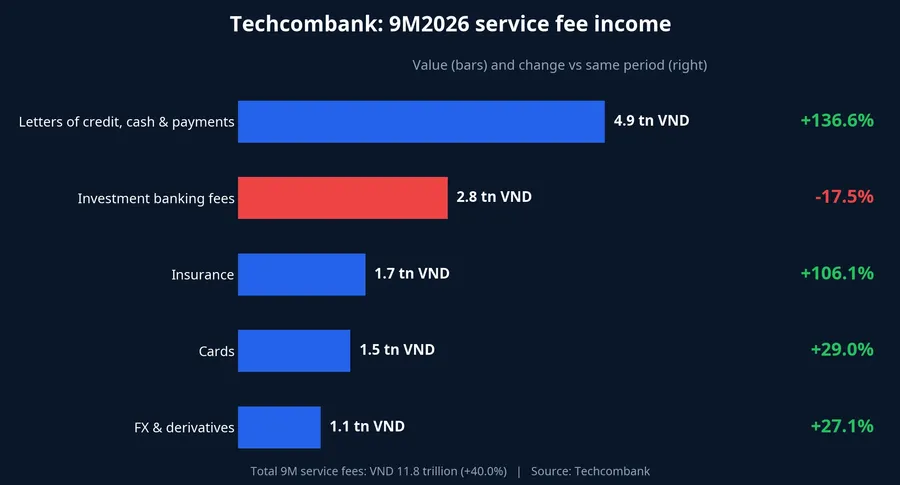
On the other side, investment banking fees came in at VND 2.8 trillion, down 17.5%. The release says distribution activity remained healthy compared with 2025, but margins were squeezed by higher interest rates.VnEconomy Net income from other activities also fell 48.2% to VND 872.7 billion over nine months.Techcombank
For ordinary readers, the fastest-growing fees are money paid by the bank's own customers: bundled insurance premiums, payment fees and card instalment fees.
Why profit grew faster than income
Over nine months, total operating income rose 17.1% while pre-tax profit rose 23.7%. The gap does not come from operating costs, which grew even faster than income at 18.7%.Techcombank
It comes from provisioning. Over nine months, Techcombank set aside VND 2.50 trillion, down 30.5% year on year. Backing out from the release's tables (total income less operating expenses and pre-tax profit), Q3 provisioning was roughly VND 918 billion, against roughly VND 1,499 billion in Q3 2025.Techcombank The saving of about VND 580 billion is close to the entire increase in non-interest income for the quarter, which rose only from VND 4,317 billion to VND 4,888 billion because a drop in other income ate into the fee gains.Techcombank
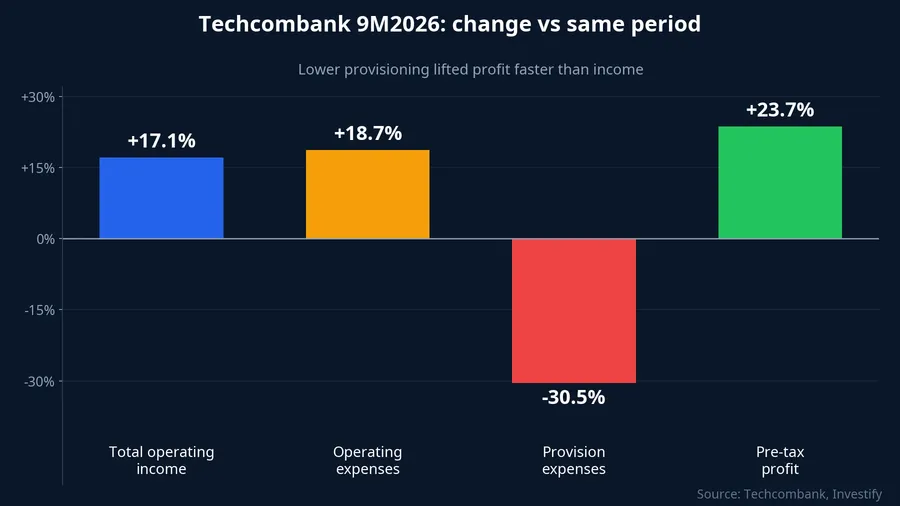
So the record quarter has several supports: net interest income is the largest, fees grew fastest, and lower provisioning contributed a meaningful share, in the very quarter that bad debt rose.
Where the risk is building
Including the effect of reclassification under data from the National Credit Information Center (CIC), Techcombank's NPL ratio rose to 1.36% at the end of Q3 from 1.15% at the end of Q2.Techcombank Excluding the CIC effect, it is 1.26%.VnEconomy The release says the increase came mainly from a few individual loans in non-core sectors being reclassified, while strategic portfolios remained within target.
With bad debt up and provisioning down, coverage fell. At 107.0%, the bank holds about VND 107 of reserves for every VND 100 of NPLs, against about VND 125 a quarter earlier. That is still above 100%, but it is the lowest of the last five quarters in the release's tables (Q3 2025 was 119.1%).Techcombank
On the funding side, retail current-account balances (including automatic interest-earning balances) fell 6.9% from the start of the year. The release explains that high deposit rates pushed customers into term deposits for better interest, although Q3 balances were stable versus the prior quarter. The share of demand deposits in total deposits fell to 35.5% from 42.5% a year earlier.Techcombank Demand deposits are a bank's cheapest funding. As they shrink, funding costs rise, which matches the 5.1% figure above.
Other safety metrics remain steady: the loan-to-deposit ratio (LDR) fell from 80.1% to 77.7%,VnEconomy the Basel II capital adequacy ratio held at 15.0%, and per the release both are within State Bank of Vietnam limits.
TCBS: the subsidiary also posted its best quarter
Listed subsidiary Techcom Securities (TCBS, ticker TCX) reported Q3 pre-tax profit of VND 2,152 billion, its highest quarterly figure in the company's history. The nine-month total was VND 5,708 billion, up 13%, or 76% of its full-year plan.VnEconomy
What Q3 does not answer
The quarter ended on September 30, before the latest round of lending-rate cuts across the sector. BIDV is offering short-term loans from 6.0% a year for eligible borrowers from October 15.Tin nhanh chứng khoán Vietcombank is cutting lending rates by 1.5–2% a year from October 19.CafeF As of the morning of October 21, Techcombank had not announced a lending-rate cut program of its own. If it joins the lower-rate environment in Q4, the way it protected margin in Q3 (charging borrowers more) will be hard to repeat.
The Q3 results show a bank less dependent on net interest margin. Yet profit now leans more on selling insurance and financing trade, and it was helped by low provisioning while bad debt rose. The thesis here is that the reserve cushion has thinned and shows no sign of being rebuilt yet. If NPLs keep rising without coverage being replenished, provisioning costs will have to climb back, and the profit boost from this year's low provisioning will disappear.
The Q4 2026 report will answer two specific questions:
- Whether NIM holds around 3.5% after the rate cuts.
- Whether NPL coverage keeps sliding toward 100%.
This article does not offer a view on the TCB or TCX share price.