

Rong Viet Securities (VDS) has swung from profit to loss. According to its standalone Q3 2026 financial statements, released on the evening of October 16, the company posted a pre-tax loss of VND 105.1 billion and an after-tax loss of VND 83.3 billion.Vietstock In the same quarter of 2025 it earned nearly VND 249 billion after tax.Người Quan Sát
The VND 83.3 billion figure does not capture the full damage to shareholders. The largest unrealized loss in Rong Viet's proprietary portfolio sits in Khang Dien (KDH), and that loss of more than VND 111 billion is not in the reported profit and loss. To see why, two layers need unpacking: which revenue lines dried up in Q3, and how the proprietary book is accounted for in two different ways.
Lending grew while everything else fell
Lending was the only Rong Viet business line that grew in Q3. Interest from loans and receivables reached VND 124 billion, up 14.8% year on year and 64% of total revenue.Vietstock Outstanding loans ended the quarter at VND 3,816 billion, down 4.5% from the start of the year, still roughly half of total assets.DNSE
Other income lines shrank sharply. Gains from selling proprietary stocks booked through profit and loss fell from VND 237 billion to just over VND 2 billion.Người Quan Sát Brokerage revenue dropped from VND 81.5 billion to VND 38.6 billion by DNSE's count; the company's own release shows VND 31.3 billion because it groups line items differently.DNSE Brokerage moved with market liquidity: average market-wide daily turnover in Q3 was VND 18,643 billion, down 57.8% year on year.DNSE
On the cost side, losses on assets measured through profit and loss reached VND 125 billion versus VND 33 billion a year earlier, and interest expense rose from VND 9 billion to VND 20 billion.Người Quan Sát Most of that loss came from marking assets down. Rong Viet's release describes it as a regulatory provision amid market volatility.
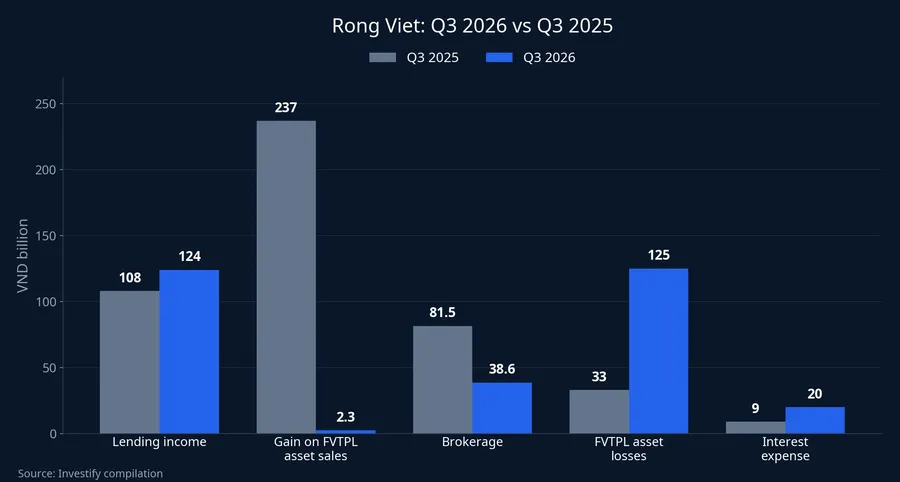
Which force mattered most? Year on year, the biggest gap is the near-total loss of trading gains: last year Rong Viet booked more than VND 230 billion, this year almost nothing. Lower brokerage and higher interest add tens of billions each. The roughly VND 125 billion mark-to-market loss is what pushed Q3 below breakeven. All three coincide with a weak market: the VN-Index ended the quarter at 1,768.62, down 4.91% from the end of Q2.Vietstock For nine months, the after-tax loss stands at VND 62.5 billion.
Two compartments in the proprietary book
A brokerage's proprietary portfolio is usually split into two compartments, and each reaches the financials by a different route.
Compartment one: assets through profit and loss. These stocks are marked to market at the end of every reporting period. When prices fall, the decline goes straight into expenses and cuts quarterly profit, even if nothing was sold. At September 30, 2026, Rong Viet's holdings here had a cost of nearly VND 979 billion and a revalued amount of VND 759 billion, about VND 220 billion lower. The two largest shortfalls are Kinh Bac (KBC), from about VND 355 billion to VND 283 billion, and Hoa Sen (HSG), from nearly VND 96 billion to VND 57 billion.Người Quan Sát
The VND 220 billion is a cumulative gap at September 30, not a Q3 figure. Q3 itself recorded only the roughly VND 125 billion loss mentioned above; the remainder already passed through profit in earlier quarters.
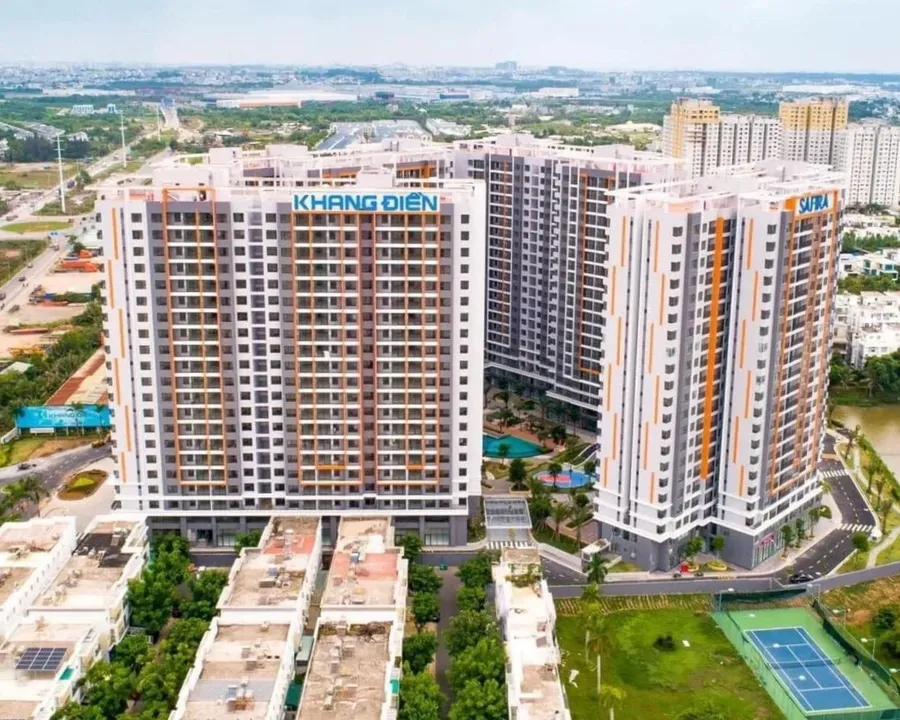
Compartment two: available-for-sale assets. These are also marked to market, but the difference bypasses the income statement. It is booked directly in equity, under asset revaluation differences, and shows up in total comprehensive income. At September 30, 2026, this compartment had a cost of nearly VND 574 billion and a revalued amount of about VND 352 billion, more than VND 222 billion lower. Khang Dien is the largest shortfall across both compartments: cost of VND 203 billion, revalued at VND 92 billion, a drop of 54.7%. The other two names here are CMC (CMG), down about VND 62 billion, and Eximbank (EIB), down about VND 31 billion.Người Quan Sát
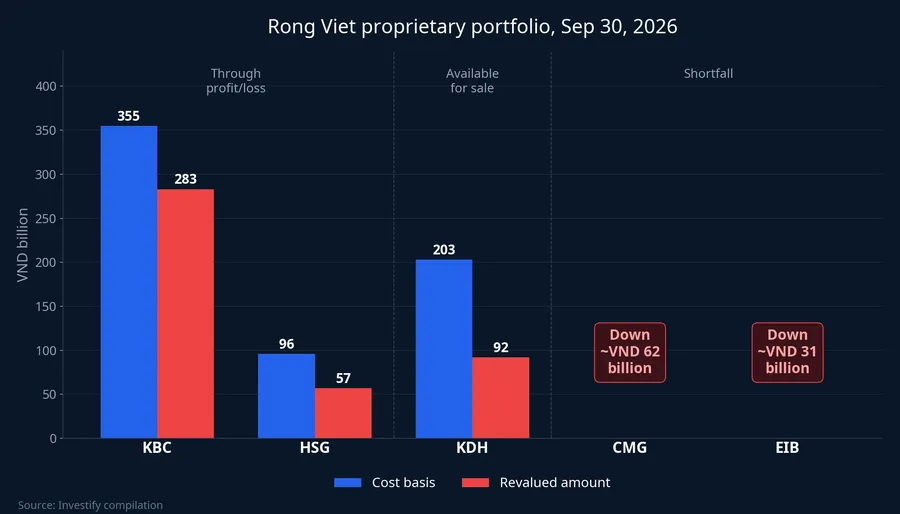
Across both compartments, the portfolio has a cost of more than VND 1,553 billion and a revalued amount of about VND 1,111 billion, roughly VND 442 billion below cost. This is a paper shortfall at one point in time. The company has not sold these shares, so it is not yet a realized loss.
The gap between profit and comprehensive income
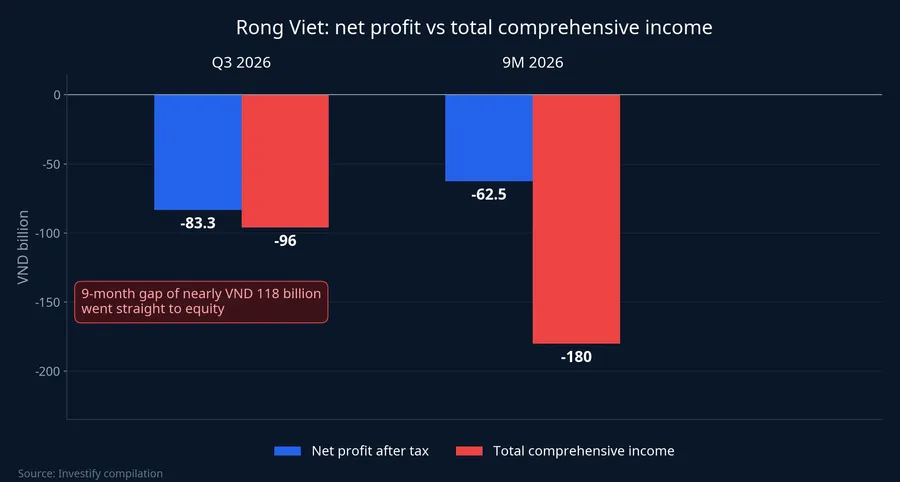
The two-compartment accounting creates a gap that anyone reading only the after-tax profit line will miss. Per DNSE, Rong Viet's Q3 total comprehensive income was negative VND 96 billion, deeper than the VND 83.3 billion after-tax loss. For nine months, total comprehensive income is negative VND 180 billion against an after-tax loss of VND 62.5 billion.DNSE
Subtracting the nine-month figures leaves about VND 118 billion that went through the available-for-sale compartment and straight into equity since January. That also implies most of the second compartment's damage came in the first half: in Q3 alone the gap is only about VND 13 billion.
The loss in the second compartment will not stay outside profit forever. Under accounting rules for securities firms, when an available-for-sale stock is sold, the accumulated revaluation difference in equity is moved to the income statement for that period. If Rong Viet sold Khang Dien, CMC or Eximbank below cost, the loss would become realized and show up in profit. If prices recover before a sale, the shortfall narrows and profit is untouched.
What VDS holders should look at
At the end of September, Rong Viet's equity was nearly VND 2,806 billion, with book value of VND 10,316 per share. The capital adequacy ratio was 418.4%, well above the 180% minimum, and debt to equity was 1.64 times.Vietstock VDS closed at VND 9,900 on October 16, below book value. The Q3 loss therefore does not push the company into regulatory capital risk.
The size of the portfolio relative to equity makes Rong Viet's earnings sensitive to share prices. The revalued amount of about VND 1,111 billion across both compartments equals nearly 40% of equity, so a few more percentage points of decline across its holdings would shift quarterly results noticeably.
Its capital plan has also changed. Rong Viet is still issuing 27.2 million shares for a 10% stock dividend between Q4 2026 and Q1 2027, lifting charter capital from VND 2,720 billion to VND 2,992 billion.Vietstock A stock dividend moves no cash in or out. Per DNSE, the company has halted its 2026 employee share issue and the first rights offering to existing shareholders, which were to cover 6.4 million and 54.4 million shares at VND 10,000. Instead it is issuing VND 800 billion of one-year private bonds at 9.7% a year, above the 8% of earlier issues.DNSE
With the share price below the VND 10,000 offer price, halting the offering is understandable. The consequence is that funding shifts to debt at higher cost. Bank loans carry rates of 4.67% to 9.5% a year and outstanding bonds 8% to 9.3%. The new 9.7% bonds sit above the top of that range, so interest expense, which already doubled in Q3, is unlikely to fall quickly in coming quarters.
What the Q4 report will answer
The Q4 2026 report will show the revalued amounts of both compartments at December 31. Three things are worth reading. First, the gap between after-tax profit and total comprehensive income: if it widens, the available-for-sale compartment is still eroding equity even when profit does not worsen. Second, realized gains or losses on available-for-sale sales: a large realized loss would signal that part of Khang Dien, CMC or Eximbank was sold below cost. Third, equity against today's nearly VND 2,806 billion, the closest gauge of what shareholders actually own, since it reflects both compartments.
For a brokerage whose proprietary book is large relative to its capital, quarterly profit tracks the share prices of its own holdings. After-tax profit therefore tells only half the story. The other half sits in total comprehensive income and equity.