

Q3 2026 was the first quarter this year in which profit at Binh Minh Plastics (BMP) went backwards. According to the consolidated financial statements summarized by CafeF on October 18, BMP earned VND 319.3 billion after tax, down 8.9% year on year, ending a run of three straight quarterly increases.CafeF
A drop of almost 9% does not sound dramatic. What matters is how it happened. BMP carries almost no debt, and it cut selling expenses by a third. The lost profit sits at the very top of the income statement: the company sold less, while the cost of making what it sold went up.
Gross profit lost about VND 144 billion in one quarter
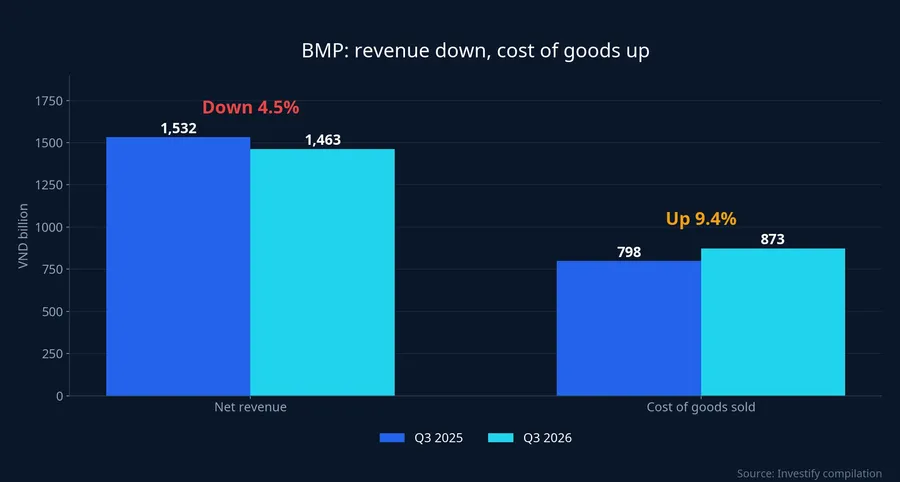
Start with the numbers. Net revenue came in at VND 1,463 billion, down 4.5%, while cost of goods sold rose 9.4% to VND 873 billion.CafeF Two lines moving in opposite directions erode gross profit fast. Gross profit fell 19.7% to nearly VND 590 billion, and the gross margin narrowed from 47.9% to 40.3%, a loss of about 7.6 percentage points.CafeF
In plain terms: in Q3 2025, every VND 100 of revenue left almost VND 48 of gross profit. This quarter it leaves about VND 40.
Working backwards from those ratios, Q3 2025 revenue was roughly VND 1,532 billion and cost of goods about VND 798 billion, which puts gross profit a year ago near VND 734 billion. Against nearly VND 590 billion now, BMP lost about VND 144 billion of gross profit. That is the largest number in this story, and every saving further down the income statement has to be measured against it.
Cost cuts recovered roughly seven-tenths
BMP did not stand still. Selling expenses fell 33.4% to VND 136 billion, and financial expenses fell 46.7% to VND 42.6 billion.CafeF In absolute terms, selling expenses dropped about VND 68 billion (from roughly VND 204 billion) and financial expenses about VND 37 billion (from roughly VND 80 billion). Together that is about VND 105 billion saved, or about 73% of the gross profit lost.
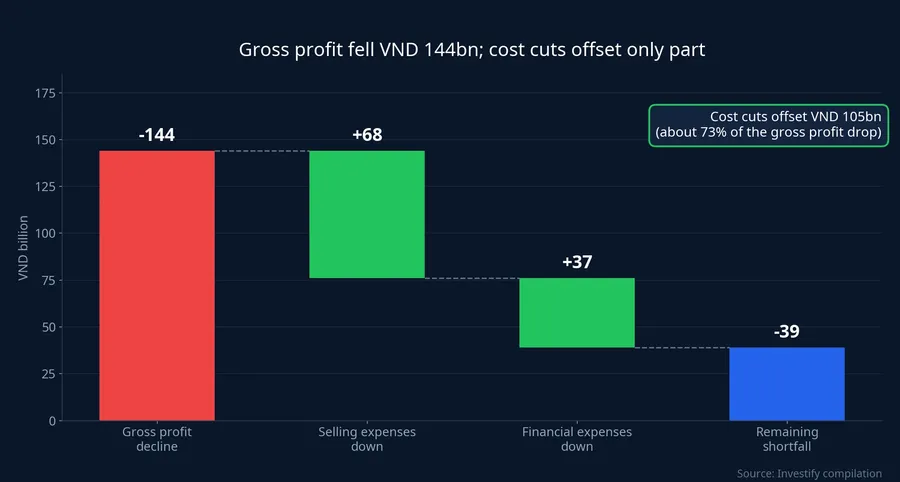
The remaining VND 39 billion or so had nothing to offset it. Pre-tax profit therefore fell 9.3% to VND 399 billion, roughly VND 41 billion lower than a year earlier.CafeF The arithmetic fits the simple explanation: the gross profit lost was larger than the expenses saved.
This kind of offset also has a natural ceiling. A company cannot cut selling expenses by another third every quarter. If the gross margin stays near 40% in coming quarters, savings on this scale will be hard to repeat.
Why cost of goods rose: the company has not said
This is the most important question for anyone holding BMP, and the available data cannot answer it. The financial-statement summary does not include any explanation from BMP for why cost of goods sold rose while revenue fell.
The first explanation most people reach for is the price of PVC resin, the main raw material for plastic pipes. The reference PVC price series in the Chinese market does not support that simple story. The Q3 2026 average was about CNY 4,658 per tonne, below the roughly CNY 4,918 per tonne of Q3 2025, about 5% lower. Prices did climb during the quarter, from CNY 4,408 per tonne on June 30 to CNY 4,906 on September 30, but the quarterly average was still below a year earlier.
So what lifted cost of goods by 9.4%? The data is not enough to pick one answer, but a few directions are worth marking out. Raw material bought in earlier, higher-priced months may only have entered cost of goods when the products were sold in Q3, so a same-quarter price series would not reflect what BMP actually paid. The Chinese PVC price is also a general indicator, not BMP's purchase invoice, and the company uses other resins for its HDPE and PPR pipes. Finally, falling revenue alongside rising cost could also mean a lower average selling price, or a sales mix tilting toward lower-margin products.
The summary gives no sales volumes, so it is not possible to separate the effect of selling price from cost per unit. The notes to the financial statements, the profit-variance explanation that listed companies must file when earnings swing sharply, or the annual report will be where the answer appears.
Two balance-sheet items deserve watching alongside. Inventory at September 30, 2026 was up 18% from the start of the year to VND 619 billion, which means cost of goods in coming quarters will depend on the price of the stock now sitting in warehouses. Short-term receivables rose 176.6% to nearly VND 267 billion, suggesting cash from sales is arriving more slowly than at the start of the year, though the data does not say whether that reflects a change in sales terms or simply quarter-end timing.CafeF
The pressure does not come from debt
At many companies, falling profit is tied to interest costs. Not here. Financial borrowings at September 30, 2026 were just VND 54.9 billion, under 1.5% of total assets of VND 3,747.7 billion.CafeF
Most of BMP's assets are cash. Cash and equivalents stood at VND 713.2 billion and short-term financial investments at VND 1,470.2 billion. Together that is more than VND 2,183 billion, or 58% of total assets, against equity of VND 3,171.3 billion.CafeF
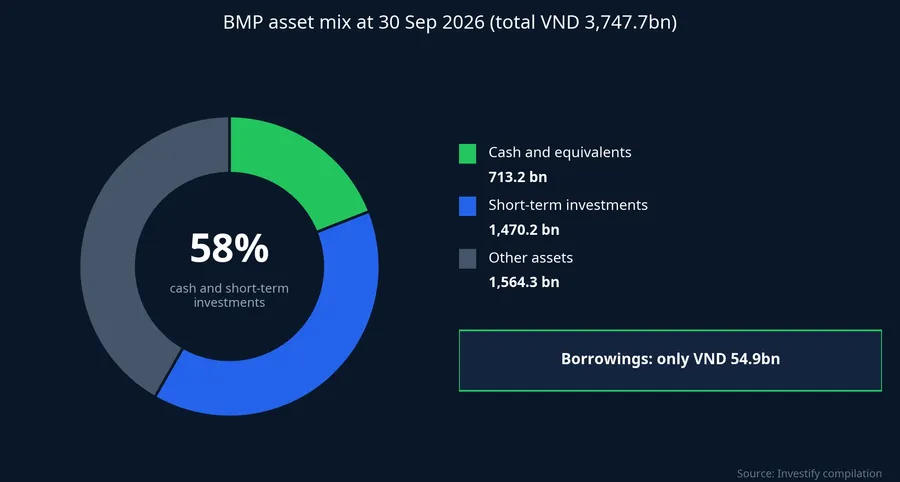
So Q3 raises no question about debt repayment or financial strength. The question is about earning power from selling pipes: whether the gross margin returns to its old range.
Full-year plan and the source of dividends
For the first nine months, BMP reported net revenue of VND 4,239.7 billion, up 0.4%, and net profit of VND 990.5 billion, up 2.4% year on year.CafeF The first two quarters were strong enough to keep the cumulative figure rising.
BMP's 2026 plan calls for net profit of VND 1,278 billion on revenue of VND 6,053 billion.Doanh nhân After nine months it has reached about 77.5% of the profit target. To hit it, Q4 needs net profit of about VND 287.5 billion, roughly 90% of Q3's result. On revenue, nine months is only about 70% of plan, so Q4 would need about VND 1,813 billion, more than any quarter this year.
For anyone holding BMP for its cash dividend, the funding base is still thick. Undistributed after-tax profit at September 30, 2026 was nearly VND 1,149 billion, while cash and short-term investments exceeded VND 2,183 billion, so the company does not need to borrow to pay dividends.CafeF The 2026 dividend policy in the annual shareholder meeting documents is a cash payout of at least 50% of after-tax profit.Doanh nhân That is a floor measured on actual profit, not on the plan.
The specific payout is not yet known. The board decides on interim advances during the year, while the annual shareholder meeting settles the full-year plan. This article does not guess at the payout, because Q4 profit and the board's decision are both still pending.
BMP's largest shareholder is Nawaplastic Industries, a member of Thailand's SCG group, with 54.99% of charter capital.CafeF BMP shares closed at VND 140,500 on October 16, 2026.
What to watch
Q3 shows one thing clearly: BMP's pressure comes from cost of goods and revenue, not from debt. It does not yet show whether a gross margin near 40% is a one-off quarter or a new baseline.
The Q4 2026 financial statements, expected around the end of January 2027, should settle that. If the gross margin returns close to the 47% to 48% of a year earlier, Q3 was most likely the product of temporary costs, such as high-priced inventory. If it stays near 40%, the VND 1,278 billion target becomes harder to reach, and profit expectations, which are the base for dividends, would need to be set on a lower footing.
Until then, the cost-of-goods notes in the Q3 financial statements are the first document that can show which line items drove costs up.