


On October 18, the State Bank of Vietnam (SBV) issued official letter 9608/NHNN-CSTT on operating measures for credit institutions. One line speaks directly to savers: lower listed deposit rates by at least 0.5 for terms of six months and longer.Thời báo Ngân hàng Banks also promised to cut rates back in April. This time the instruction comes with a minimum, a term range and sanctions, which is why the letter deserves a closer read than earlier rounds.

From the March appeal to the April 9 meeting
According to Mr. Phạm Thanh Hà, Deputy Governor of the SBV, speaking at the first-quarter press briefing on the afternoon of April 14, the SBV sent a letter on March 30 asking credit institutions to keep market interest rates stable.CafeF That letter spoke of stability, not of cuts.
On April 9 the SBV met commercial banks. Per the Financial and Monetary Markets Review, the banks "pledged to jointly cut deposit and lending rates after this meeting."Financial and Monetary Markets Review The accounts of the meeting record no common minimum cut and no common deadline. The measurable result by April 14: about 26 banks had trimmed listed rates by 0.1 to 0.5 percentage point a year, mostly on terms of six months or longer, and each chose its own cut.CafeF At that point 0.5 was the top of the range, picked by only some banks.
The rate level has not come down
At the third-quarter briefing on October 7, the SBV said that as of September 20 the average deposit rate on newly originated transactions stood at 6.38% a year, up 1.15 percentage points from the end of 2025.Báo Đấu thầu Mr. Hà said the pace of increase was slowing and that rates were essentially hovering around a new level.Tiền Phong
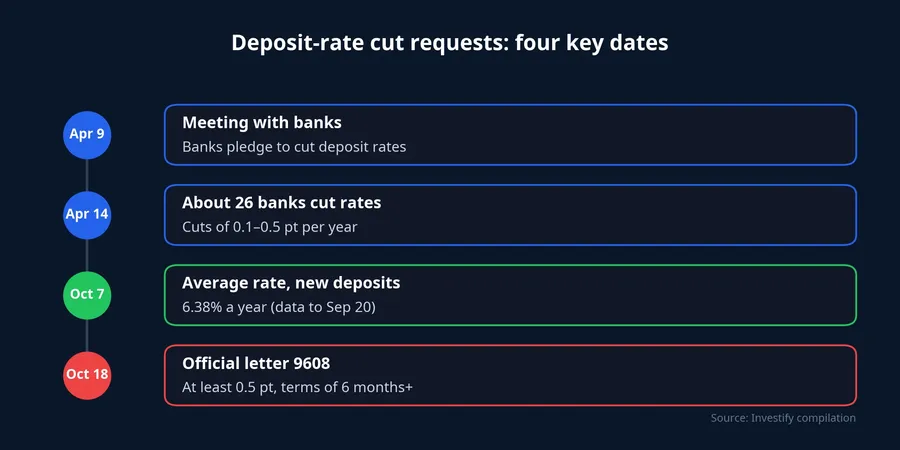
Set side by side, the voluntary April cuts did not pull funding rates back to where they began the year. The available data cannot separate the causes. Still, reports of the April 9 meeting show the SBV itself pointed to some banks competing for deposits and pushing rates up.Financial and Monetary Markets Review Letter 9608 targets that behavior directly, with the phrase "absolutely no racing to raise deposit rates."
Throughout this period the policy rate stayed at 4.5% a year. In other words, the SBV did not use its policy rate to pull funding costs down. It went through direct instructions to individual banks.
The government meeting and letter 9608
On the afternoon of October 16, Deputy Prime Minister Nguyễn Văn Thắng chaired a meeting on monetary policy management for the rest of the year, centered on lowering interest rates to support businesses, households and growth.Thời báo Ngân hàng Two days later the SBV issued letter 9608. As Thời báo Ngân hàng quotes it, the key sentence reads: "For now, cut listed deposit rates by at least 0.5 for terms of six months and above, and absolutely do not race to raise funding rates or compete unfairly in ways that threaten financial and monetary security." The same sentence calls for lower lending rates, with a focus on cuts of 1.5 to 2 points for production, business and priority sectors.Thời báo Ngân hàng
Compared with April 9, the letter adds three things, and each touches savers differently.
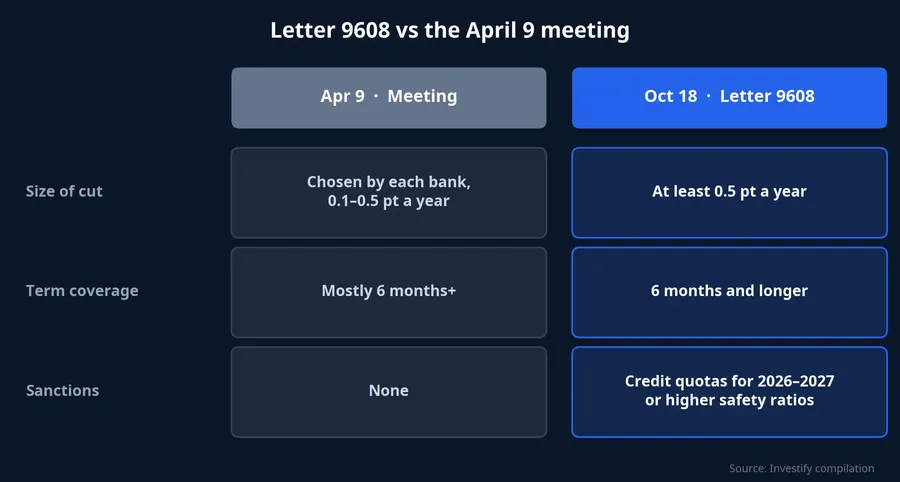
A minimum. The 0.5 figure used to be the top of a range that some banks chose for themselves. Now it is the floor. Thời báo Ngân hàng and Người Quan Sát both report it as 0.5 a year, in the same unit as the rate itself.Người Quan Sát On that reading, the cut comes straight off the listed rate: a term listed at 6% a year would fall to 5.5% at most.
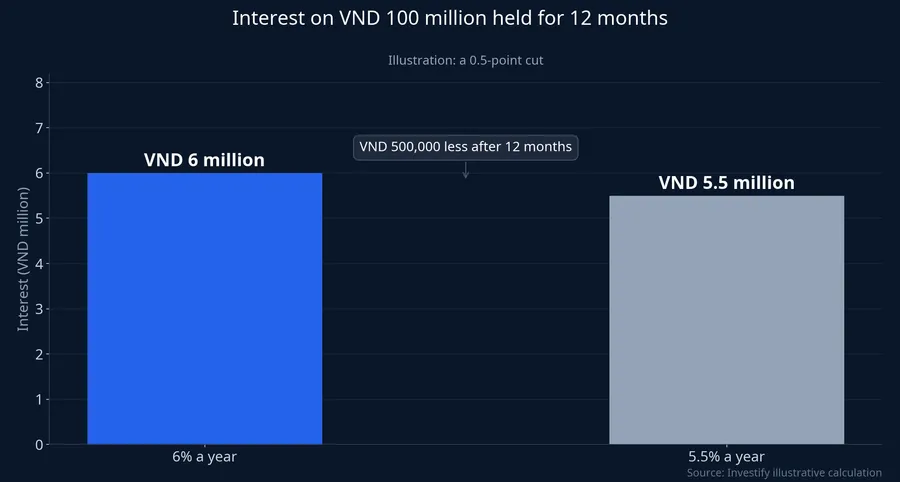
On VND 100 million held for 12 months, each 0.5 percentage point equals VND 500,000 less interest a year. This is an illustrative calculation, not any specific bank's rate card.
A term range. The instruction covers only terms of six months and longer. The letter sets no cut for terms under six months, so one-to-five-month terms sit outside this "at least 0.5" requirement.
Sanctions. According to Thời báo Ngân hàng, from now to the end of 2026, for any credit institution that fails to follow the rate guidance or competes unfairly in a way that unsettles the market, the SBV will weigh measures based on the nature and level of risk. These include reviewing its remaining 2026 credit growth quota, assigning a lower quota for 2027, or requiring higher prudential ratios than the standard.Thời báo Ngân hàng For a bank, the credit quota caps additional lending and generates most of its income. That is a price the April 9 pledge did not carry.
The letter says "for now" and gives no separate effective date for the deposit-rate cut. Each bank will therefore set its own date when it publishes a new rate card.
Existing deposits and new deposits
Savers first ask whether the deposit they already hold can be marked down mid-term. Under the rules on savings deposits (Circular 48/2018/TT-NHNN), the rate is fixed in the agreement when the account is opened. For a fixed-rate term deposit, a bank cannot unilaterally change the rate before maturity just because its listed rates change. Letter 9608 also refers only to "listed deposit rates," meaning the rate card for new transactions. That leaves three cases:
- Term deposit of six months or more, not yet matured: keeps the agreed rate until maturity. The exception is a product with a floating-rate clause tied to a formula in the contract.
- Deposit that matures and rolls over automatically: usually priced at the listed rate on the rollover date. If that date falls after the bank changes its rate card, the deposit gets the new, lower rate.
- New deposit: takes the listed rate on the day it is opened.
Breaking a deposit early to chase a higher rate also has a cost: under Circular 04/2022/TT-NHNN, the amount withdrawn earns only the bank's demand-deposit rate, far below the agreed term rate.
For holders of bank stocks
Letter 9608 is not only about interest rates. According to Thời báo Ngân hàng, the SBV asks credit institutions to tightly control large, long-standing or hard-to-collect accrued interest, to control dividends and profit distribution so that results reflect substance, to control interest expense sensibly, and to watch group 2 loans and bad debt closely.Thời báo Ngân hàng The letter names no bank and sets no specific dividend limit.
What can be said with confidence is that compliance with the rate request is now linked to credit quotas, the direct driver of asset growth. Lower deposit rates reduce funding costs, while lending-rate cuts of 1.5 to 2 points in priority sectors pull interest income down. Whether a given bank's net interest margin (NIM) rises or falls depends on how those two effects offset each other, and fourth-quarter financial statements will give the first answer.
What to watch next week
As of the evening of October 18, no bank had been reported to publish a new deposit rate card under letter 9608. What is clear is that anyone opening a new deposit, or rolling over a term of six months or more, after a bank changes its rate card will face a rate at least 0.5 percentage point below that bank's old card. Existing deposits keep the agreed rate until maturity.
Two things remain unknown: how much each bank will cut, since 0.5 is only the minimum, and from what date. The rate cards banks publish during October 19 to 23 should answer both. For anyone with a deposit nearing maturity, the date on the passbook is the number to set beside the date their bank changes its rates.