

On the afternoon of October 18, at a National Assembly group discussion on the economy and society, Prime Minister Lê Minh Hưng spoke about property prices in unusually firm terms. According to Người Quan Sát, he said: "On land prices, when the National Assembly considers and passes the Land Law, the State will regulate strongly. The State will decide this, and land prices and real estate prices will certainly fall."Người Quan Sát

The remark came in a section on cutting input costs for the economy. In the same section, the Prime Minister said decrees would be amended to trim intermediaries in fuel trading, lower the cost of supplying medicines and medical equipment, and restructure the power sector. Property was being listed alongside fuel, drugs and electricity: a cost the government wants to push down.
This is a statement of direction. It is not a legal document, and it comes with no figure for how far prices will fall or by when. To understand who it will reach and when, it helps to split it into the two reasons the Prime Minister himself gave. Each feeds into home prices along its own path.
The supply lever: social housing and rental homes
The first reason is supply. Per the report, the Prime Minister said the government is pushing social housing and rental housing, and as supply of these homes grows, market prices, especially for apartments, will follow a downward trend.
The mechanism is fairly direct. A middle-income buyer looking for a home to live in, if eligible for social housing or able to rent affordably, is no longer forced into a commercial apartment. When enough people leave the queue for commercial units in the same segment, developers find it harder to hold their asking prices.
Figures from the Ministry of Construction at its Q3 briefing show the scale. Since the start of 2026, 170 social housing projects with 46,962 units have been completed nationwide, and another 128 projects with 183,293 units have started construction. For rental housing, 8,314 of the 17,176 units planned for the year are done, or 48%, and the ministry expects 18,049 units by year-end, 105% of plan.VietnamPlus
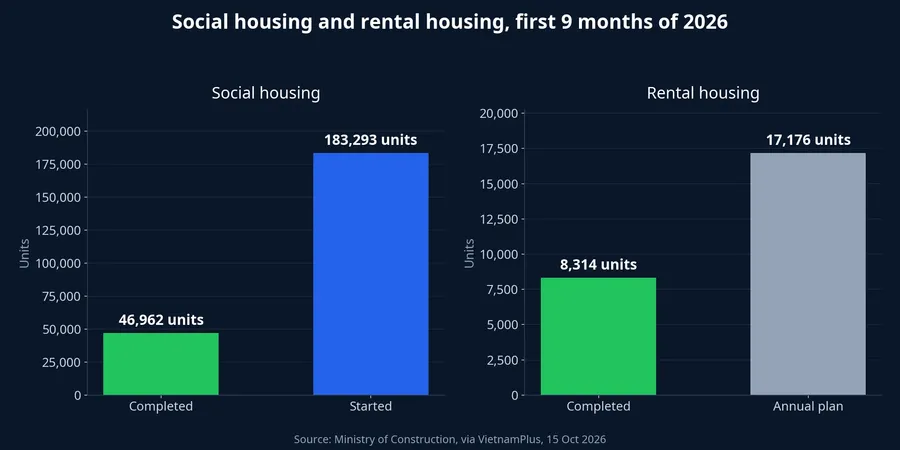
These numbers need careful reading. Units started are nearly four times units completed, but a started unit is not yet supply. It still has to be built, handed over and occupied before it counts. On a cumulative basis, the completed portion is 363 projects with 216,626 units.VietnamPlus
Hanoi apartment prices have fallen, but social housing cannot take all the credit
Q3 2026 reports show Hanoi apartment prices moving down. According to CBRE, the average asking price across the whole market was VND 86 million per square metre (net floor area), 9% below Q2 and 6% below a year earlier. The average secondary price was approximately VND 60 million per square metre, down 5% on the quarter and 8% year on year. CBRE says this is the first year-on-year decline in secondary prices after two years of sharp gains.Vietnam Financial Times
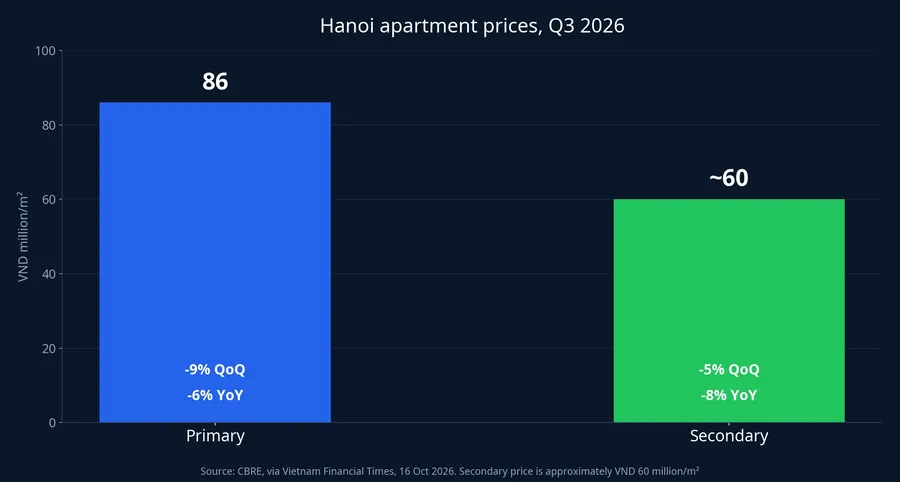
Savills measures a different basket and gets a different level: average primary prices of about VND 107 million per square metre in Q3, slightly lower than the previous quarter, with secondary prices down for a third straight quarter.VnBusiness The two data sets should not be compared on level, but they point the same way. This piece uses only Hanoi data because no Q3 price figures for Ho Chi Minh City were published in the past week.
The harder question is why prices fell. Social housing is one answer, not the only one. CBRE notes that liquidity fell as borrowing costs exceeded what buyers could bear, and market-wide absorption is only 39%.VnBusiness The reports stress weak demand and high interest rates and do not isolate social housing's contribution. So it is fair to say Hanoi apartment prices are falling; how much of that is due to social housing cannot be measured with the data available.
One detail shows the limits of this lever: commercial apartments priced at VND 2–4 billion have almost vanished from new supply in Hanoi.Người Quan Sát Social housing fills exactly that gap, but only for people who meet income and housing eligibility rules. Those who do not qualify still buy commercial homes, where price is set by the developer's costs, land cost included.
The land price lever: the State sets prices, and the law is still pending
The second reason is where the Prime Minister used the word "certainly". It is tied to the draft amended Land Law, which the National Assembly has not yet passed.
According to Hà Nội Online, the current draft drops the provision for valuing land on market principles. Land prices would instead be set by the State under principles of openness and transparency, aimed at curbing price manipulation and inflated prices.Hà Nội Online

Land prices reach apartment prices through the land use fee. When a developer is allocated land for a project, it pays this fee to the State and then adds it to the cost base of each apartment sold. If the new method shrinks the fee, new projects have room to price lower. If it grows, the effect runs the other way.
Which way it goes depends on the wording of the law, not on who sets the price. The Ho Chi Minh City Real Estate Association (HoREA) warned in early October that if the land use fee is calculated from the land price table multiplied by an adjustment coefficient, as in the draft, it could be considerably higher than under the residual method, which subtracts costs from a project's expected revenue. That is a business association's calculation, not an official figure, and it predates the Prime Minister's remarks by more than two weeks, so this piece does not reuse its specific number. Still, it shows that "the State decides land prices" does not automatically mean lower land prices. The coefficient permitted by the law and its implementing decree will decide the direction.
The Prime Minister looks at the broad picture: if the State holds pricing power, land prices are harder to push up through speculation or inflated pricing, and over time the price level comes down. HoREA looks at individual projects: a specific formula could raise the land fee for a new project. The two views are not mutually exclusive. The text of the law as passed, and the decree on how land prices are determined, will show which is closer to right.
Why the two levers work on different timelines
The supply lever is already running. Tens of thousands of social housing units were completed this year, rental housing is nearing its annual plan, and projects already started will keep turning into homes over the next few years. The effect arrives gradually, project by project, and first where projects are large enough.
The land price lever has to wait for the National Assembly to pass the law, for the law to take effect, and for the government to issue a decree on how land prices are determined. After that, it applies only to projects whose land use fee is calculated from then on. A commercial project priced under the new method still needs construction time before launch. So even if the new method lowers the land fee, buyers of commercial homes would see the effect only in projects launched later.
What the statement changes, and does not change, for each group
Current property owners: title, land use rights and completed obligations do not change because of a speech. What to watch is the land price table under the new law, since it underpins many taxes and fees on transfers and change of land use.
Buyers who have paid a deposit on an apartment under construction: the price is in the contract. The October 18 remarks do not automatically change that number.
First-time buyers saving up: those eligible for social or rental housing may see the effect soonest. Those who are not will find commercial prices following demand, borrowing costs and the land fee of new projects, and the land fee part still depends on the law.
Holders of shares in housing developers: the land use fee is part of a new project's cost. The coefficient provisions in the final law will show whether that cost goes up or down.
Conclusion
The October 18 remarks rest on two levers of very different nature. The supply lever is already running and reaches first those buying or renting a home to live in, in segments where social and rental housing compete. Hanoi apartment prices are falling, although the data cannot separate social housing's share from high borrowing costs and weak demand.
The land price lever is the part the Prime Minister stated most firmly, and also the part with no legal text yet. How far land prices fall, and from when, has no answer so far. The answer will come from two documents: the land price provisions as passed by the National Assembly, and the decree on how land prices are determined. If the adjustment coefficient is set low enough that a new project's land fee is no higher than under the residual method, the Prime Minister's statement has a path into commercial home prices. If the formula stays as in the draft HoREA analysed, the land fee could move the other way.