


At the annual shareholders' meeting in June 2026, Ms. Nguyễn Thị Như Loan posed a question when the subject of bank borrowing came up: "What do we use to pay the interest?" On October 14, Quốc Cường Gia Lai JSC (QCG) approved a plan to borrow, or take credit lines or guarantees, from banks up to a combined VND 1,500 billion. The person tasked with negotiating and signing is Ms. Loan herself.Người Quan Sát
The real risk sits in the gap between those two moments. This post looks at why the company changed course, and at the costs QCG shareholders could end up carrying if the credit line is drawn.
What the October 14 resolution approves
According to Người Quan Sát, the board resolution dated October 14, 2026, signed by QCG board Chairman Lại Thế Hà, has three main parts.
The first is the limit. The company may approach commercial banks and credit institutions for loans, credit lines or guarantees totaling no more than VND 1,500 billion, for production, business and investment purposes.Báo Đầu tư Chứng khoán
The second is collateral. QCG agrees to pledge or mortgage assets that it, or a third party, legally owns or has the right to use, or to place them as deposits, as the lender requires.
The third is who carries it out. The board fully authorized Ms. Nguyễn Thị Như Loan, QCG's General Director and legal representative, to negotiate interest rates, choose lenders, complete the paperwork and sign the credit and mortgage contracts. Ms. Loan was reappointed General Director from October 12, replacing her son, Mr. Nguyễn Quốc Cường.
Three things remain unstated: which bank will lend, how much will actually be borrowed, and which specific assets will be pledged. No credit contract has been disclosed so far. The VND 1,500 billion figure also combines loans and guarantees, so it is a ceiling, not outstanding debt.
What management told shareholders in June
The press paid close attention because the resolution runs against what the company told shareholders less than four months ago. As Người Quan Sát recounts, when a shareholder asked why the company was not borrowing more from banks, Mr. Nguyễn Quốc Cường, then General Director, answered that the company still had assets and access to capital. Even so, management's stance was to minimize reliance on outside funding until revenue was truly secure, and to ease repayment pressure and interest costs.Người Quan Sát
Ms. Loan offered a concrete calculation at the time: borrowing VND 1,000 to 1,500 billion would add more than VND 100 billion in interest a year. Instead of bank loans, she lent the company her own assets, interest-free.
The newly approved limit sits at the top end of the range Ms. Loan herself used to argue against borrowing. The new resolution does not dispute that arithmetic. It shows management is now willing to accept that cost.
Why the shift: the remaining sum for Bắc Phước Kiển
The motive the press cites most is the obligation arising from the Vạn Thịnh Phát case. Under the December 3, 2024 appeal verdict, QCG must repay VND 2,882.8 billion received from Sunny Island Investment JSC. The original compensation and site-clearance files for the Bắc Phước Kiển residential project are held by the enforcement agency and will be returned only once the company pays in full.Người Quan Sát
Press reports describe the payment progress as follows. By the end of Q1 2026 the company had repaid VND 1,300 billion. On July 21 it paid another VND 11.4 billion and on July 22 another VND 100 billion, lifting the cumulative total to VND 1,411.4 billion as of end-July 2026. The remainder is therefore about VND 1,471.4 billion.
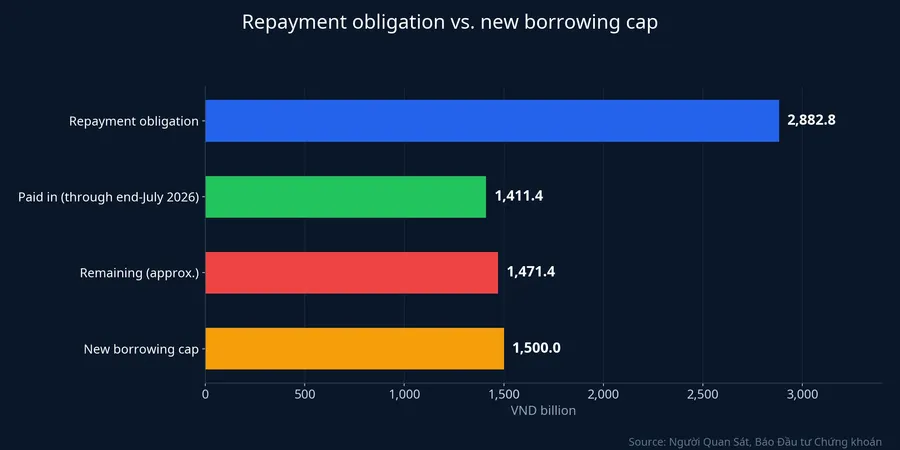
The remaining balance of about VND 1,471.4 billion sits very close to the VND 1,500 billion cap on the new limit, and that coincidence is why the press links the two figures. To be clear, this is the press's reading. The resolution states only a general purpose of production, business and investment, and does not mention Bắc Phước Kiển.
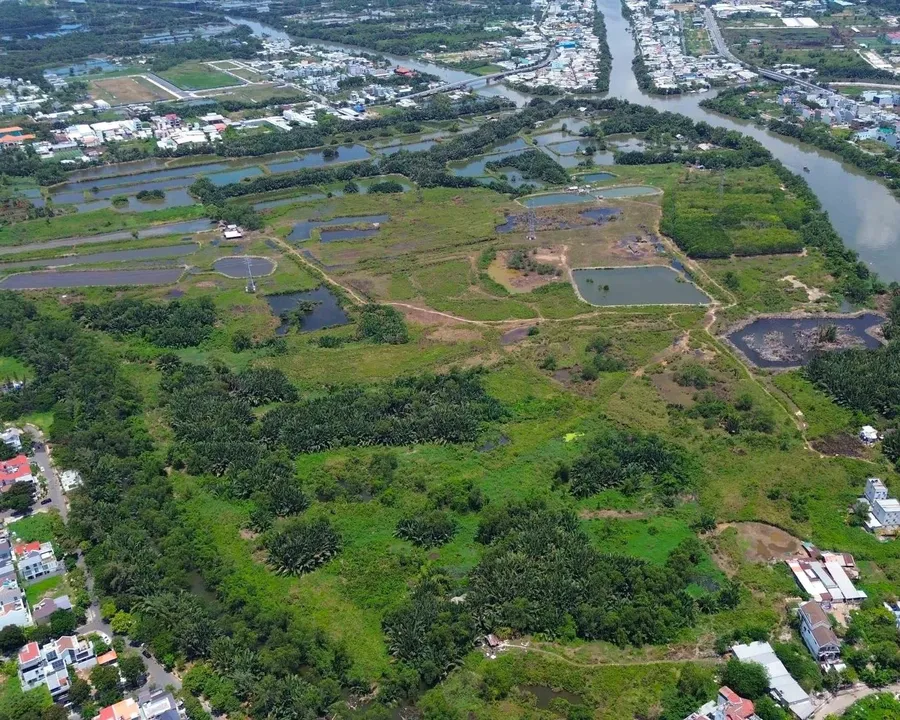
The reading is plausible, but it is not the only explanation. Part of the limit could go to guarantees rather than cash drawdowns. Another part could repay earlier interest-free advances from relatives of management, or fund other projects. Without contracts and a cash-flow statement, the split among these uses cannot be known. What can be said with confidence is that Bắc Phước Kiển is the largest pressure by size, and the only one with a publicly disclosed amount.
Why the shift: the core business does not yet generate enough cash
The second driver is in the operating results. In the first half of 2026, QCG recorded revenue of VND 80.78 billion, down 66.7% year on year.Báo Đầu tư Chứng khoán
Net profit came in at VND 181.69 billion, which looks like a sharp rise. But gross profit was only VND 22.31 billion, below combined financial, selling and administrative expenses of VND 38.34 billion. The company was profitable thanks to VND 242.42 billion in other profit, against negative VND 18.32 billion a year earlier. That other profit came from asset sales, a one-off item.
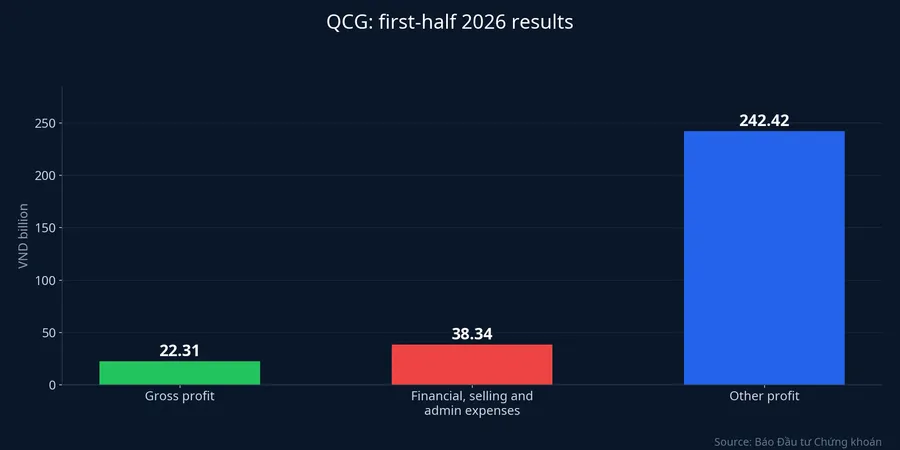
In other words, sales in the first six months did not cover operating costs. A company in that position will struggle to gather more than VND 1,400 billion from operating cash alone.
Auditor UHY has also repeatedly warned about QCG's ability to continue as a going concern, because short-term liabilities exceed short-term assets.Người Quan Sát That kind of warning typically makes banks demand firmer collateral, which may be one reason the resolution leaves room to pledge third-party assets.
Why the shift: interest-free borrowing has limits
The third driver is quieter. The company has pulled together internal resources and interest-free loans from relatives of management, yet the payment schedule is still not closed. The latest dated cumulative figure the press has recorded remains end-July.
Interest-free money from family is cheap for shareholders, since the company pays almost nothing. But it depends on the finances of a handful of individuals. With the remaining balance still near VND 1,500 billion, the banking channel becomes the main source left.
Of the three drivers, the remaining sum for Bắc Phước Kiển sets the size of the limit. The other two explain why the company cannot cover that sum from operating cash or family loans.
What it means for QCG shareholders
Moving from interest-free loans to bank debt changes two things on QCG's balance sheet.
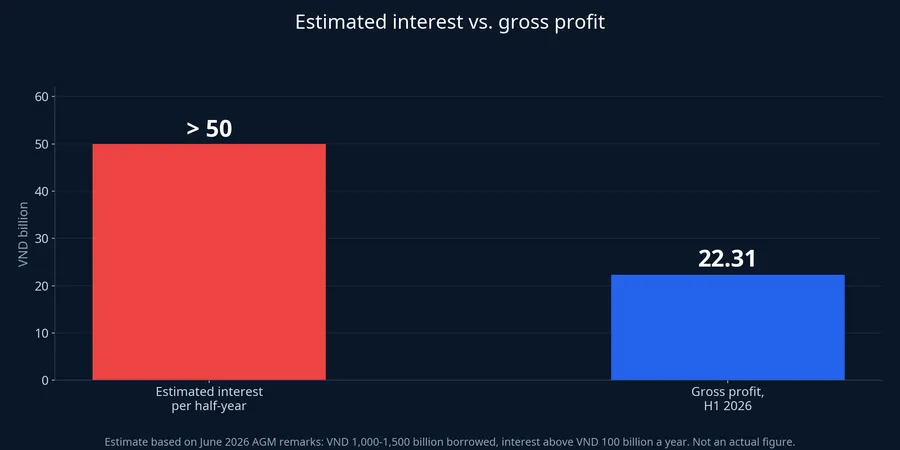
The first is interest cost. By Ms. Loan's own calculation, borrowing VND 1,000 to 1,500 billion would cost more than VND 100 billion in interest a year, or more than VND 50 billion per half-year. That is more than twice the VND 22.31 billion of gross profit the company earned in the first half of 2026. If the limit is nearly fully drawn, interest would come straight out of profit attributable to shareholders, at a company whose core business does not yet cover its current costs.
The second is collateral. Company assets may be mortgaged or pledged to banks, and until the loan is repaid those assets are no longer free to sell or contribute as capital.
The upside deserves a fair hearing too. If the loan lets QCG pay in full and recover the Bắc Phước Kiển files, the company regains the right to develop a stalled project. That benefit turns into cash only once the project is built and sold, while interest starts running the day funds are disbursed.
QCG shares closed at VND 10,800 on October 16, 2026.
Which documents will show the real size of the loan
QCG's Q3 financial statements are struck as of September 30, before the borrowing resolution existed. They will show whether the company paid more toward Bắc Phước Kiển during the quarter, and what debt it carried before the new limit. They cannot yet reflect any bank loan signed after October 14.
That leaves two milestones to watch. The first is any disclosure of a credit or mortgage contract, which would reveal the bank, the amount, the interest rate and the collateral. The second is the Q4 financial statements, expected around the end of January 2027, the first period to show how far bank debt actually rises and how much interest cost enters the income statement.
If bank debt rises sharply and payments toward Bắc Phước Kiển rise in step, the press's reading is confirmed, and shareholders are trading interest cost for a chance to recover the project. If debt rises while payments stand still, the question of how the money is used will need a much clearer answer.