


At a meeting on monetary policy management on the afternoon of October 16, Deputy Prime Minister Nguyen Van Thang said lending rates remain high, weighing on funding costs, production, business activity and access to credit. He asked the State Bank of Vietnam (SBV) to act quickly so that lending rates fall by 1.5–2% for production, business and priority sectors, and tasked the Governor with directing the effort and answering for the results.
This was an instruction given at a meeting, relayed by the press. So far the SBV has issued no document setting a specific reduction for each loan category, which means the question borrowers care about, how much of a cut and starting when, has no answer yet. What can be answered now is why loan rates rose, and which links in the banking chain a cut has to pass through.
Loan rates sit roughly 3 percentage points above a year ago
According to SBV data cited by VnExpress, the average lending rate in August 2026 was 10.7%, 0.2 percentage points above July and about 3 percentage points above loans disbursed a year earlier. Put simply, on every VND 1 billion of outstanding debt, a borrower today pays roughly VND 30 million more in interest per year than a borrower with the same loan last year.
The figures individual banks publish are lower than that average. BIDV and Vietcombank report average lending rates of about 7.4–7.6%, while some private banks such as Eximbank, KienlongBank and MBV report 8.4–9.5%. A VnExpress survey, however, found the Big 4 lending in practice at 9–10.5%, and private banks at up to 12%.
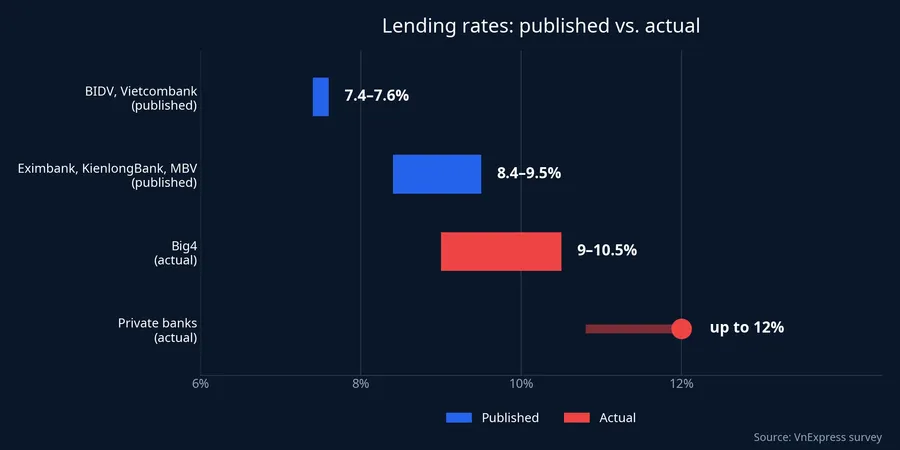
The gap is not necessarily a contradiction. A bank's published average covers its whole portfolio, including short-term preferential loans, well-collateralized loans and large corporate clients. A small business owner borrowing for the first time gets a rate based on loan term, purpose, collateral and their own credit history. So when you read "average lending rate 7.5%", treat it as the bank-wide mean, not the rate you will be offered.
Loan rates rose because banks' funding costs rose first
Think of a lending rate as a bank's selling price. It covers the cost of obtaining the money to lend, operating costs, provisions for risk and a profit margin. To lower that price in a lasting way, a bank has to lower at least one of those components, and the largest is usually the cost of attracting deposits.
Inflation is one force pushing that cost up. CPI rose 5.08% year-on-year in September 2026, against 2.53% in January. When prices climb quickly, depositors demand higher interest to protect their purchasing power, and banks find it hard to cut deposit rates. In his report to the National Assembly on the morning of October 17, Prime Minister Le Minh Hung also cited heavy investment capital demand and inflationary pressure as reasons deposit and lending rates remain high.
Competition among banks for deposits is a second force, but we do not have recent enough data here to gauge its weight. It is therefore not possible to say which force contributed more to higher loan rates. What is clear is that both push funding costs up, and any cut in lending rates has to begin with those costs ceasing to rise.
The policy rate is unchanged, so the cut has to come from the banks
This instruction differs from earlier ones in that it has not come with a cut in the policy rate. According to Investify's internal data, Vietnam's policy rate has stood at 4.5% from June through October 2026. With the policy rate flat, banks' cost of borrowing from the SBV is flat too, so a 1.5–2% reduction in lending rates cannot simply arrive from the regulator's side.
The content of the October 16 meeting suggests the expected cut runs through three links inside the banks themselves.
The first link is deposit rates. If funding costs do not fall, a bank can only cut into the spread between what it charges and what it pays. That is why this link decides whether a cut lasts.
The second link is operating costs. The Deputy Prime Minister asked banks to keep trimming costs, accelerate digital transformation and raise operating efficiency in order to lower loan rates, and to disclose interest rates openly as required by regulation.
The third link is liquidity and enforcement. The Governor was given responsibility both for lowering lending rates and for ensuring liquidity at commercial banks. The Deputy Prime Minister also called for stronger inspection and strict handling of credit institutions that ignore the interest-rate instruction or compete unhealthily on rates. For social housing alone, the SBV refinances at reasonable rates the banks taking part in the lending program. That is the only item discussed at the meeting that comes with cheap funding from the SBV.
On the morning of October 17, Prime Minister Le Minh Hung said the Government had instructed the SBV on policy management and had asked the credit system to jointly cut lending rates by 1.5–2% for production, business and priority sectors. The instruction was thus repeated at the top of the Government two days running, yet no bank-by-bank reduction has been announced.
How to read the 1.5–2% figure
News reports all say "cut by 1.5–2%" without specifying the unit. There are two readings, and the gap between them is large.
If it means 1.5–2% of the rate itself, a loan at 10.7% would fall only about 0.16–0.21 percentage points. That is roughly what the average rate rose in August alone, hardly commensurate with an instruction that makes the Governor personally accountable.
If it means 1.5–2 percentage points, a 10.7% loan would drop to roughly 8.7–9.2%. That would recover half to two-thirds of the roughly 3 percentage points added over the past year, without returning rates to last year's level. The percentage-point reading fits the context of the meeting better, but borrowers will only know their own cut once the SBV or the banks publish new rate schedules.
Who is named, and who is not
The call for lower rates targets production, business and priority-sector loans. Household businesses, owners of small firms and borrowers of working capital are directly in the named group.

Consumer loans and ordinary home loans are not named in the rate-cut part. Real estate appears in a different part: the Deputy Prime Minister stressed controlling credit quality and limiting new bad debt, especially in real estate. Not being named does not mean mortgage rates will certainly stay put. If banks' overall funding costs fall, every loan has room to come down. But for this group, the reduction will follow the general market trend, not the 1.5–2% figure.
Anyone with a floating-rate loan should remember that the October 16 instruction does not rewrite their contract. A floating rate is normally reset at the adjustment dates in the contract, as the bank's base rate plus a fixed margin. The margin barely changes over the life of the loan, and the base rate only falls when the bank's funding costs fall. So even if a bank cuts rates on new loans within October, a borrower with an existing balance will see a change only at the next reset.
What it means for savers and bank shareholders
For savers, the direction is fairly clear. If banks want to cut loan rates and still protect profit, deposit rates will find it hard to stay flat, especially on promotional programs. Conversely, if deposit rates do not fall, it is hard to see a bank cutting loan rates by a full 1.5–2 percentage points without eating deeply into earnings.
For bank shareholders, the story turns on the spread between lending and deposit rates, captured by net interest margin (NIM). If lending rates fall faster than deposit rates, NIM narrows and next quarter's profit comes under pressure. If both fall in step, the spread is preserved and the effect lands on depositors. Banks with plenty of low-cost demand deposits have more room to absorb a cut than banks that must attract funds with high promotional rates.

Three data points that will show whether the instruction has taken hold
Our conclusion is that a 1.5–2% cut has a basis to reach new production and business loans first, and that the real cut will equal exactly the portion of funding cost banks manage to lower. With the policy rate unchanged, there will be no across-the-board cut from the SBV. Home loans, consumer loans and older floating-rate balances will follow, in step with the broader trend.
The first data point is any document or specific measure the SBV issues after the meeting, above all whether the policy rate changes or the effort stays at requests to banks. The second is the schedule of longer-term deposit rates over the next few weeks: if promotional add-on rates are phased out, funding costs are genuinely falling. The third is the average lending rate the SBV publishes for September and October. If it is still around 10.7%, the instruction has not yet passed through the funding-cost link.