

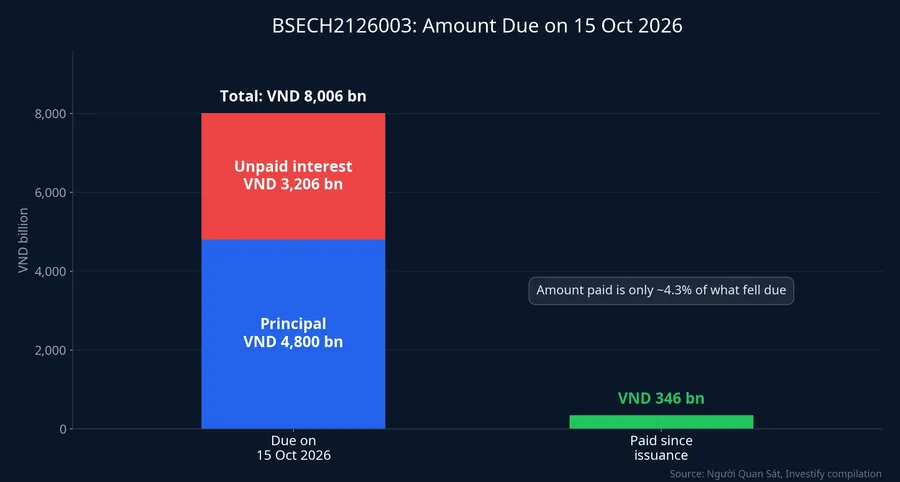
Bông Sen JSC's only outstanding bond series, BSECH2126003, was issued at VND 4,800 billion. On the payment date of October 15, 2026, the company owed more than VND 8,006 billion: VND 4,800 billion of principal and VND 3,206 billion of interest. According to the company's disclosure as relayed by Người Quan Sát on October 17, Bông Sen has not made any payment.Người Quan Sát
The series is secured, and the collateral includes shares in the company that owns the Hanoi Daewoo Hotel. That sounds solid, but the real risk sits elsewhere: who holds title to the assets, whether cash can leave the company's accounts, and how the assets would ever be turned into money. Bông Sen's own wording is "late payment" and "not yet paid," and this article keeps to it.
What fell due, and what was paid
Bông Sen issued BSECH2126003 in October 2021 with a five-year term. The issuing agent was Tan Viet Securities (TVSI). The proceeds went into a project at 152 Trần Phú, Ho Chi Minh City.Người Quan Sát
Since issuance, the company has completed only the first three interest payments, about VND 346 billion in total. Payments then stopped. Unpaid interest now stands at VND 3,206 billion, roughly two-thirds of the VND 4,800 billion principal (calculated from the disclosed figures). Put differently, of the more than VND 3,500 billion in interest the bonds have generated, holders have received less than a tenth.Người Quan Sát
Bông Sen is linked to the family of Trương Mỹ Lan, former chairwoman of Vạn Thịnh Phát Group. At the March 15, 2024 trial, she said her family owned 93.6% of Bông Sen and asked to sell the Hanoi Daewoo Hotel and other assets to remedy the consequences of the case.Người Quan Sát
Accounts frozen since October 2022
Bông Sen's explanation for the missed payment is that all of its bank accounts remain frozen at the request of the authorities for investigative purposes. The freeze has lasted since October 2022, when prosecutors opened the Vạn Thịnh Phát case.Người Quan Sát It coincides with the point at which Bông Sen stopped paying interest.
The consequence for bondholders is direct. Even if hotel operations bring in cash, that money cannot leave the accounts to repay debt while the freeze stands. The company has not announced when it might be lifted.
Operating cash flow: four straight years of losses
Even without the freeze, the operating results show no obvious source of repayment. Bông Sen lost VND 479 billion in 2022, VND 668 billion in 2023 and VND 730 billion in 2024. Its 2025 financial statements again show a loss, the fourth in a row.Người Quan Sát
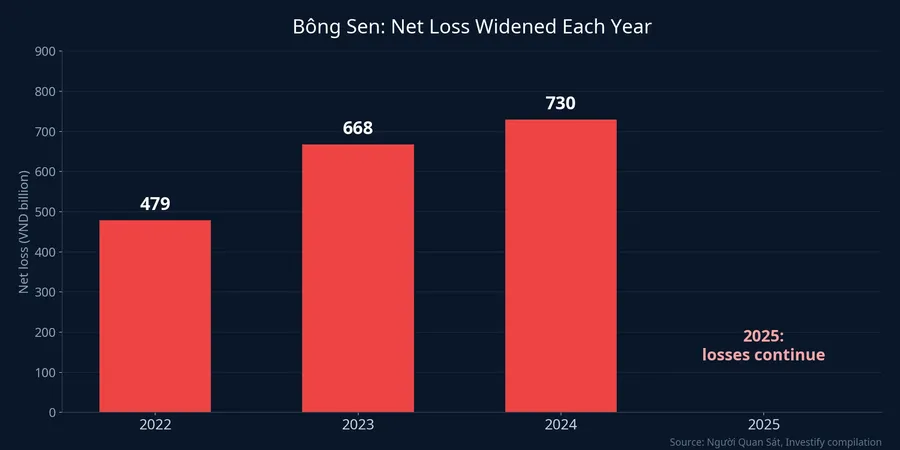
Across 2022 to 2024 alone, losses total about VND 1,877 billion (summed from the figures above). A company losing several hundred billion dong every year has no profit to set aside against VND 4,800 billion of principal, so the repayment route Bông Sen points to is its collateral, not its business.
Besides the Hanoi Daewoo Hotel, the company owns Bông Sen Saigon Hotel, Palace Saigon Hotel and Bông Sen Annex in central Ho Chi Minh City.Người Quan Sát But owning large assets and having cash to repay debt are two different things.
Collateral: the parts with numbers and the parts without
According to the company's disclosure, the collateral for BSECH2126003 falls into three groups, each with a different level of detail.
Capital contribution in Trí Đức. A stake equal to 30% of the charter capital of Trí Đức Real Estate Co., Ltd., with a total value of VND 180 billion. It is owned by Ms. Trần Thị Phơ, not by Bông Sen.Người Quan Sát
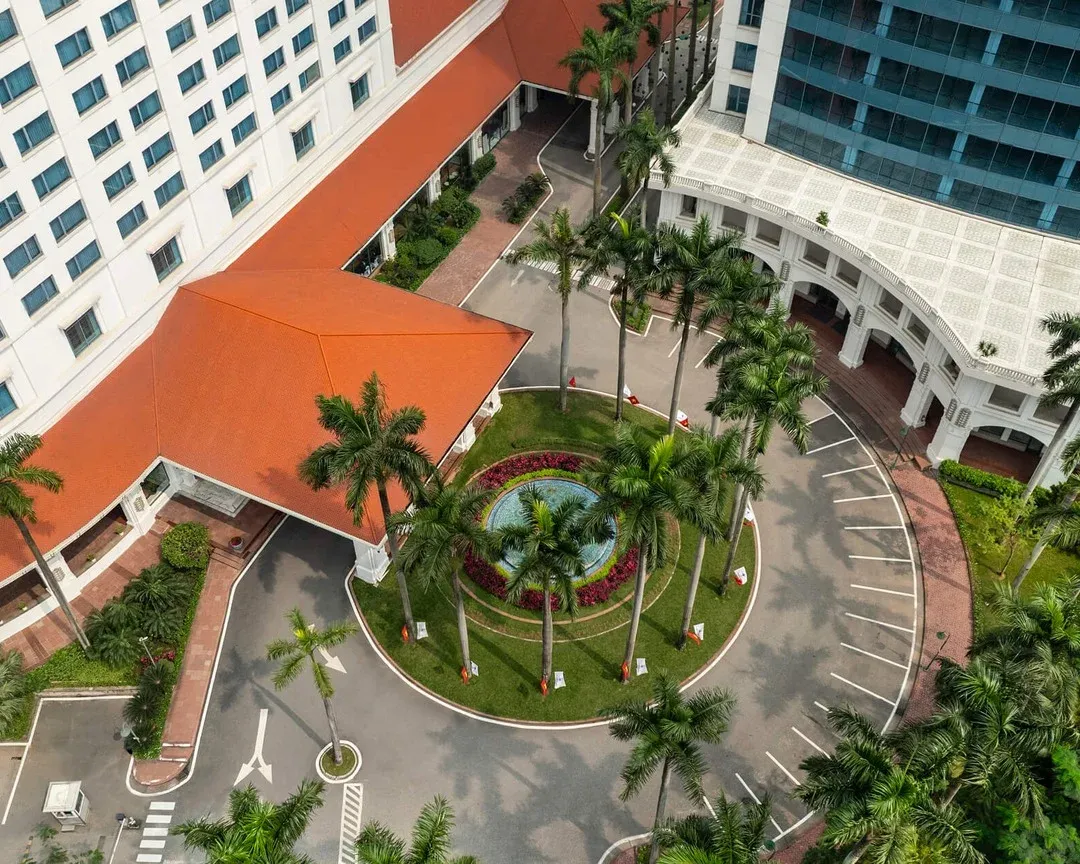
Daeha shares. 63,448,128 shares of Daeha JSC, valued at VND 634 billion at par, equal to 69.9% of charter capital. They belong to Hợp Thành 1 Investment JSC, again not to Bông Sen. Daeha owns the Hanoi Daewoo Hotel at 360 Kim Mã, opened in 1996, with 411 rooms plus restaurants and a conference center.Người Quan Sát
Other real estate and movable assets. Assets that exist now or will be formed in future, owned by Bông Sen or by third parties. The disclosure gives no value for this group.
The first thing to notice is that both assets with a number attached sit in third parties' names. Bông Sen does not directly own the Trí Đức stake or the Daeha shares, so any transfer would need Ms. Phơ and Hợp Thành 1 to take part as owners.
Second, the VND 634 billion is par value, meaning VND 10,000 per share times the number of shares, not market value. A five-star hotel in central Hanoi may be worth far more than the par value of its owner's shares, yet that owner may also carry its own debt. The disclosure offers no valuation of Daeha, so the VND 634 billion cannot be used to estimate what bondholders might recover.
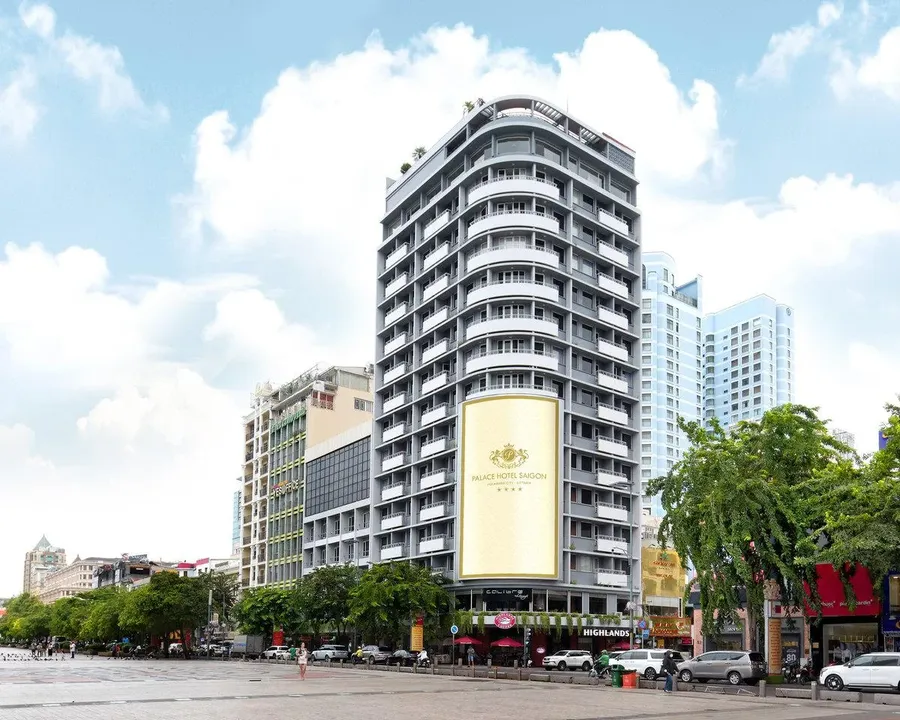
Third, the group that may be the largest has no number at all. Since 2023, Bông Sen has approved an asset-handling plan to meet its bond obligations and to pay money toward remedying the case's consequences. The plan covers Ms. Phơ's stake, the Daeha shares and mortgage files on several properties, including Palace Hotel at 56–66 Nguyễn Huệ, Bông Sen 2 Hotel at 61–63 Hai Bà Trưng, and properties at 5 Nguyễn Thiệp and 93–95–97 Đồng Khởi.Người Quan Sát These are all central Ho Chi Minh City addresses, but the disclosure gives no value for any of them and does not separate which assets serve the bonds and which serve the case.
For that reason this article does not add the figures together to judge whether collateral is enough against VND 8,006 billion.
The only route to cash: a negotiation with no named counterparty
Bông Sen says it is negotiating with potential partners on taking over or jointly handling the collateral. If a transfer goes ahead, the ownership of Daeha, and with it the Hanoi Daewoo Hotel, could change.Người Quan Sát
So far the disclosure names no counterparty, price or completion deadline. The asset plan was approved in 2023, yet more than three years later bondholders have received nothing from it.
The slow progress could have several causes: assets sit in several owners' names, so each deal needs multiple parties to agree; handling assets tied to a major criminal case may have to wait for the competent authority; and with accounts still frozen, it is unclear through which account sale proceeds would reach bondholders. The available sources do not say which obstacle matters most.
The debt remains, the cash has not arrived
Missing the date does not erase the debt. In principle Bông Sen still owes principal and interest, and late-payment interest may accrue under the bond terms. The disclosure as relayed by the press gives no specific rate, so holders should check the offering documents for this series.
More important, a debt that grows on paper is not cash in an account. What bondholders actually recover depends on the sale price of the collateral and the order of distribution, not on accrued interest.
What "secured" means on the due date
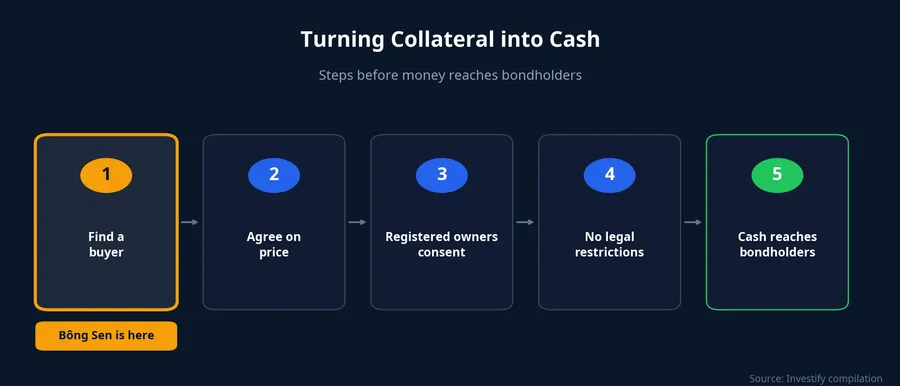
The Bông Sen case shows anyone being pitched high-yield corporate bonds that "secured" does not mean "paid on time." Collateral becomes cash only after several steps: finding a buyer, agreeing on price, getting the registered owners to consent, and clearing any legal restrictions. Each step can take years, and Bông Sen is still at the first, negotiating without a named buyer.
When reading a bond's documents, the question for the issuing agent is therefore not only whether collateral exists. It is whose name the asset is in, how it was valued, when the valuation was done, and whether its transfer is restricted. BSECH2126003 has a clear answer to the first question and no full answer to the rest.
There is no date yet for working out what bondholders will recover. The question will get an answer when one of these signals appears: Bông Sen's next disclosure naming a buyer, with price and timeline, or the unfreezing of the company's accounts. If either appears, holders will have a basis for estimating recovery. If neither does, the debt of more than VND 8,006 billion stays on paper.