

On October 14, 2026, the Ho Chi Minh City People's Committee approved a plan to restructure State capital in city-owned enterprises for 2026–2030. For Becamex IDC (BCM, HoSE), the plan puts the State's ownership at above 65% before 2030, by keeping the State's capital unchanged while reducing its percentage stake.Tin nhanh chứng khoán As of September 30, 2026, the committee owned 95.44% of Becamex.
"Keep the capital, cut the stake" sounds like an administrative detail. For anyone holding BCM, it is the most important phrase in the plan. If the State sells no shares, its share count stays the same, so its percentage can only fall if the total number of shares rises. That means new shares, and the money raised goes into Becamex, not into the city budget.
This article walks through the mechanism layer by layer: why Becamex has to lower the State's stake, how it can do so, why the target is 65%, and what shareholders still do not know.
What the October 14 plan says about Becamex
The original People's Committee document has not been quoted in the press, so everything below is as relayed by media reports. According to CafeF, 11 enterprises keep their current State ownership, including the HCMC State Investment and Finance Company (HFIC). Another 60 are subject to restructuring, including the transfer of the State's ownership representation at SJC to HFIC.CafeF
Becamex gets its own treatment: the city does not sell the capital it holds and only lowers its percentage. A shared timeline for the whole list has also been reported. From September 2026 to June 30, 2027, units circulate the decisions and prepare procedures. From July 2027 through the end of 2028, the restructuring methods are carried out. The city reviews progress at the end of 2028 and continues with unfinished cases in 2029–2030.Người Quan Sát
The plan does not yet state how many shares will be issued, at what price, when, or who can buy them.
Why Becamex has to lower the State's stake
The reason comes from securities law. Under the Securities Law as amended by Law No. 56/2024/QH15, a public company must have at least 10% of its voting shares held by at least 100 investors who are not major shareholders.SSC Companies listed before 2021, like Becamex, must meet this condition no later than January 1, 2026.
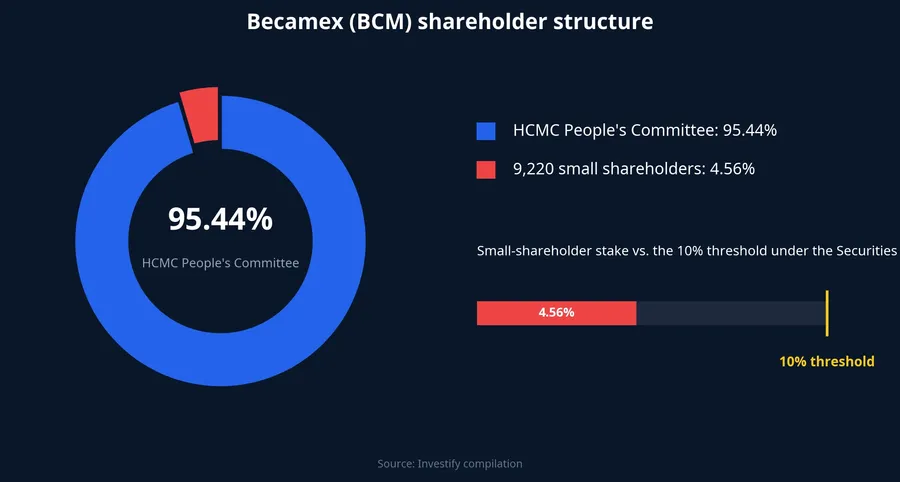
Becamex has enough holders, but not enough shares in their hands. In the shareholder list closed at the end of May 2026, Becamex had 9,221 shareholders. The State is the only major shareholder, and the other 9,220 together own 4.56%.Người Quan Sát That is about 5.44 percentage points below the 10% minimum.
Becamex has not lost its public-company status. According to a letter the company sent to the State Securities Commission, relayed by Vietnam Finance Times in early June 2026, Becamex falls under a transitional rule in the Law on Management and Investment of State Capital in Enterprises, effective August 1, 2025, which lets it keep public-company status while an approved capital restructuring plan is being carried out.Vietnam Finance Times In plain terms, the plan just approved is what keeps Becamex a public company while it sits below the 10% line.
One detail is worth setting beside the 65% figure. To reach 10% alone, Becamex would not need to go nearly that far. By our own calculation from public data, and assuming all new shares go to non-major investors, about 63 million additional shares, roughly 6% of those outstanding, would lift small shareholders to 10% and leave the State at about 90%. The plan sets a target far deeper than the securities law requires.
How: the arithmetic behind "keep the capital"
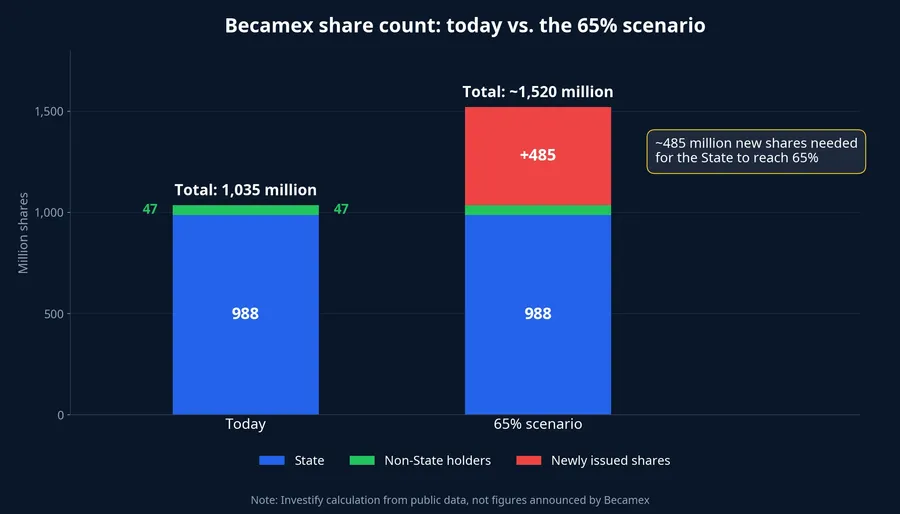
Becamex has about 1.035 billion shares outstanding,Người Quan Sát a market capitalization of roughly VND 39,900 billion at the October 16 close of VND 38,550 per share. With 95.44% held by the People's Committee, the State's stake equals about 988 million shares.
If the State keeps those 988 million shares and wants exactly 65%, the total must rise to about 1.52 billion. That means issuing roughly 485 million new shares, about 47% of the current count. The plan says "above 65%," so the actual number could be lower. For example, if the State's stake stops at 70%, the new issuance would be around 376 million shares, about 36%. This is a calculation from public data, not a figure Becamex has announced.
The biggest difference from a divestment is where the money goes. When the State sells shares it already owns, as Petrovietnam is doing with BSR, the proceeds go to the owner. When a company issues new shares, the proceeds go into the company and raise Becamex's own equity.
The method is not fully settled. At the annual shareholders' meeting in late June 2026, Becamex management said the stake could be reduced through divestment or a new share issue, and that no specific plan had been chosen.Người Quan Sát Yet the plan the city just approved, as the press relays it, speaks of keeping the State's capital unchanged. Becamex's own earlier proposal was also a public share offering to fix its shareholder structure.Tin nhanh chứng khoán Both sources lean toward new issuance, since a divestment would shrink the State's capital, contradicting the plan's wording.
Why 65%
The press has not quoted any explanation from the People's Committee for this figure, so we only note the relevant rule. Under Article 148 of the 2020 Enterprise Law, a set of important shareholder resolutions passes when holders representing at least 65% of the votes cast at the meeting approve.LuatVietnam That set includes changing share classes, changing business lines, changing the management structure, investment projects or asset sales worth 35% or more of total assets, and reorganizing or dissolving the company.
With a stake above 65%, one shareholder would still hold enough votes to pass these resolutions alone, while ordinary resolutions need only above 50%. That is the rule. We do not speculate on why the city chose 65%.
What this means for BCM holders
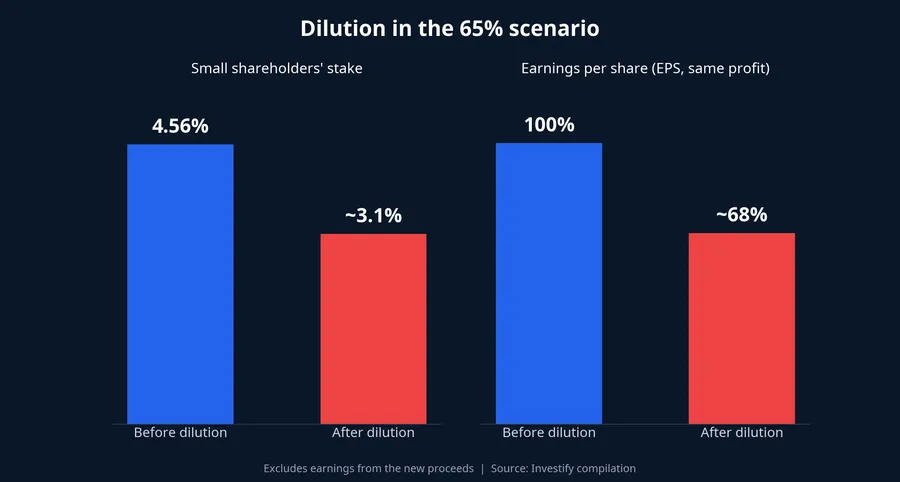
Take the scenario where the State's stake falls to exactly 65% to see the scale. Shareholders outside the State now hold about 47 million shares, or 4.56% of the company. If they buy nothing more, their share of the total falls to about 3.1%. Within the non-State group, the slice they now hold entirely would shrink to about 9%, because the rest would be 485 million new shares. These percentages are our own calculation.
Profit is also divided across more shares. At the same level of earnings, earnings per share (EPS) after the share count rises about 47% would be roughly 68% of the old level. That ignores any new profit the proceeds might generate for Becamex, which depends on how much is actually raised and how it is used, neither of which is known.
The earnings backdrop is not favorable either. In the first half of 2026, Becamex reported consolidated revenue of more than VND 1,600 billion and profit after tax of more than VND 300 billion, both sharply lower than a year earlier.Người Quan Sát
Recent history shows that share issuance at Becamex has never gone smoothly. In 2025 the company planned to auction 300 million shares, aiming to raise about VND 21,000 billion, but postponed it because of unfavorable market conditions. A later plan to offer 150 million shares by public auction was not approved by shareholders.Người Quan Sát Getting the State below 65% would take more new shares than either of those plans.
On price, BCM closed at VND 38,550 on October 16, up VND 300. That move is too small to read as any market reaction to the plan.
What the plan does not yet answer
Four items that determine the real impact on a shareholder still have no answer.
- Number of shares: sets the level of dilution, from a few hundred million up to nearly 485 million shares depending on the final stake.
- Issue price: the closer to the market price, the more money each new share brings in, and the less of existing holders' value is shared out.
- Timing: the city's common timeline puts implementation between July 2027 and the end of 2028, but that is a frame for the whole list, not a Becamex-specific schedule.
- Who can buy: a public auction, like the two 2025 plans, forces existing shareholders to bid if they want to keep their share. An issue with purchase rights for existing shareholders lets them hold their percentage by right.
These answers will only come when Becamex announces a specific issuance plan and puts it to a shareholders' meeting.
Conclusion
The October 14 plan fixes the direction but not the numbers. The direction is dilution: the State keeps its shares, the total count rises, and new money goes into Becamex. If the plan follows its wording, a BCM holder who buys nothing more will see both ownership share and earnings per share thinned. What nobody can yet say is whether the money raised makes up for that thinning.
The deciding variable is the issuance plan Becamex will put to shareholders. If it includes purchase rights for existing holders and a price near the market, dilution is considerably lighter for those who want to keep their share. If it repeats the public auction format of 2025, small shareholders must compete with new investors to hold their position. That document is the one to read closely when it is released.