
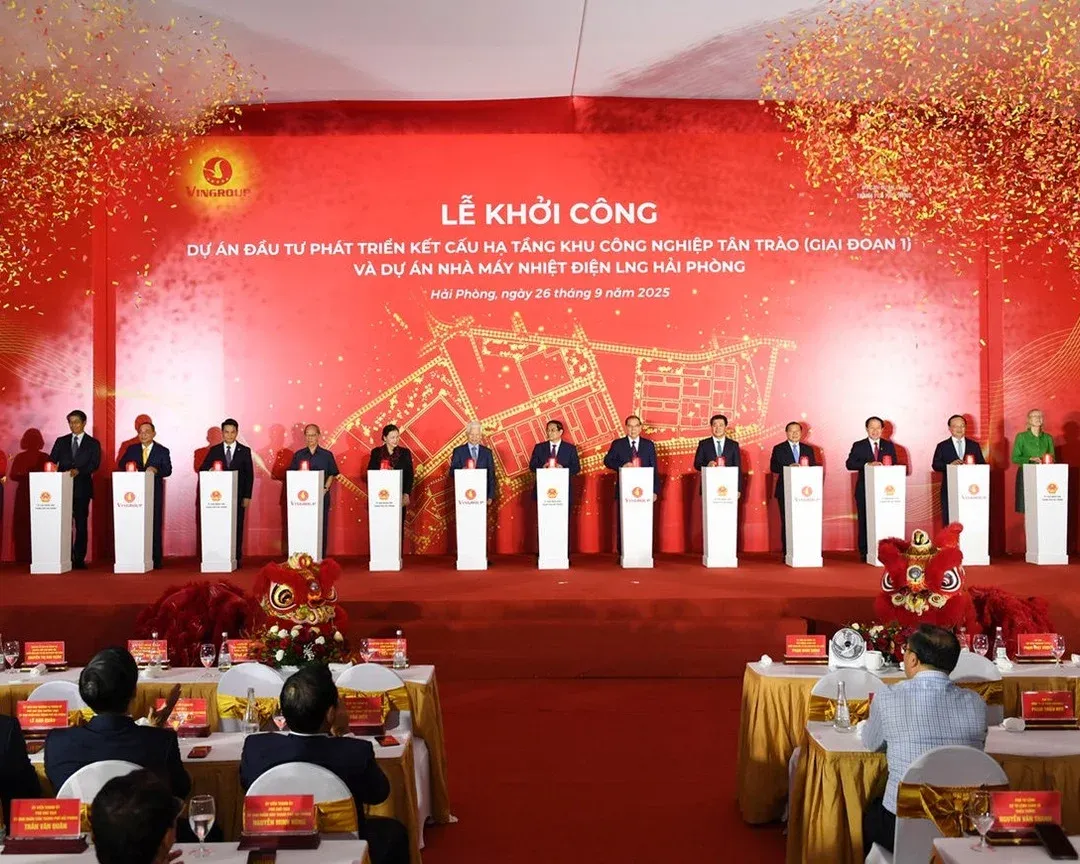

Hai Phong LNG Power Plant broke ground more than a year ago, yet its future is still open. At the Ministry of Industry and Trade's regular Q3/2026 press briefing, Mr. Bui Quoc Hung, Deputy Director of the Electricity Department at the Ministry of Industry and Trade, said the Ministry had received a proposal to replace the plant with a renewable energy complex paired with battery storage. The Ministry has reported to the Prime Minister and recommended continuing the gas-fired plant as set out in the approved plan. On the renewable option, it has asked for the Prime Minister's guidance and will provide details once the competent authority decides.CafeF
As of October 15, no decision has been made. The gas plant has not been cancelled, and the renewable option has not been approved. This article walks through the two possible paths, who carries the burden under each, and which facts will show which path is unfolding.
A project that has come a long way
The project is led by a joint venture of Vingroup and VinEnergo Energy JSC, in the nearly 100-hectare Tan Trao Industrial Park, with total capital of more than VND 178,000 billion.CafeF At the October 14 rate of VND 25,887 per USD, that is roughly USD 6.9 billion.
Design capacity totals 4,800 MW, split into two phases of 1,600 MW and 3,200 MW. Once running, the plant is expected to supply about 9.6 billion kWh a year in phase 1 and 19.2 billion kWh a year in phase 2.Người Quan Sát Groundbreaking took place on September 26, 2025, construction is set to take about five years, and operation is planned for late 2030.CafeF
According to the Electricity Department, it is one of 12 LNG power projects in the revised Power Development Plan VIII (Decision 768/QĐ-TTg). The project has an approved investment policy, a selected investor, a groundbreaking behind it and an agreement for gas turbines from US-based GE.Người Quan Sát Those are the milestones the Ministry cited in recommending the project stay.

Why a project already under construction faces a replacement proposal
The Ministry did not name who made the proposal. CafeF notes that there is no official information yet on the proposer, the capacity or the total investment of the renewable option.CafeF However, in a report published in October 2026, the Institute for Energy Economics and Financial Analysis (IEEFA) cited information that Vingroup pointed to higher LNG prices, driven by the Middle East conflict, as one reason for proposing a change of course.Người Quan Sát
IEEFA's numbers show why fuel prices weigh so heavily. A 4,800 MW plant needs about 5 million tonnes of LNG a year. At early-2026 prices, imported fuel is estimated at USD 3.5–3.8 billion a year. With spot prices near USD 24 per million BTU, as in September 2026, that bill could exceed USD 6.2 billion a year.Người Quan Sát
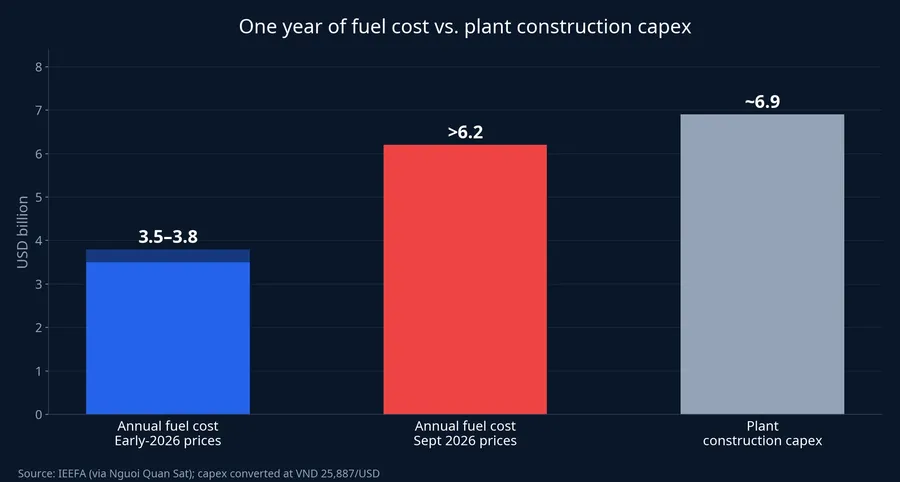
Set USD 6.2 billion beside capital of about USD 6.9 billion and the nature of the problem is clear: at September prices, one year of gas purchases is already close to the entire construction budget. For a gas plant, construction capital is a one-time payment. Fuel is paid again every year for the plant's life, at world prices and exchange rates.
A caveat: these are IEEFA estimates. IEEFA is an independent research institute with a clean-energy stance, and the figures were not published by the developer. Gas prices could also fall if the conflict eases. Even so, the USD 3.5–3.8 billion range at early-2026 prices shows that a return to old prices would still leave a large annual bill.
Path one: the Prime Minister agrees to keep the gas plant
This path assumes the Prime Minister agrees with the Ministry's recommendation and the project continues under the approved plan.
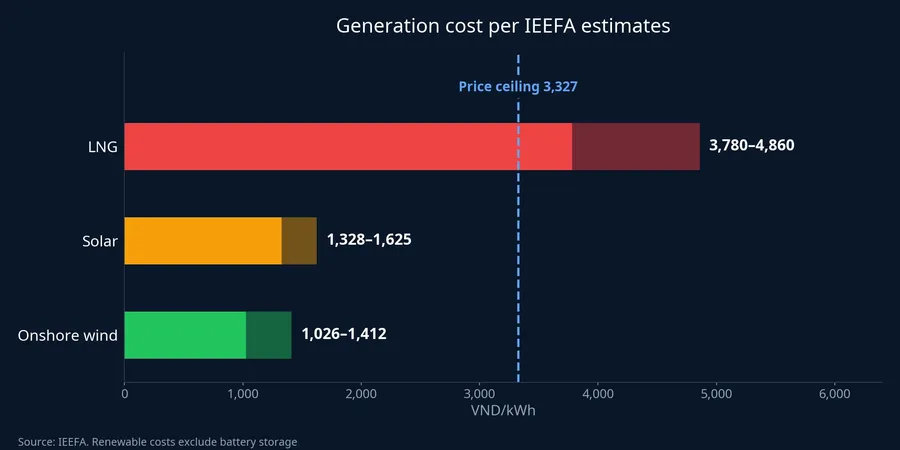
The developer must secure gas supply for many years, through long-term contracts or spot purchases, so operating costs follow international fuel prices and the exchange rate.Người Quan Sát The problem is that input costs are running above the output price allowed. IEEFA estimates LNG generation costs under Q3/2026 market conditions at roughly VND 3,780–4,860 per kWh, above the VND 3,327 per kWh ceiling set by the Ministry of Industry and Trade.Người Quan Sát
When cost exceeds the ceiling, someone has to pay the gap. If the power purchase price stays inside the cap, the gap eats into the plant's profit, which means Vingroup's shareholders carry it. If the price framework is raised to follow costs, the gap shifts to the power buyer and eventually to electricity users. No public information says how the project's power purchase agreement is structured.
Nationally, this path keeps Vietnam on a heavy gas-import trajectory. IEEFA says that if all 22.5 GW of LNG power in the plan to 2030 is built and operated, import demand could reach 18.7 million tonnes a year, costing USD 15.5–23.6 billion. That could raise Vietnam's energy import bill by roughly 66–106% from 2025.Người Quan Sát The Hai Phong plant alone, at about 5 million tonnes a year, would account for a sizeable share.
Path two: the Prime Minister approves renewables with battery storage
This path requires the Prime Minister to approve the proposal and the power plan to be adjusted accordingly. The second point matters: the plant's 4,800 MW of gas capacity sits in the revised Power Development Plan VIII. How that capacity would be handled if the plan changes is not answered by available sources. IEEFA's report also notes that the conversion proposal should be distinguished from an adjustment of the project already approved by the competent authority.Người Quan Sát
For the developer, under the option IEEFA describes, replacing the gas plant with solar, wind and battery storage could require upfront capital about 5 times higher.Người Quan Sát This path pushes the burden forward: the group must raise a much larger sum at the start, while Vingroup also needs capital for many other businesses. In return, the plant buys no fuel, so gas price and exchange-rate risk largely leave the operating equation.
On output cost, IEEFA estimates utility-scale solar in Vietnam at about VND 1,328–1,625 per kWh and onshore wind at about VND 1,026–1,412 per kWh.Người Quan Sát These are costs of the generating source alone. Adding batteries to make supply as steady as a gas plant would raise the figure, and available sources have not published a number for this specific combination.
IEEFA argues that Vingroup's proposal shows lower upfront capital is not necessarily the more economical option over the long run, since investors need to look at total lifecycle cost.Người Quan Sát
Two paths, two shapes of risk
The two paths differ not in whether risk exists but in its shape. Keeping the gas plant means lower construction capital, but it carries an annual fuel bill from about USD 3.5 billion to more than USD 6.2 billion, set by world prices, while generation cost is estimated above the price ceiling. Switching to renewables and storage means roughly 5 times more upfront capital in exchange for no fuel bill, with risk concentrated in fundraising and in whether the power plan is revised.
For Vingroup shareholders, either path is a very large obligation. The first stretches over many years and moves with gas prices. The second is front-loaded into the first few years. With about four years until operation, this is for now a policy variable rather than a source of cash flow for the group.
Which facts will settle it
The facts on hand lean toward path one, because the Ministry has recommended keeping the gas plant under the plan. But the decision belongs to the Prime Minister, and the Ministry chose to seek guidance on the renewable option rather than reject it outright. The firmest conclusion today is that neither path can yet be called.
The deciding fact is the Prime Minister's directive, which the Ministry says it will announce after a decision. When it appears, two things are worth reading. If the gas plant stays, the next question is at what price the power purchase agreement is signed relative to generation cost, since that decides who pays the gap. If the renewable option is approved, watch the capacity, the total capital of the new complex and how the power plan handles the 4,800 MW of gas capacity. That decision could also set a precedent for the remaining 11 LNG projects in the plan, while fuel prices keep moving with the Middle East conflict.