


After nine months of 2026, fees for operating telecom networks, the steadiest income stream at Viettel Construction (ticker CTR on HoSE), account for only 39% of total revenue, down from 45% a year earlier.Tin nhanh Chứng khoán The share it lost has moved to construction and technical solutions, two segments where the company earns money contract by contract.
The company released the figures on October 15. They are self-reported monthly numbers, not the Q3 financial statements. So this piece separates what is already known from what shareholders still have to wait for.

The big picture: revenue is outrunning profit
Looking at the numbers, Viettel Construction booked revenue of nearly VND 12,343 billion for the first nine months of 2026, up 23% year on year. Pre-tax profit was approximately VND 617 billion, up 13%.Tin nhanh Chứng khoán For the same period of 2025, pre-tax profit was VND 545.32 billion.
In Q3 alone, revenue was approximately VND 4,293 billion, up almost 8%, while pre-tax profit was approximately VND 215 billion, up slightly.Tin nhanh Chứng khoán Pre-tax profit in Q3 2025 was VND 209.52 billion, so this quarter's gain works out to only about 3%.
Revenue growth also slowed visibly. In the first half, revenue rose 33.2%, from VND 5,974.81 billion to VND 7,958.84 billion. Q3 growth was just under 8%. Part of the reason is a high base: Q3 2025 revenue was VND 3,965.18 billion, against only VND 3,236.36 billion in Q2 2025. The monthly figures cannot separate how much is the high base and how much is a slower pace of construction work.
Against the full-year plan (revenue of VND 15,653 billion, pre-tax profit of VND 778 billion), CTR has covered approximately 79% on both measures.Tin nhanh Chứng khoán The remaining profit needed, about VND 161 billion, is lower than the pre-tax profit of any single quarter this year. The annual plan is therefore not the big question. The bigger one is how much profit each new dong of revenue is bringing in.
Where the extra revenue comes from
Viettel Construction reports four segments, and over the past nine months they moved at very different speeds.
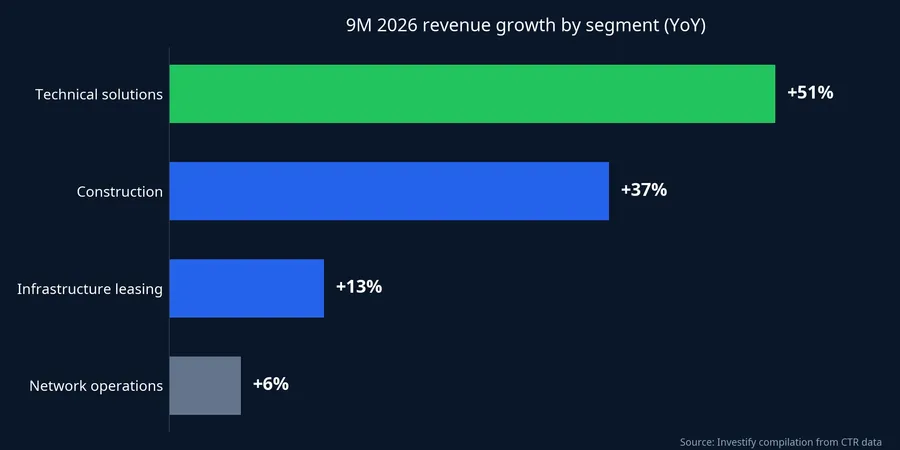
Construction brought in nearly VND 4,670 billion, up 37%.Tin nhanh Chứng khoán Its share of revenue rose from 34% to 38%, only about one percentage point behind network operations.Fili
Technical solutions and services reached more than VND 2,140 billion, up 51%, about 17% of total revenue.Fili Solar power is the fastest-growing piece: new contracts signed over nine months were worth approximately VND 1,700 billion, up 84%.Fili
Infrastructure leasing, meaning towers and sites rented to mobile carriers, earned VND 716 billion, up 13%. It remains the smallest segment.
Network operations, meaning running and maintaining telecom networks, is still the largest at VND 4,754 billion but grew only 6%.Tin nhanh Chứng khoán
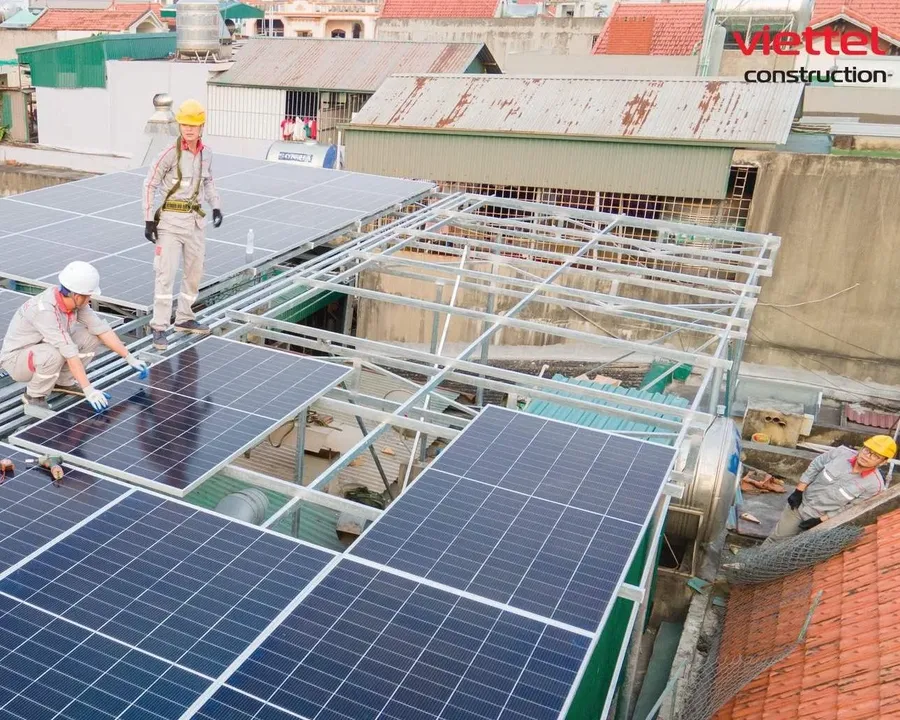
Adding the four up, nine-month revenue grew by about VND 2,400 billion year on year. Working back from each segment's growth rate, construction contributed roughly VND 1,260 billion and technical solutions roughly VND 720 billion. That means more than four-fifths of the added revenue came from these two segments. Network operations contributed only about VND 270 billion.
From recurring fees to contract-based income
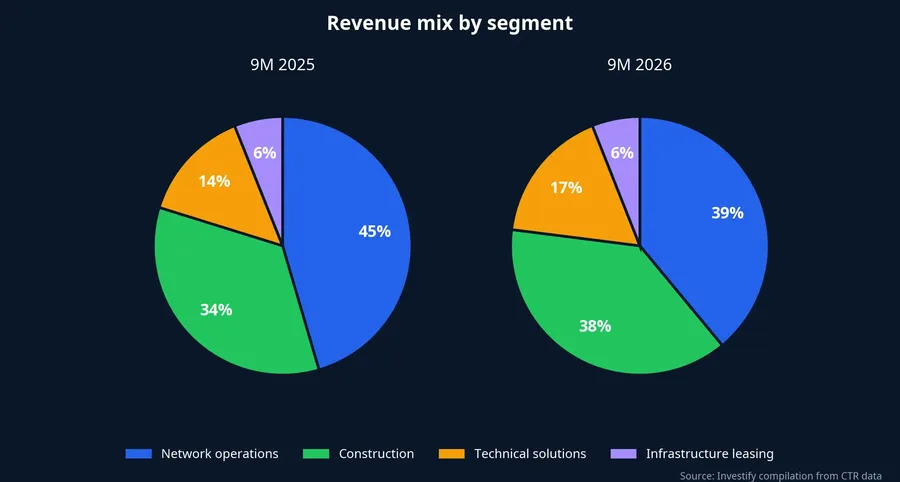
A drop in share from 45% to 39% does not mean network operations is shrinking. Its revenue is still rising, just much more slowly than the rest of the business.
What has changed is how Viettel Construction makes its money. Network operations is a periodic fee for keeping the network running: it arrives every month and moves little. Construction and technical solutions are different. The company has to win each project, revenue is recognized only once the work is done, and when a project ends it must find the next contract. As the mix tilts toward these segments, quarterly revenue depends more on how many contracts are signed and how fast they are built.
On that front, signings look healthy. New construction contracts signed over nine months were worth approximately VND 4,595 billion, up 76%.Tin nhanh Chứng khoán In September alone the company signed another VND 1,035 billion and started 247 new projects, averaging VND 1.46 billion each, above the full-year target average of VND 1.1 billion.Fili
Setting new signings next to construction revenue shows one notable detail. New contracts this year (approximately VND 4,595 billion) are roughly equal to construction revenue already booked (nearly VND 4,670 billion), so new work is replacing completed work almost one for one. The comparison is only indicative, since a contract signed this year can be recognized as revenue over many later quarters. Even so, it suggests construction is not running out of work in the coming quarters.
What is still unknown: margins by segment
Revenue is up 23% while pre-tax profit is up only 13%. The pre-tax profit to revenue ratio for nine months therefore fell from about 5.5% to about 5.0%, based on the company's figures and last year's comparable numbers.
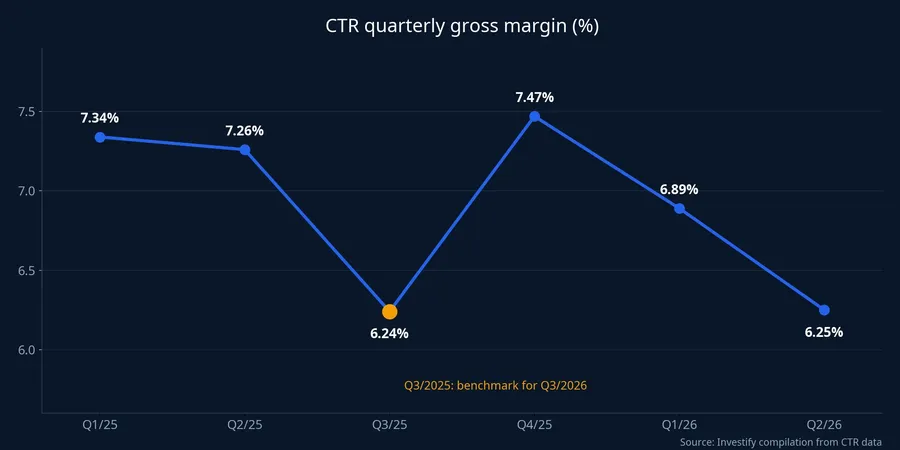
The trend began in the first half. According to the financial statements, gross profit for the first six months of 2026 was VND 522.00 billion, up only 19.8% while revenue rose 33.2%. The Q2 2026 gross margin was 6.25%, below the 7.26% of Q2 2025.
There are three plausible explanations for profit lagging revenue:
- Mix shift. If construction and technical solutions carry lower margins than network operations or leasing, their rapid growth pulls the blended margin down on its own.
- Margins within each segment changed. Causes could include material or labor costs, or the company accepting lower bid prices to win contracts.
- Costs below gross profit. Selling, administrative or financial expenses may be growing faster than revenue.
The monthly self-reported data includes revenue by segment and total profit, but no profit by segment. There is not yet enough data to say which explanation dominates. Shareholders need to wait for the Q3 financial statements.
Under disclosure rules, listed companies must publish quarterly financial statements within 20 days of quarter-end, which means around October 20 for Q3.Thời báo Tài chính If the parent company has separately accounted subsidiaries, the deadline is 30 days. Either way, CTR's report should arrive before the end of October.
When it does, the figure to compare is the Q3 2026 gross margin against 6.24% in Q3 2025. Last year's Q3 was the lowest-margin quarter of 2025, so this is not a demanding base. If this year's Q3 gross margin holds around or above that level, the lag in profit comes mainly from costs below gross profit, and the shift toward construction contracts has not yet thinned gross profit. If gross margin stays below last year's level as it did in Q2, each new dong of revenue from construction and technical solutions earns less profit than the old dong did. Fast revenue growth would then no longer mean a matching rise in profit.
The stock and the long-term target
CTR closed on October 15 at VND 68,100, down about 4.8% from the start of October and nearly 9.8% from the start of September.Tin nhanh Chứng khoán Most of that decline came before the nine-month figures were released, so it does not fully reflect the market's reaction to the results. The October 16 session is the first full session after the release.
Over the long term, Viettel Construction targets 2030 revenue of VND 28,790 billion and pre-tax profit of VND 1,315 billion.Tin nhanh Chứng khoán Those two numbers imply that the company itself expects a pre-tax profit to revenue ratio of only about 4.6% in 2030, below the roughly 5.0% of this year's nine months. The target fits the direction already visible: the company grows through contract volume and accepts a thinner profit on each dong of revenue.
Conclusion
On the available data, the picture is fairly clear. Viettel Construction is moving from a business that lives mainly on recurring operating fees to one that lives more on construction and technical contracts, with enough new contracts to sustain revenue momentum. What remains open is the price paid in margins. The Q3 gross margin against the 6.24% benchmark of Q3 2025, in the financial statements due before the end of October, will give the first answer.