

Vietnam's banks hold two property loan books of almost equal size. One is money lent to businesses and individuals to do real estate business. The other is money lent to households for consumption or their own use of property, including loans to buy a home to live in. Each book has a balance of about VND 2.6 quadrillion.CafeF Over the first eight months of 2026, though, the two grew at very different speeds.
The figures were presented by State Bank of Vietnam (SBV) Deputy Governor Nguyễn Ngọc Cảnh at the first meeting of the reconstituted Central Steering Committee on housing policy and the real estate market, held on the morning of October 13 at the Government Office.

One book, two speeds
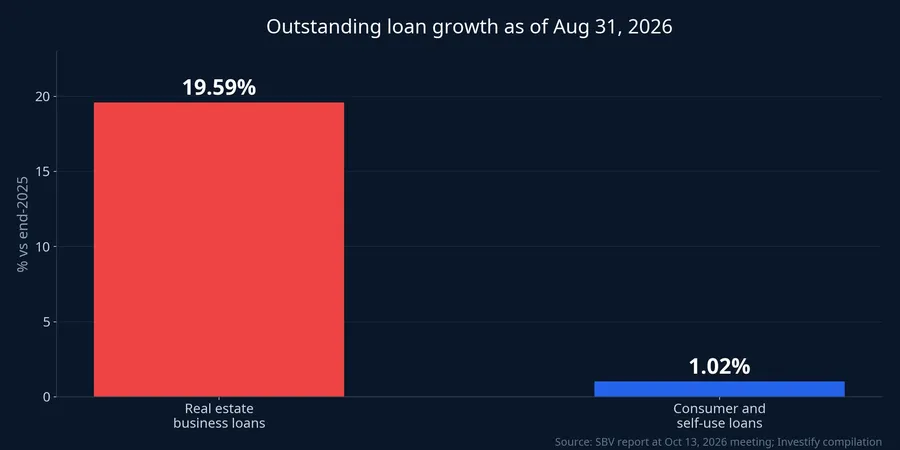
Start with the total. As of August 31, 2026, property credit at credit institutions stood at VND 5.21 quadrillion, up 9.49% from the end of 2025.CafeF That is 25.39% of all outstanding credit in the economy.Người Quan Sát Put simply, more than one of every four dong banks lend is tied to property.
Split the book in two and the picture changes:
| Metric | Real estate business loans | Consumer and self-use property loans |
|---|---|---|
| Balance at Aug 31, 2026 | VND 2.59 quadrillion | VND 2.61 quadrillion |
| Share of the property book | 49.85% | 50.15% |
| Growth vs end-2025 | 19.59% | 1.02% |
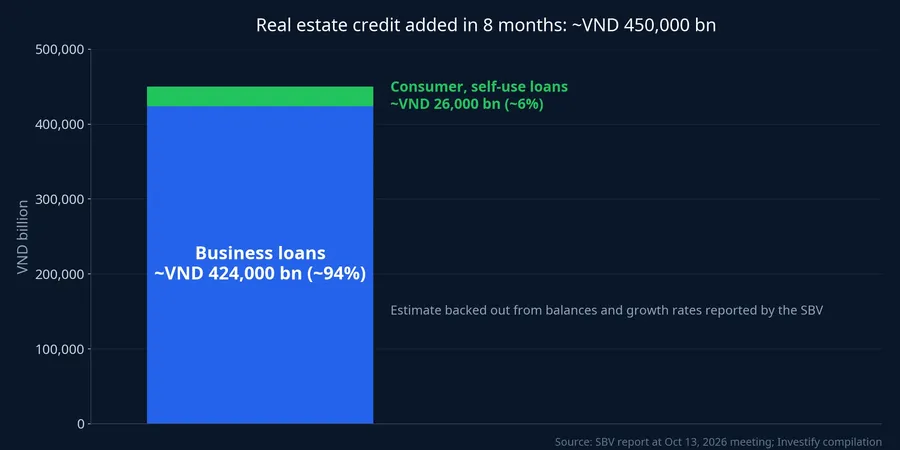
| Amount added (estimate) | about VND 424,000 billion | about VND 26,000 billion |
A note on the last row: it is not an SBV figure. It is backed out from the reported balances and growth rates. If business loans reached VND 2.59 quadrillion after growing 19.59%, that group stood at about VND 2.17 quadrillion at end-2025. The same arithmetic puts the consumer and self-use group at about VND 2.58 quadrillion.
On that basis the whole book added about VND 450,000 billion in eight months. Roughly 94% of the increase came from business loans, and only about 6% from consumer and self-use loans.
The result is that the ordering inside the book has nearly flipped. By this estimate, business loans were only about 46% of the property book at the end of 2025. By August 31, 2026, that share had reached 49.85%, less than half a percentage point behind the home-use and consumer group. If both growth rates hold at their eight-month pace, business loans will soon be the larger group.
What the 2026 credit cap does and does not tell us
According to Deputy Governor Cảnh, the SBV instructed credit institutions in 2026 to keep property credit growth from exceeding each bank's own overall credit growth.CafeF There is one carve-out: the increase since end-2025 in lending for social housing, industrial parks and export processing zones, and for restaurants, hotels, tourism, eco-resort and holiday areas is excluded from property credit when the cap is calculated.
That rule calls for a more careful reading of the 19.59%. Banks can lend more to those segments without it counting against the property growth ceiling. So part of the extra money in business loans may have gone into industrial parks, hotels, resorts or social housing projects.
However, the report at the meeting did not break the 19.59% down by segment. We cannot tell how much of the roughly VND 424,000 billion belongs to the excluded segments and how much to commercial housing projects. The data are therefore not enough to call the growth in business loans speculative. They show only that, over eight months, bank money entering property went mainly through those building and doing business, not through home buyers.
There are other readings. Many projects may be under construction, so funds reach developers first and buyers only at handover. It is also possible that the excluded segments pushed business loan balances up quickly. The available figures do not allow us to choose between them.
Social housing: small next to the book, and also tilted toward developers
Bank lending for social housing stands at more than VND 51,000 billion, of which the Vietnam Bank for Social Policies has lent more than VND 26,000 billion and commercial banks more than VND 25,000 billion.Người Quan Sát Against a VND 5.21 quadrillion book, that is under 1%.
Under the Resolution 33/NQ-CP lending program, banks had disbursed about VND 17,500 billion by August 31, 2026. About VND 15,000 billion went to developers and VND 2,500 billion to home buyers. The program for buyers under 35 has disbursed only about VND 577 billion so far.Người Quan Sát
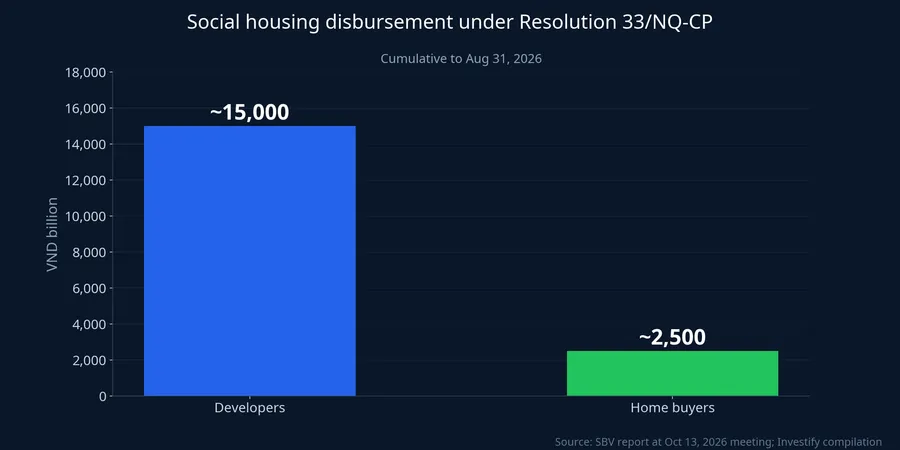
For social housing, the tilt toward developers has a fairly clear explanation: projects must be built before buyers can borrow to take possession. What deserves watching is whether the gap narrows once projects start handing over.
For bank shareholders
At the meeting, Deputy Governor Cảnh stressed that property investment is medium to long term, while banks fund themselves mostly with short-term money. In his words, that maturity gap can create liquidity risk if borrowers fail to repay on time, which is why funding channels for property need to be diversified.CafeF
For shareholders, this risk is not spread evenly. A bank with a high share of property lending, especially to developers of large projects, is more exposed when project sales cash flow slows. A personal home loan is usually repaid monthly from the borrower's income. A project loan depends on the project selling units and collecting payments on schedule.
So when third-quarter bank results come out, look at the note on loan structure by sector: what share is property, and how has it changed since end-2025. It is a gauge of risk, not a buy or sell signal for any particular stock.
For people borrowing or planning to borrow for a home
The 1.02% figure is growth in the balance, not new disbursement. A balance that barely moves does not mean nobody is borrowing. It means what households borrowed over eight months was close to what they repaid.
The report did not explain why this group grew slowly, and the sources do not separate home-purchase loans from other consumer loans tied to property. This article therefore stops at what the data show: in the first eight months of the year, the added property debt barely came from this group of borrowers.
Conclusion
From the start of the year to August 31, 2026, bank money flowing into property went mainly through businesses and individuals doing real estate business. About 94% of the added balance belongs to that group, while loans to home-use buyers and consumers hardly moved. Part of it may sit in segments the SBV lets banks exclude, such as industrial parks or social housing, but the source does not say how much.
This gap reflects an eight-month window and is not yet enough to call a long-term trend. Credit data for the final months of the year will show whether the two speeds converge. If home-use lending stays near 1% growth while business lending keeps growing close to 20%, business loans will become the larger group in the property book. The maturity-gap risk the Deputy Governor himself raised at the meeting would then weigh more heavily on project loans.