


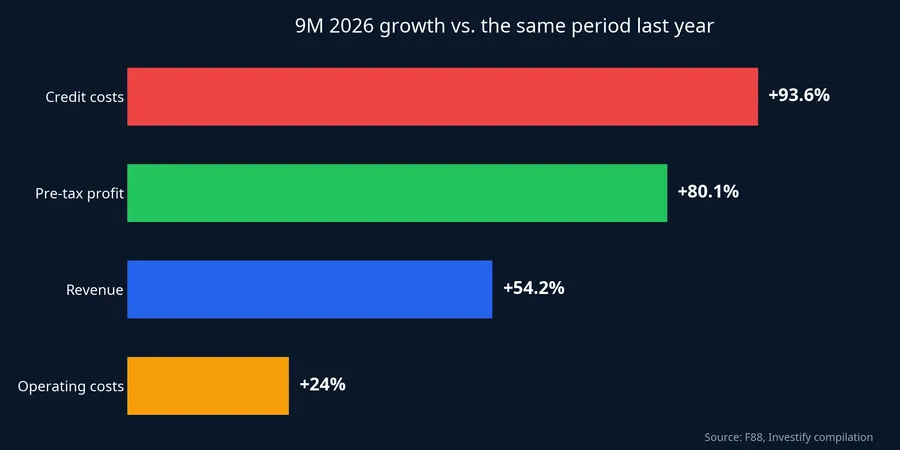
F88 Investment JSC (ticker F88, traded on UPCoM) has released its third-quarter and nine-month 2026 results. Pre-tax profit for the nine months came to VND 1,087 billion, up 80.1% year on year and about 96% of the full-year target approved by shareholders. Total revenue rose 54.2% to VND 4,349 billion.Tin nhanh chứng khoán
Profit outpacing revenue is common for a company that is expanding. The more telling detail is elsewhere: the line item tied most directly to the risks of pawn lending also grew faster than revenue. According to the company's figures, nine-month credit costs were about VND 1,316.5 billion, up 93.6%.Công luận If a cost nearly doubles and profit still climbs 80%, the offset has to come from somewhere else.
Where the extra revenue went
The easiest way to see where profit came from is to follow the additional revenue. From the 54.2% growth rate, nine-month 2025 revenue works out to roughly VND 2,820 billion, so F88 collected about VND 1,530 billion more this year. Using the same arithmetic on the published figures, credit costs rose by about VND 636 billion, and pre-tax profit rose by about VND 484 billion from roughly VND 603 billion in the first nine months of 2025.
In other words, credit risk absorbed more of the incremental revenue than profit did. Over the full period, about 30 dong of every 100 dong of revenue went to credit costs, versus about 24 dong a year earlier. Profit still grew strongly because the other large cost lines grew much more slowly.
A cost base that grows slower than revenue
The clearest offset is operating cost: rent, salaries and the running costs of the branch network. These rose 24% over nine months, less than half the pace of revenue. The cost-to-income ratio fell to 43%, down 10.3 percentage points from a year earlier.Thị trường Tài chính Tiền tệ
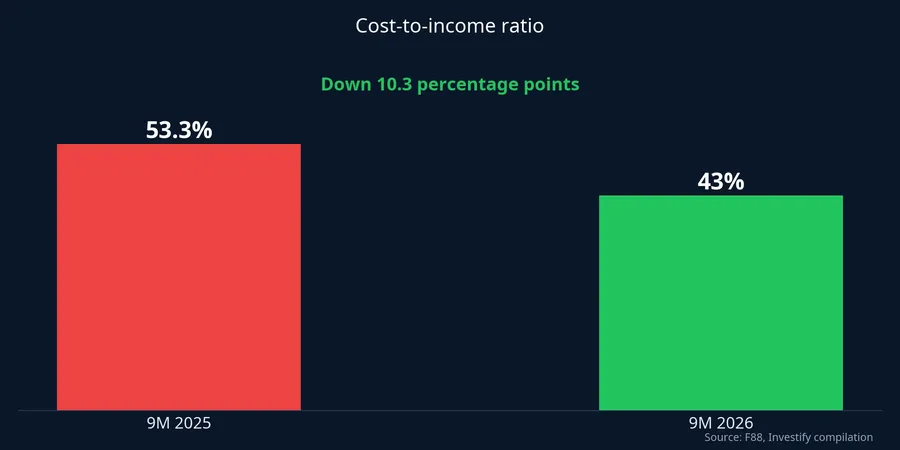
This fits how a pawn-lending chain scales. F88's network has reached 1,000 branches, in line with its start-of-year target. Once a branch has paid back its opening costs, each additional loan written there adds almost nothing in rent or headcount. In the third quarter alone, the company had about 95,500 new borrowers, and 68% of customers were repeat borrowers.Thị trường Tài chính Tiền tệ Repeat customers cost nothing to find, and their repayment history is already in the system.

Cheaper money, wider funding
The second offset is the cost of funds. The trailing 12-month cost of capital stood at 13.3%, versus 14.4% a year earlier.Thị trường Tài chính Tiền tệ For a company that borrows in order to lend, a drop of more than one percentage point across a loan book worth thousands of billions of dong is a meaningful saving, although the published data does not allow an exact conversion into money.
Funding costs fell while F88 had to raise a lot of new money. Net loans outstanding at 30 September reached VND 9,540 billion, up 32.2% from the start of the year and 48.8% year on year, an increase of about VND 2,320 billion in nine months. The company named VND 833.5 billion of public bonds and VND 781.9 billion from a public share offering as new funding. Together that is about VND 1,615 billion, roughly 70% of the increase in loans. In the third quarter the board also approved foreign borrowing of up to USD 50 million.Báo Đầu tư
One detail is easy to miss in the VND 9,540 billion figure: according to the disclosure, it includes loans disbursed by partner banks.Tin nhanh chứng khoán On those loans F88 manages the collateral, earns service fees and still carries the related credit risk. The money belongs to the bank, so this part of the book does not push up F88's own funding cost, yet if a borrower defaults, F88 still bears the loss. That may be one reason funding costs can fall while credit costs surge, though the disclosure does not break this out.
Insurance: small but fast-growing
Besides lending, F88 distributes insurance, partly under the Ngôi Nhà Xanh brand. Nine-month revenue from this segment was nearly VND 583 billion, up 74.6%, faster than lending at nearly VND 3,728 billion, up 52.4%.Thị trường Tài chính Tiền tệ
That puts insurance at about 13.4% of nine-month revenue, up from about 11.8% a year earlier. The segment needs no lending capital and carries no bad debt, so each dong of insurance revenue typically retains more profit than a dong of loan interest. Still, at around 13% of the total, insurance is a supporting driver. Most of the profit continues to depend on the quality of the loans.
Q3: profit grows slower than revenue
Comparing the third quarter with the first half shows the rhythm of profit has changed. In Q3, revenue was VND 1,591 billion, up 48%, while pre-tax profit was VND 401 billion, up 42.1%.Tin nhanh chứng khoán Subtracting Q3 from the nine-month total puts first-half pre-tax profit at about VND 686 billion, more than double the roughly VND 321 billion of the first half of 2025. In the first half profit grew far faster than revenue; in Q3 it grew more slowly.
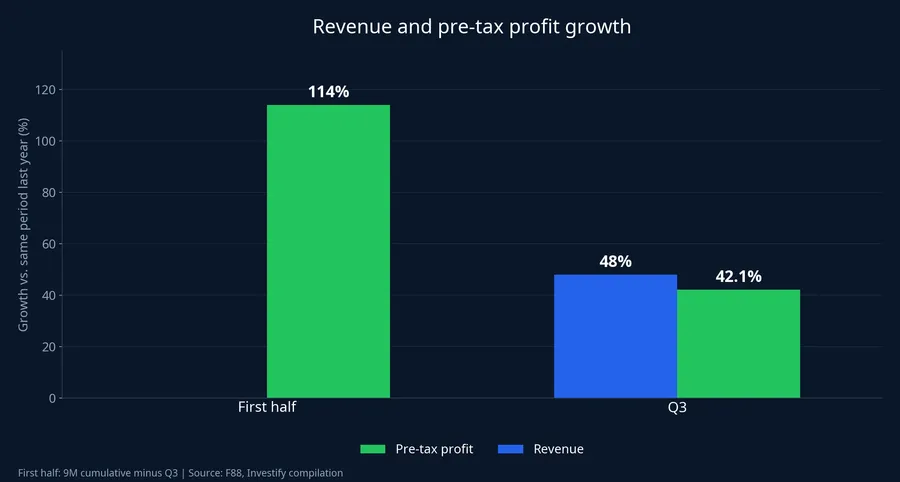
There are two explanations, and they are not mutually exclusive. The first is the base effect: F88 earned about VND 282 billion in Q3 last year, nearly as much as the whole of the first half of 2025, so the percentage gain against such a high quarter is naturally lower. The second comes from the company itself. In its release, F88 said revenue growth, operating efficiency and funding optimization supported profit, while credit costs remained under pressure. It said it is adjusting policy by customer segment and region, tracking early-warning risk indicators and tightening underwriting.Thị trường Tài chính Tiền tệ
The published figures do not isolate Q3 credit costs, so it is not possible to say which explanation weighs more. Still, with nine-month credit costs up 93.6% and the company itself pointing to the pressure, there is reason to think loan risk is part of the Q3 slowdown, alongside the high base.
Where overdue loans go
How F88 handles bad debt explains why credit costs are so large and so sensitive. Under company policy, loans more than 90 days overdue are written off the balance sheet and then continue to be tracked and recovered. Bad debt therefore does not sit on the books waiting; it reaches the cost line fairly early, and later recoveries are recorded separately. Over nine months, income from previously written-off debt was VND 289 billion, up 9.1%.Thị trường Tài chính Tiền tệ
The two numbers move at very different speeds: credit costs up 93.6%, recoveries on written-off debt up only 9.1%. The company says its net write-off ratio remains within a controlled range, but the release does not give the actual ratio.
What the model rests on
Putting the pieces together, F88's nine-month profit growth came mainly from operating efficiency: a 1,000-branch network that costs money more slowly than it generates revenue. Lower funding costs and a fast-growing insurance arm added to that at a smaller scale. All three together were large enough to absorb credit costs that nearly doubled, with room left for profit to grow 80.1%.
Operating efficiency, however, has a natural limit. The cost-to-income ratio fell by more than 10 percentage points in a year and is unlikely to keep falling at that pace. When that saving slows, credit risk cost becomes the variable that decides profit, especially since loans outstanding have grown 32.2% since the start of the year and newer loans need more time to show whether borrowers can repay.
Management expects full-year pre-tax profit of VND 1,500 billion, about 32% above the plan approved by shareholders.Báo Đầu tư That is the company's expectation, not a figure already achieved. To reach it, Q4 alone would need about VND 413 billion in profit, higher than Q3.
The evidence on how durable this profit is sits in the full Q3 financial statements: Q3-only provisions and write-offs, the size of overdue loans before they leave the balance sheet, and the portion of partner-bank loans on which F88 carries risk. If Q3 credit costs grew more slowly than loans, the profit slowdown was mostly the high base. If they still grew faster than loans, operating savings are being eaten away by loan risk, and the VND 1,500 billion expectation will depend more on how tightly F88 underwrites borrowers.
This matters to several groups. F88 shareholders need to know how durable earnings are. Buyers of F88's public bonds are paid out of the same profit stream and the quality of those same loans. And for borrowers pledging motorbikes and phones at the 1,000 branches, the company's funding cost and loan risk sit behind the interest and fees they pay.