
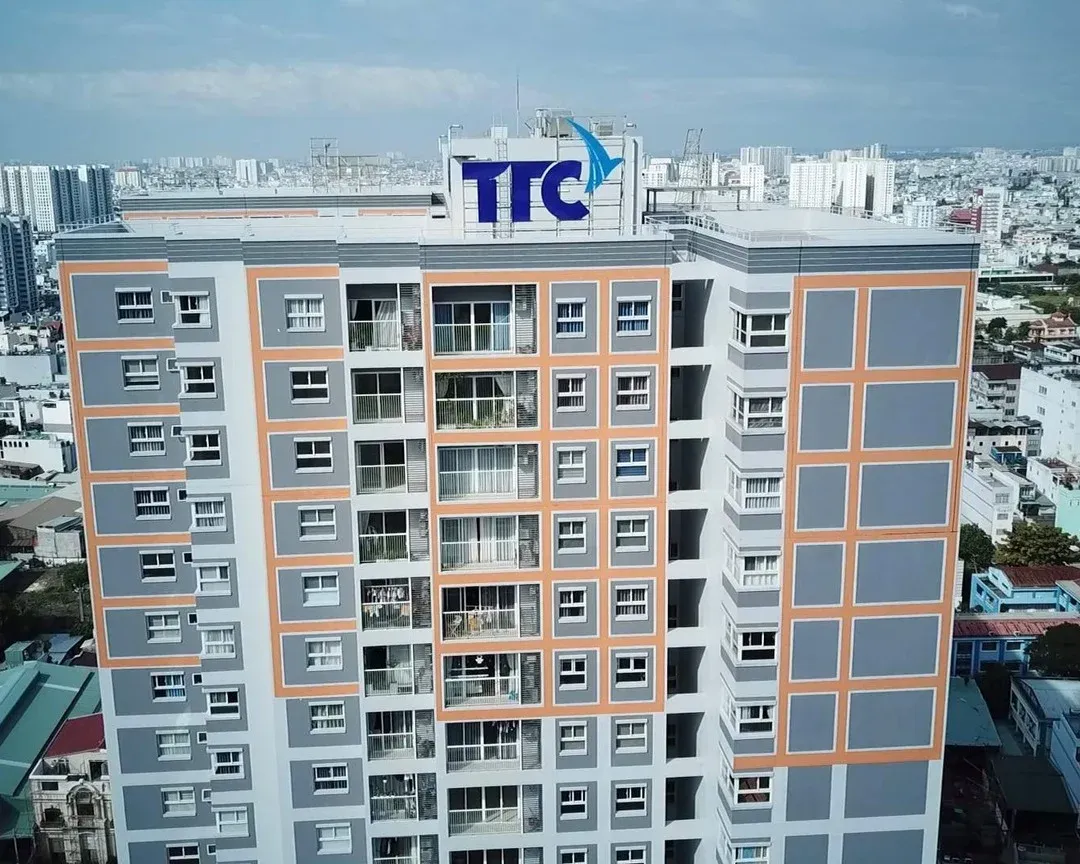

On October 9, the State Securities Commission's inspectorate fined Sai Gon Thuong Tin Real Estate JSC (TTC Land, ticker SCR) VND 85 million for failing to register and deposit privately placed bonds on time.Vietstock The penalty was issued under Point dd, Clause 2, Article 8 of Decree 156/2020/ND-CP.
Put simply, the fine is tiny next to the bond issue it names: SCR12401, VND 850 billion, 8,500 bonds, a 60-month tenor, fully issued on December 30, 2024 and maturing on December 30, 2029.Vietstock The fine says little about the bond's health. What deserves attention is elsewhere: interest rose sharply after the first year, a bank guarantees payment, and the money went into a resort project on Phu Quoc.

The Fine Is About Timing, Not About Repayment
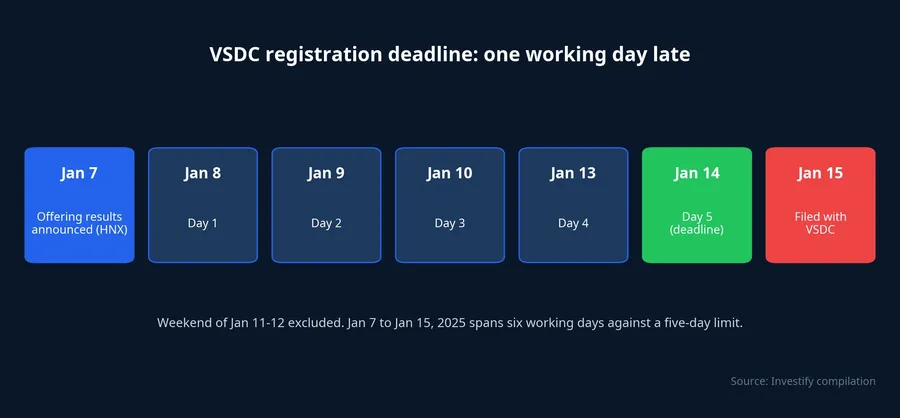
According to the decision, TTC Land announced the offering results on HNX on January 7, 2025, but only filed its first registration documents with the Vietnam Securities Depository and Clearing Corporation (VSDC) on January 15, 2025.Vietstock The rule for private bonds sets the VSDC registration deadline at 5 working days from the announcement of offering results.Báo Đấu thầu From January 7 to January 15, 2025 there are six working days, so TTC Land was exactly one day late. The company explains that reconciling procedures among the parties delayed the filing by one working day, and says it has complied with the decision.Vietstock
Why would one day's delay draw a fine? Registration and depository at VSDC puts bond ownership into a central ledger. From then on, who holds how many bonds is recorded in a place independent of the issuer, and transfers must run through HNX's private-bond trading system. Before this step is complete, buyers rely only on the issuer's books and its advisers. A short deadline exists so that gap does not stay open.
The limits of this step also matter. Registration at VSDC does not confirm that an offering is valid or that the issuer can repay principal and interest.LuatVietnam The fine therefore speaks only to TTC Land's procedural discipline, not to its ability to pay. On that front, the company says no bond principal or interest is overdue.Vietstock That is the company's own statement, and the payment reports filed with HNX are where it can be checked.
Floating Interest Pushed the Borrowing Cost to 11.7% a Year
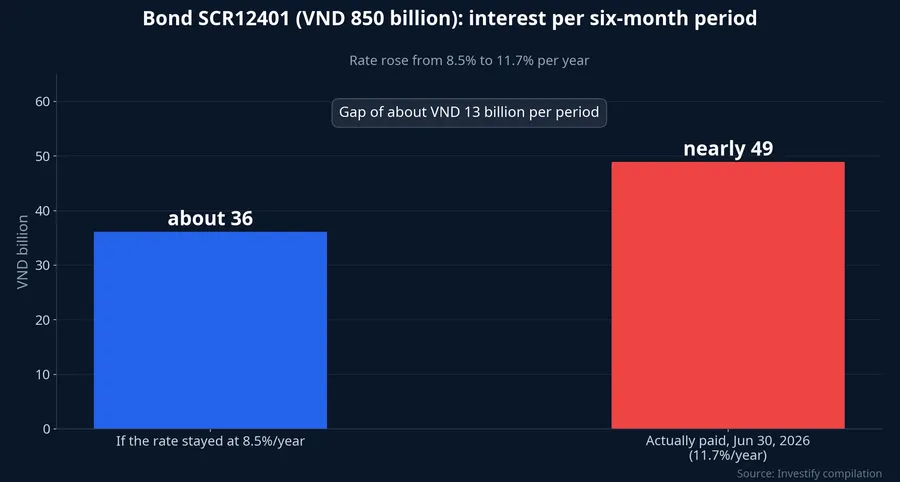
SCR12401 paid 8.5% in the first year, with later periods floating.Vietstock According to the principal and interest payment report for January 1 to June 30, 2026, filed with HNX, TTC Land paid nearly VND 49 billion in interest, equal to 11.7% a year. The company says the June 30, 2026 payment cost more than VND 48.9 billion.Vietstock
A simple calculation shows the gap. If the rate had stayed at 8.5% a year, half a year on VND 850 billion would cost about VND 36 billion. At 11.7% a year, the latest period cost nearly VND 49 billion. The extra is roughly VND 13 billion every six months, meaning interest rose by more than a third from the first year while the amount borrowed did not change.
Floating interest on corporate bonds is usually a reference rate plus a fixed margin, where the reference is often the average 12-month deposit rate at a group of banks. The public sources we reviewed on SCR12401 do not state the reference rate or the margin, so we cannot say whether the 11.7% comes from a higher reference rate or a wider margin. The consequence is clearer: under a floating structure, when deposit rates rise, TTC Land's next interest payment rises with them, and vice versa. The borrowing cost of this bond is no longer in the company's hands.
SCR Shareholders Ultimately Bear This Interest
Nearly VND 49 billion of interest should be set against earnings for the same period. In the first half of 2026, TTC Land posted consolidated net revenue of more than VND 336 billion, down 35% year on year. Financial expenses rose 10% to more than VND 143 billion. Pre-tax profit was nearly VND 24 billion, down 53%. The full-year plan is VND 100 billion in pre-tax profit, so after six months the company had covered about 24% of the distance.Vietstock
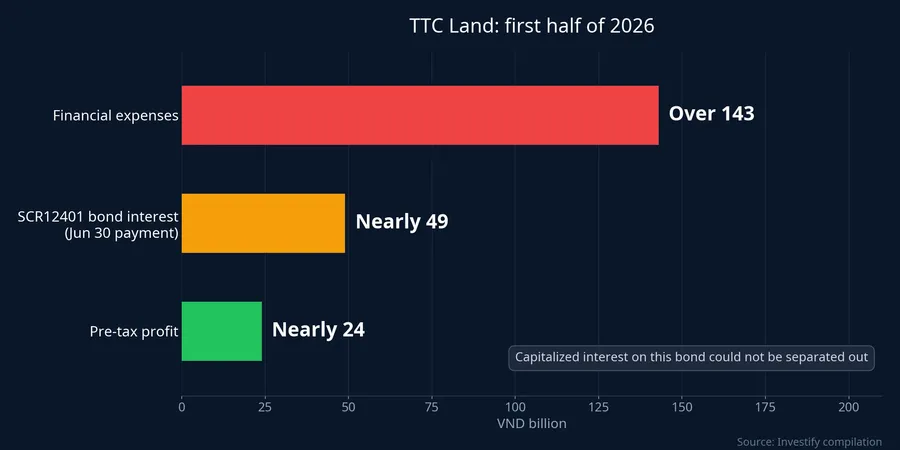
One point needs clarifying before comparing VND 49 billion with VND 24 billion. The VND 49 billion is cash actually paid to bondholders. On the income statement it may sit inside the VND 143 billion of financial expenses, or it may be capitalized, meaning added to the value of the project cooperation investment instead of being deducted from profit immediately. The disclosed data we have does not separate out capitalized interest for this bond alone, so saying the bond interest is "double the profit" lacks sufficient basis.
Accounting treatment only decides when the cost appears in the reports. If booked straight to financial expenses, each quarter's profit gets thinner. If capitalized, the investment's carrying value swells, and the cost returns when the project books revenue or when the investment needs a provision. Either way the interest is the company's money, and the one who ultimately bears it is the SCR shareholder. SCR shares closed at VND 4,020 on October 12, not far from the VND 3,860 low of mid-November 2022.Vietstock
OCB Guarantees Payment: Bondholders Get an Extra Layer of Cover
According to Vietstock, SCR12401 is guaranteed for payment by Orient Commercial Joint Stock Bank (OCB).Vietstock In its explanation, TTC Land referred only to one credit institution providing the guarantee, without naming it.Vietstock
A payment guarantee means the bank commits to pay on the issuer's behalf if the issuer cannot meet an obligation when due, within the scope of the guarantee contract. For a bondholder, the main risk shifts from the health of a real estate company with falling profit to the paying capacity of a bank. That is a big difference from many property bonds secured only by shares or project asset rights.
How far that cover reaches is unclear. The public sources available do not say whether OCB guarantees all principal and interest or only part, whether the guarantee runs as long as the bond's 2029 maturity, or what steps a bondholder must take to call on the bank. For anyone holding this bond, those are the terms to read in the disclosure document issued before the offering.
Where the VND 850 Billion Went
Under the plan approved by the board on December 24, 2024, the bond proceeds go to a resort at plot A4-1 and a tourism and lodging services complex at plot B1-9 in the Vinh Dam complex (Selavia Phu Quoc).Vietstock The developer is Toan Hai Van JSC, a member of the TTC Group. On the same day the board approved cooperating with Toan Hai Van, with TTC Land expected to contribute VND 2,245 billion over a five-year cooperation period, profits shared in proportion to each side's actual contribution.
So the VND 850 billion of bonds is only part of a much larger commitment. At the time, TTC Land estimated the investment would yield about VND 690 billion in profit and said it would disburse by the end of Q1 2025 at the latest. Selavia Phu Quoc has total investment of VND 12,664 billion according to the December 2025 investment certificate, spans 290 hectares, and broke ground on April 1, 2021.Vietstock
The money has been out for more than a year and a half, but signs of returns are not yet visible in the reports. In the first half of 2026, TTC Land's financial revenue fell 31% to nearly VND 116 billion.Vietstock That figure pools several income sources, so the Selavia portion cannot be read on its own. The project may not have reached the profit-sharing stage. Profit may be recognized on a schedule different from the reporting period. Or the cooperation may genuinely not have produced a return yet. The data available is not enough to choose among these explanations.
What This Means for the Two Groups of Holders
For SCR shareholders, this bond has become a cost that moves with the interest-rate environment, paid every six months until 2029, while profit from the place that received the money is still not showing in the reports. Until the Selavia cooperation shows returns, each interest payment is a deduction from the company's value, whether booked now or later. When deposit rates fall the burden eases; when they rise it grows heavier.
For bondholders, the picture is more comfortable. They received 11.7% a year in the latest period, well above deposit rates, and the repayment obligation has a bank standing behind it. The October 9 fine does not change that. What needs checking is the scope of OCB's guarantee, because it decides how much of their money is covered if TTC Land runs into trouble.
SCR12401 also gives anyone studying private corporate bonds a compact reading frame: how the floating rate is calculated, who guarantees and how far, and whether the bonds were registered and deposited at VSDC on time. Whether the Selavia cooperation has yet produced returns cannot be concluded from the data. SCR's upcoming Q3 financial report, together with the notes on the cooperation contract with Toan Hai Van, will be the first data point to narrow that question.