
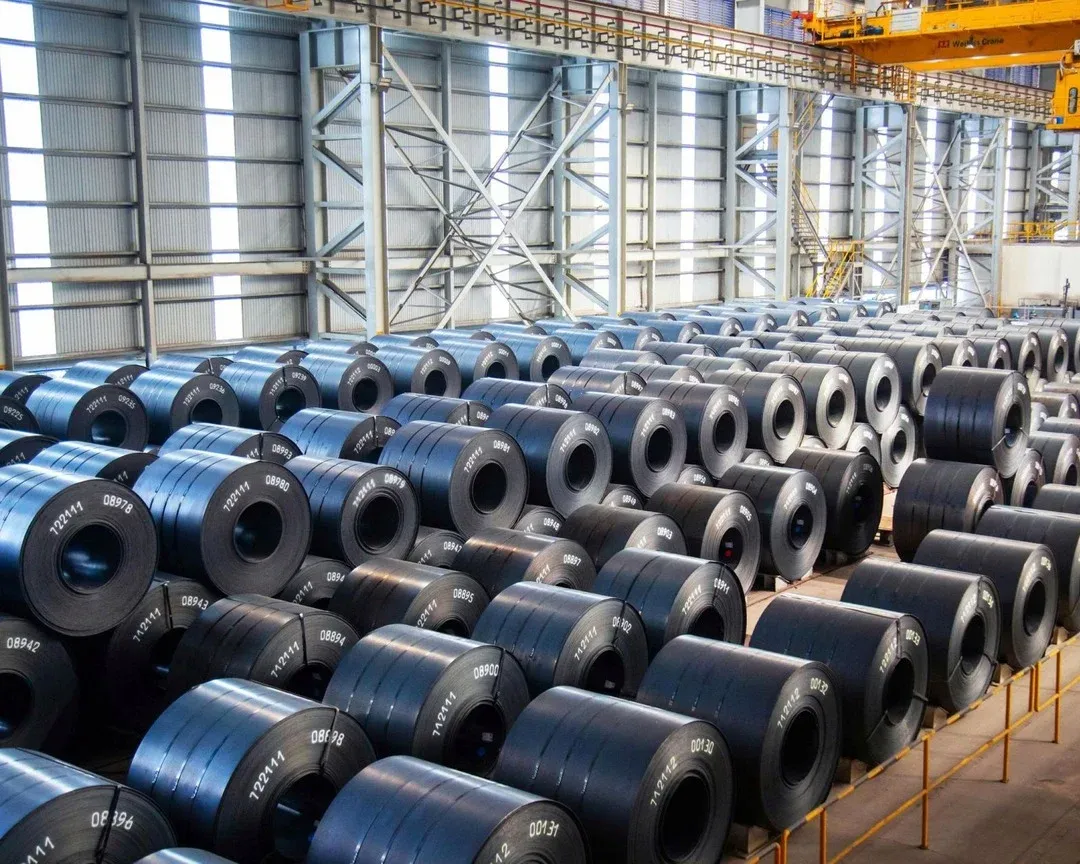

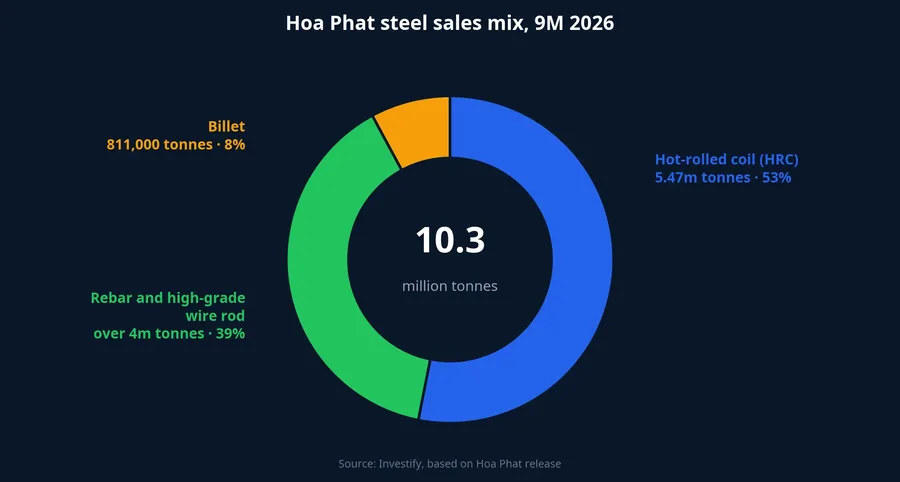
On the morning of October 12, Hoa Phat Group (HPG) released its third-quarter production and sales figures. Of the 10.3 million tonnes of steel sold in the first nine months of 2026, hot-rolled coil (HRC) accounted for 5.47 million tonnes, or about 53% of sales of the main steel products.CafeF Construction steel, the product long associated with the Hoa Phat name, now ranks second.
For anyone holding HPG, that change in the mix matters more than the volume growth itself. It means the group's results will track regional coil prices and overseas orders more closely than they track home building in Vietnam.
Nine-month volumes
In Q3 alone, Hoa Phat produced 3.7 million tonnes of crude steel, up 3% from Q2. Sales of construction steel, high-grade wire rod, HRC and billet reached 3.8 million tonnes, up 8% from Q2 and 54% from Q3 2025.CafeF
Cumulatively over nine months, the group produced 10.7 million tonnes of crude steel, up 35% year on year, and sold 10.3 million tonnes, up 39%. Crude steel capacity is now 16 million tonnes a year.CafeF Annualizing the nine-month output gives roughly 14.3 million tonnes, which means the furnaces are running at close to 90% of capacity. There is less room to lift volume further in Q4 than there was early in the year.
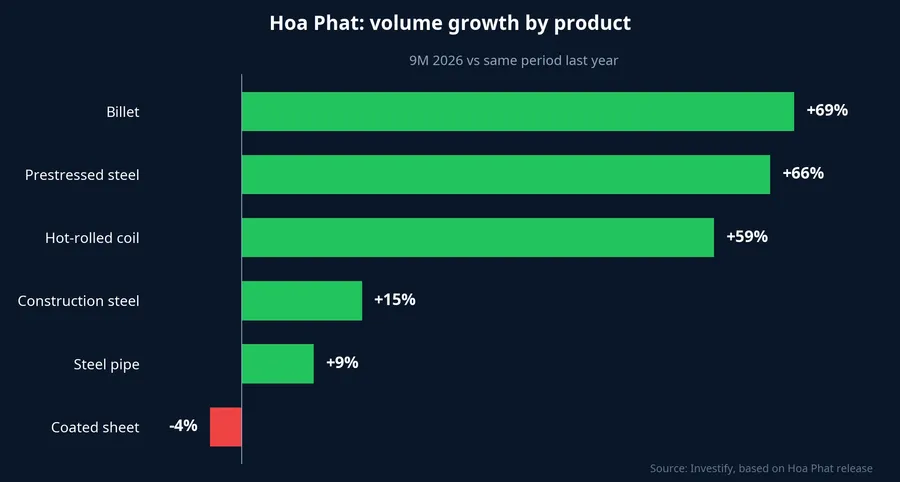
Product groups grew at very different speeds. HRC reached 5.47 million tonnes, up 59%, with Q3 alone above 2 million tonnes, up 64% year on year. Construction steel and high-grade wire rod came to over 4 million tonnes, up 15%. Billet reached 811,000 tonnes, up 69%.CafeF
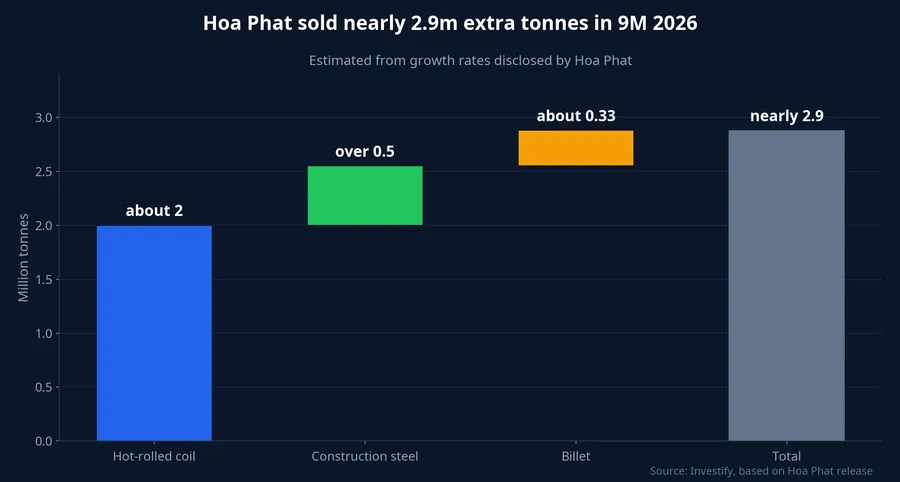
Working backward from the growth rates Hoa Phat disclosed, the group sold about 7.4 million tonnes in the first nine months of 2025, of which HRC was about 3.4 million tonnes. Of the nearly 2.9 million tonnes sold on top of that this year, HRC contributed about 2 million tonnes, roughly 7 in every 10 extra tonnes. Construction steel added over half a million tonnes and billet about 330,000 tonnes. These are our own estimates, not figures Hoa Phat published. Even so, the group's 39% growth is in substance the story of one product.
A quarter of Q3 coil went abroad
The release says exports made up 24.6% of Q3 HRC volume, shipped to 26 countries and territories.CafeF With quarterly output above 2 million tonnes, that is nearly half a million tonnes sent abroad in three months.
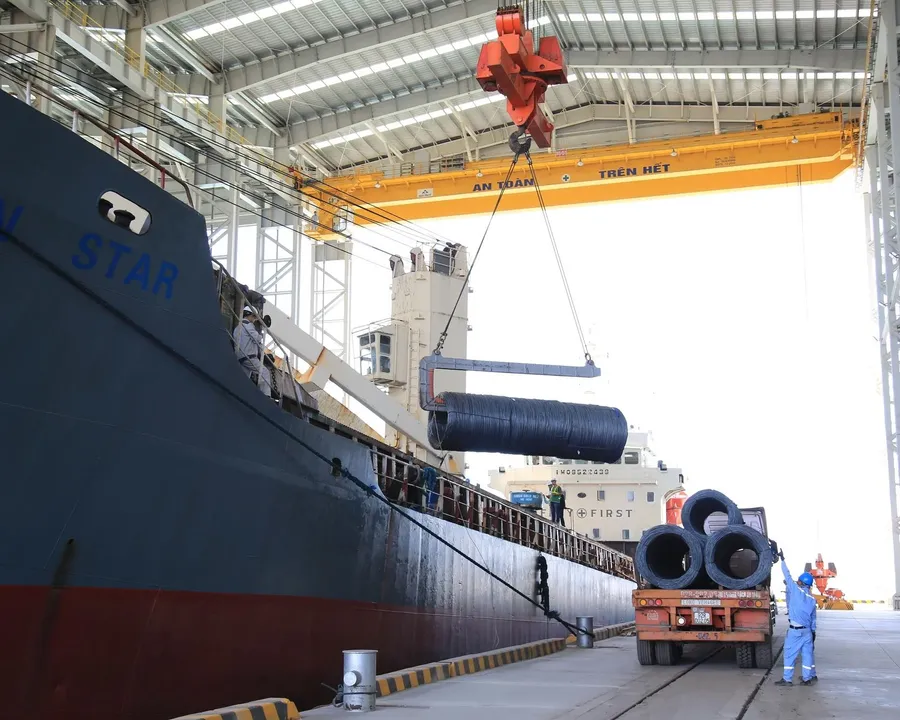
When more than half of volume is coil and a quarter of that coil is sold overseas, Hoa Phat's results become more sensitive to three factors.
Regional coil prices. HRC is traded across borders, so domestic prices come under direct pressure from offers by the region's large producers. Construction steel mostly serves domestic projects, and its price follows the local building season more closely.
Trade barriers in importing countries. Every new export market is also a place that could open an anti-dumping investigation or impose safeguard duties on Vietnamese steel. The October 12 release gives no breakdown by destination, so it is impossible to tell how that half-million tonnes splits between higher-risk and lower-risk markets.
Demand from domestic downstream mills. The remaining three quarters of coil is sold at home, largely to cold-rolling, coated-sheet and pipe makers. The production rhythm of those customers also affects Hoa Phat's order flow.
A few years ago, when construction steel was the largest line, the main question for HPG was the property market and public investment. That question remains, but it is no longer the only one.
Downstream: pipe and prestressed up, coated sheet down
Among post-rolling products, Hoa Phat sold 681,000 tonnes of steel pipe (up 9%), over 307,000 tonnes of coated sheet (down 4%) and over 192,000 tonnes of prestressed steel (up 66%) in nine months, all versus the same period last year.CafeF
The release gives volumes only. It does not explain why coated sheet fell while HRC, the input for that very segment, rose almost 60%. There is also no revenue or margin data by downstream segment, so there is no basis for saying which one is earning more. In scale, the three segments add up to about 1.18 million tonnes over nine months, roughly 11% of main steel volume, which is not enough to decide group profit.
Volume is not profit
Selling 54% more than a year earlier does not mean earning 54% more. Profit at a blast-furnace steelmaker depends on the gap between steel prices and raw-material costs, mainly iron ore and coking coal. The price data suggest that gap has not moved as favorably as volume.
Domestic D10 rebar fell from VND 15,120/kg on June 30 to VND 14,210/kg on September 30, a drop of about 6% over the quarter. On the input side, coking coal rose from USD 242/tonne to USD 261/tonne over the same period, up about 7.9%, and reached USD 270/tonne on October 9. Iron ore moved the other way, easing from USD 100.2/tonne to USD 96.59/tonne, down about 3.6%.
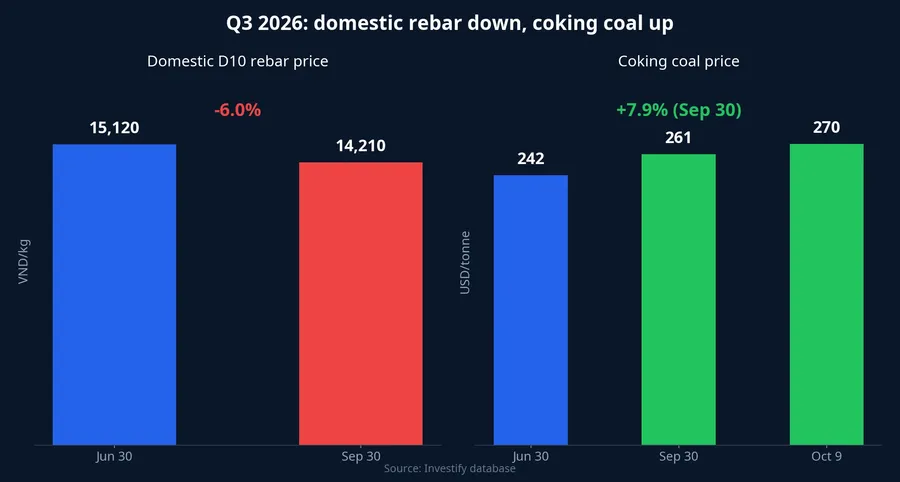
The two input prices partly offset each other, but falling finished-steel prices make it hard for per-tonne margin to hold at Q2 levels. Two caveats apply. Market raw-material prices do not feed into cost of goods immediately, because mills draw on inventory bought earlier. And D10 rebar represents construction steel only; the price at which Hoa Phat actually sold coil in Q3 was not disclosed in the release.
Hoa Phat's Q3 financial statements, expected in the coming weeks, will answer the rest. Three lines are worth reading:
- Net revenue versus volume. Dividing revenue by about 3.8 million tonnes gives the average selling price per tonne. If revenue grew much more slowly than the 8% rise in volume over Q2, selling prices fell.
- Gross margin. It shows how much of the gap between selling price and raw-material cost survived the passage through inventory.
- Interest expense. Once a large project is operating, interest on its investment loans typically stops being capitalized and goes straight to expenses, so this line shows how much gross profit is eaten before it reaches shareholders.
What is clear and what is not
What is clear: Hoa Phat is now first and foremost a coil producer, with over half of volume and roughly 7 in 10 of the nine-month extra tonnes coming from that product, plus a quarter of Q3 coil sold abroad. For HPG holders, regional coil prices and trade developments in importing markets have become the main variables, on a par with or ahead of domestic construction.
What is not clear: how much profit the 54% volume growth has turned into. If Q3 gross margin stays near Q2's, higher volume will translate into higher earnings. If margin narrows as steel prices fall and coking coal rises, the added volume mostly offsets thinner profit per tonne. The Q3 financial statements are the next data point to wait for.