
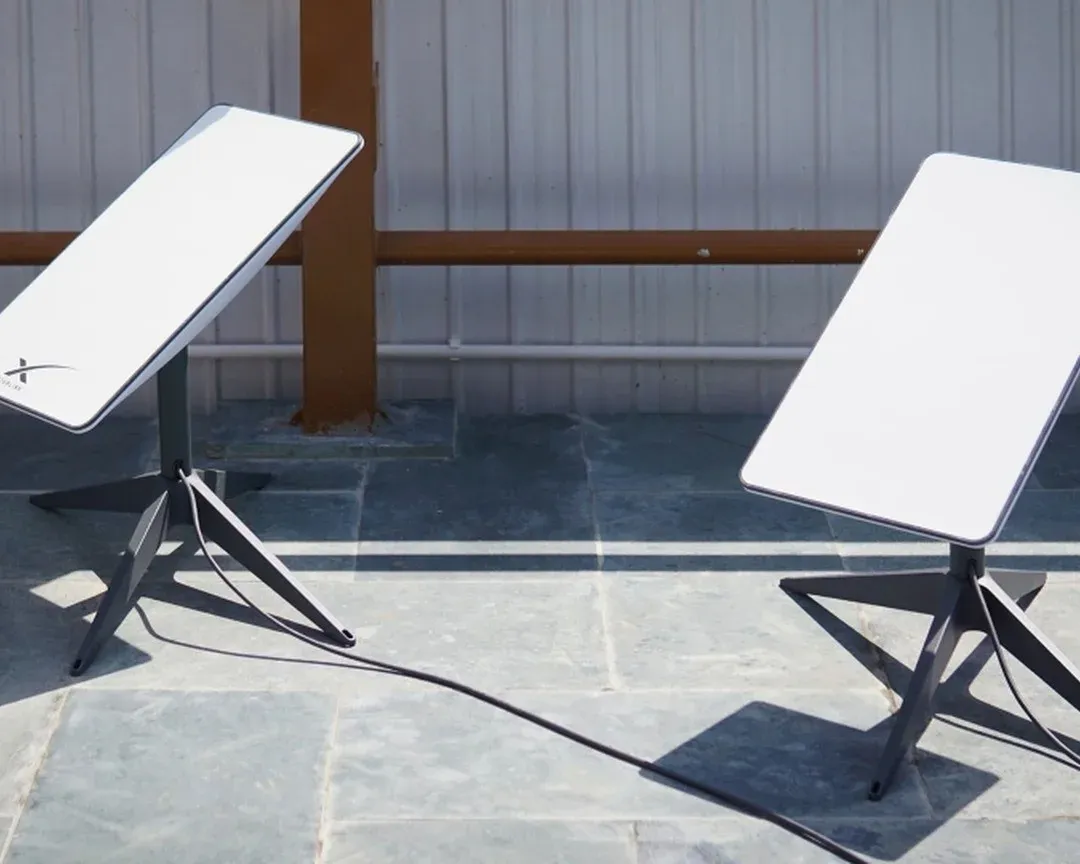

On October 8, the Ho Chi Minh City Department of Science and Technology issued Saigontel Telecommunication Technology JSC (ticker SGT) Licence No. 11042/GP-SKHCN to provide telecom services without owning network infrastructure, valid through December 31, 2030.CafeF A day later, the company, chaired by Mr. Dang Thanh Tam, announced it had become an authorized Starlink distributor in Vietnam.
Many headlines called this a "partnership with billionaire Elon Musk". That wording invites readers to picture Saigontel as an investor in, or part-owner of, a satellite network. The licence says something narrower: Saigontel finds customers and resells Starlink service plans. This piece places the new line where it actually sits in Saigontel's current business.
What the licence allows
According to the company's announcement, Saigontel may provide telecom services on a resale basis. The scope covers fixed satellite internet nationwide, mobile satellite internet for maritime connectivity, and leased lines for mobile base stations, both domestic and international.
The key phrase is "without network infrastructure". A holder of this licence owns no transmission lines or stations of its own. It buys service from an operator that does, then sells to end customers. Saigontel's work therefore sits in sales: prospecting, advising, contracting, installation and after-sales care.
The timeline fits that reading. Saigontel signed a cooperation agreement with Starlink Vietnam on September 17. The Department's licence came about three weeks later, and the distributor status was announced on October 9.
Who owns the satellites, who sells the plans
The entity authorized to operate Starlink in Vietnam is Starlink Services Vietnam Co., Ltd. In February 2026 the Ministry of Science and Technology licensed it to roll out satellite internet under a pilot programme, with 4 ground gateway stations and up to 600,000 user terminals in the first phase.Ministry of Science and Technology The gateways are located in Ho Chi Minh City (two), Da Nang and Phu Tho.VnExpress
The value chain therefore has two distinct tiers. The satellites belong to SpaceX. The gateways and the network licence in Vietnam belong to Starlink Services Vietnam. Saigontel sits in distribution.
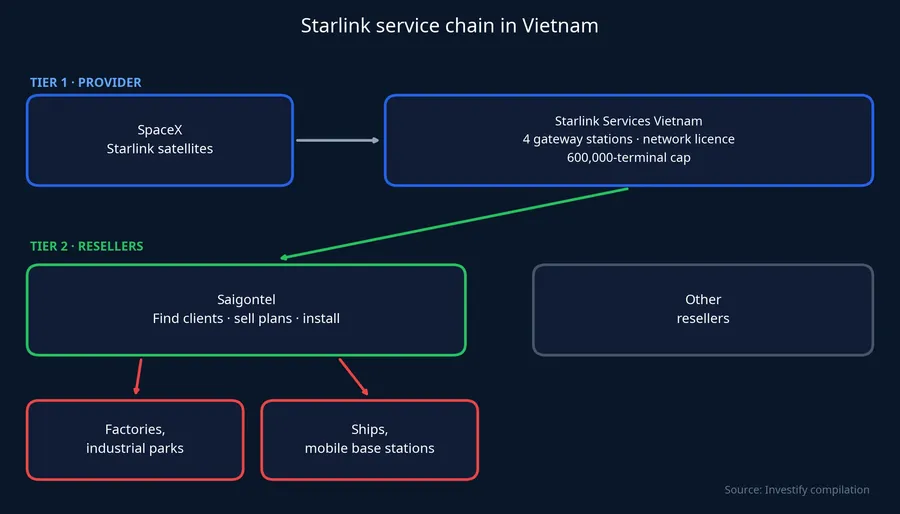
The 600,000-terminal ceiling applies to the entire pilot programme, not to Saigontel alone. The company describes itself as "one of" the authorized distributors, so there is no basis for calling this an exclusive arrangement.
For shareholders, the difference lies in the income structure. An operator with infrastructure collects all subscription revenue and bears all the capital spending. A reseller keeps only the spread between purchase and selling prices, or a commission. Saigontel has not disclosed its discount rate, enterprise pricing or expected subscriber numbers.
Target customers overlap with the industrial-park business
Saigontel says its priority customers are manufacturers, industrial parks, logistics and maritime transport. Satellite internet can serve factories, mobile base stations, ships and offshore facilities, especially where fibre is hard to lay or a backup link is needed.

These customers are not new to Saigontel. Founded in 2002 and part of Saigon Investment Group (SGI), the company earns most of its revenue today from leasing land, offices and factory space in industrial parks. Its tenants are a ready-made audience for a satellite internet offer. That is a real sales advantage, though its size cannot yet be measured.
Saigontel also takes part in a pilot to eliminate mobile dead zones across 13 provinces and cities, using 254 Starlink kits, together with the Vietnam Telecommunications Authority and Starlink Vietnam. The kits were handed over on September 11 with six months of free service.CafeF The programme gives the company field-deployment experience, but six free months mean it is unlikely to generate subscription revenue early on.
Where Saigontel stands financially
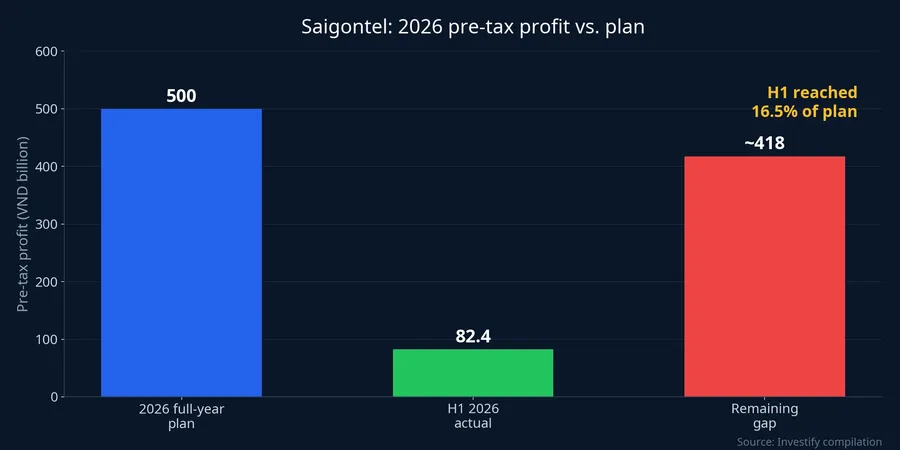
Putting the Starlink line next to the earnings shows what it is being asked to carry. The 2026 AGM materials set a plan of VND 2,000 billion in net revenue and VND 500 billion in pre-tax profit, flat against 2025.Mekong ASEAN
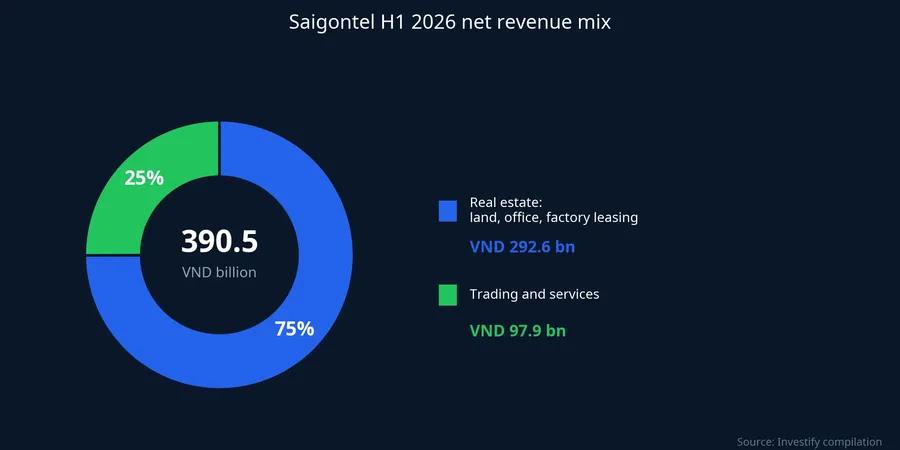
Per the Q2 financial statements published in early August, Saigontel posted H1 2026 net revenue of VND 390.5 billion, down 63% year on year. Pre-tax profit was VND 82.4 billion, down 82.3%, or 16.5% of the full-year plan. Revenue completed 19.5% of plan.DNSE These are the latest reported figures.
The revenue mix shows what keeps the company going. Real estate (land, office and factory leasing) brought in VND 292.6 billion, about 75% of the total. Trading and services, the segment closest to telecoms, reached only VND 97.9 billion, down 57% year on year. Q2 profit was also supported by land-lease revenue at the Thai Nguyen industrial park branch and the June sale of more than 31.5 million LADIC shares, a one-off item.DNSE
The arithmetic is simple. To hit its plan, Saigontel needs roughly VND 418 billion more in pre-tax profit in the second half, more than five times what it earned in the first half. The Starlink licence took effect on October 8, so Q4 2026 is the first period in which the line can book revenue, and it covers less than three months.
Large capital plans are still proposals
Starlink is not Saigontel's only expansion story this year. In late August, a consortium of Saigontel, World Harmony and SAIF Eagle II sent a letter of interest to the Tay Ninh People's Committee for an AI data-centre complex at the Nam Tan Tap Industrial Park, with a target capacity of 200 MW.MarketTimes The first 100 MW phase would cost about USD 3.5 billion, or more than VND 91,000 billion.CafeF This is a research proposal, not a project that has received investment approval. The figure is more than 11 times Saigontel's total assets of VND 7,972.3 billion at June 30, so most of the capital, if the project proceeds, would have to come from partners.
On fundraising, Saigontel once planned to offer more than 148 million shares to existing shareholders at 1:1 and VND 10,000 per share, with VND 762.03 billion earmarked for debt repayment.Baomoi In January 2026 it halted the plan and withdrew its registration filing.Tin nhanh chung khoan The April 2026 AGM materials brought the plan back at the same VND 10,000 price, lifting charter capital to VND 2,960 billion.Mekong ASEAN The sources reviewed so far show no result of any issuance.
On October 9, the day Saigontel announced its distributor status, SGT closed at VND 9,080, up 6.82%, on volume of only 5,300 shares. That is still below the proposed VND 10,000 offer price. Volume that thin also means a single up day says little about how the market values the new line.
What will show whether Starlink becomes revenue
The October 8 licence gives Saigontel a new resale channel aimed at the same industrial-park customers it already serves. But this is an agent's job on someone else's infrastructure, and the company has not disclosed revenue, margins or expected subscribers. For now, Starlink is a new sales channel, not yet a business line with numbers.
Two reporting periods will answer the question. The Q3 2026 statements, expected in late October, will not yet reflect Starlink, but they will show how much of the gap to the VND 500 billion profit plan Saigontel has closed and whether trading and services keep shrinking.
The Q4 2026 statements are the first to cover the licence. If service revenue rises clearly above the VND 97.9 billion earned in all of H1, the satellite internet line has started to carry weight. If it stays flat, the 2026 plan still depends mainly on industrial-park land rent, as it did before the licence.