
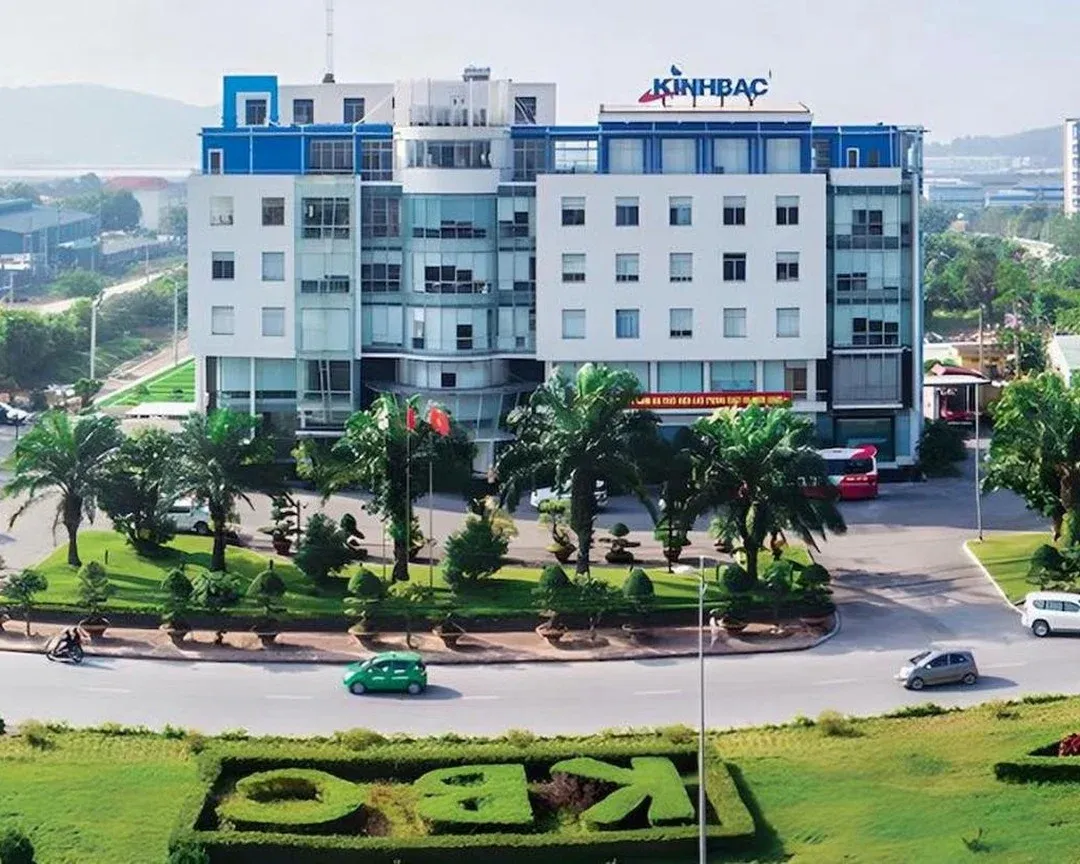

Three months ago, Kinh Bac Urban Development Corporation (KBC) reported Q2 net profit of just VND 34.4 billion, down more than 91% year on year.Mekongasean On the afternoon of October 12, 2026, the company released consolidated Q3 results with net profit of VND 937.2 billion, up 200.5% from Q3 2025.Người Quan Sát It is the first company on HoSE to file Q3 accounts this year.CafeF
The jump from VND 34 billion to VND 937 billion in three months shows how an industrial-park developer makes money. Profit lands in lumps, each time land is handed over, while interest expense runs at a steady pace through every quarter. Anyone following KBC has to read this report at that rhythm.
A strong third quarter, a nine-month total still below last year
In Q3, Kinh Bac booked net revenue of VND 3,187.3 billion, up 136.6% from VND 1,347.3 billion in Q3 2025.Người Quan Sát Gross profit was VND 1,723 billion, up 108%, and pre-tax profit was VND 1,221 billion, up 185%.CafeF
The company explained that profit rose mainly because it recognised more revenue from leasing land and industrial-park infrastructure during the period.Người Quan Sát In other words, Q3 profit came from the core business. Still, the news reports on the filing do not say which industrial park was handed over in the quarter, nor how many hectares.
On a cumulative basis the picture is quite different. Nine-month net profit was VND 1,197.1 billion, down 23.4% from the first nine months of 2025, while nine-month pre-tax profit was VND 1,768 billion, down 15%.CafeF Q3 recovered most of the first-half shortfall, but not enough to lift the nine-month total above last year.
Why profit arrives in lumps
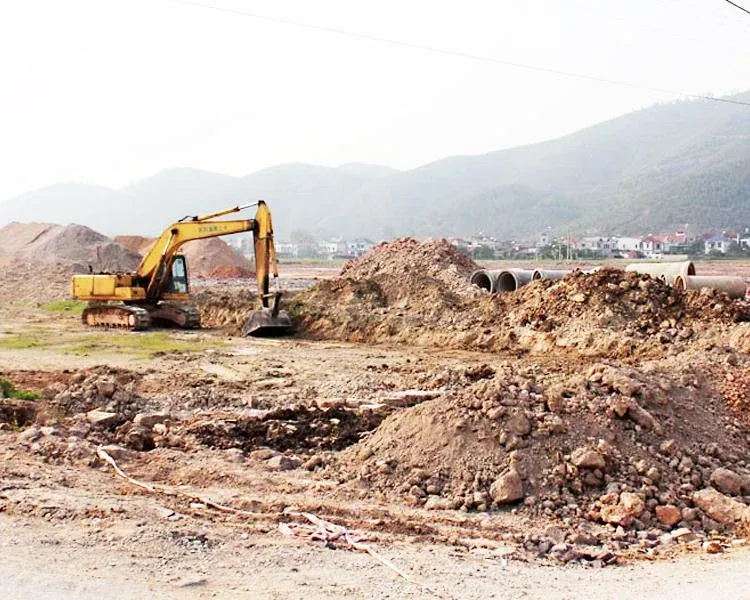
An industrial-park developer signs a land lease first and recognises revenue only when the land is ready to hand over to the customer. In between come compensation, site clearance and infrastructure work. Revenue therefore does not spread evenly across four quarters. It piles up in the quarters that have handovers.
Q2 is the clearest example. When it reported Q2 results, Kinh Bac said it had signed leases on more than 170 hectares that were not yet ready for handover because compensation and site clearance were still under way. It expected to recognise that revenue toward the end of the year. That quarter, gross profit from sales fell to just VND 199 billion.Mekongasean
Management chose this accounting approach deliberately. At the annual general meeting on April 18, 2026, Kinh Bac said it would not revalue its land bank at market prices to dress up the accounts, and would recognise profit only when sales actually happen.Báo Pháp luật The result is that reported profit tracks handover progress closely, and a quarter with late handovers is a thin quarter.
Interest does not follow the handover schedule
In Q2, Kinh Bac booked VND 289.4 billion of interest expense, more than the VND 199 billion of gross profit from sales.Mekongasean Profit that quarter stayed positive mainly thanks to VND 431 billion of financial income. In Q3, interest expense rose to VND 357 billion, while total financial expenses were up 51% year on year.CafeF
Set the two Q3 figures side by side and the VND 357 billion of interest is about one-fifth of the VND 1,723 billion of gross profit. In Q2 that ratio was above 100%. With an interest bill that barely moves, a quarter with a big land handover carries it lightly, and a quarter without one cannot carry it.
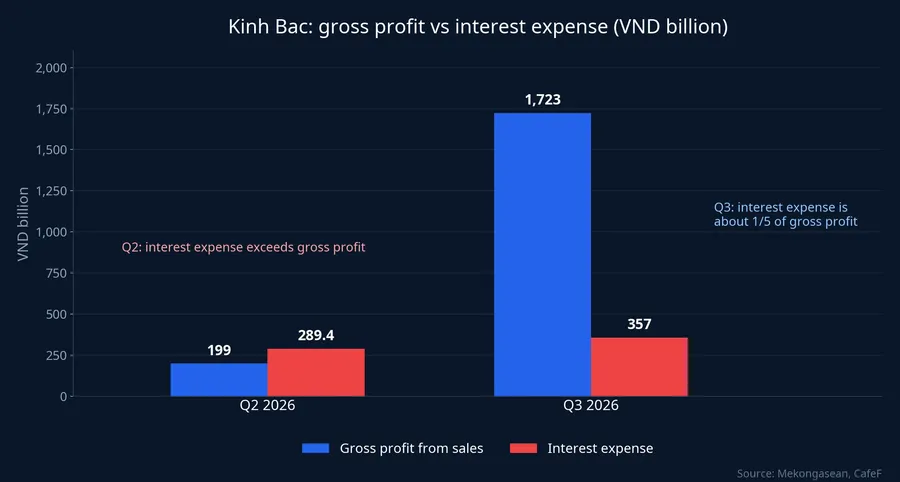
For the first half of 2026 as a whole, Kinh Bac's interest expense was VND 562.2 billion, up about 165% from VND 211.9 billion in the first half of 2025. Adding Q3 puts nine-month interest expense at around VND 919 billion. Nine-month gross profit was about VND 2,572 billion, made up of VND 849.4 billion in the first half and VND 1,723 billion in Q3. That means nearly 36% of nine-month gross profit went to paying interest.
The balance sheet: inventory near half of assets, borrowings above VND 33,800 billion
Interest grows because borrowings grow. At September 30, 2026, consolidated financial debt stood at VND 33,823.8 billion, up 18.2% from the start of the year. Long-term debt was VND 30,678.5 billion, and long-term bank loans alone made up 89% of total borrowings. Debt grew almost twice as fast as total assets, which rose 10.2% to VND 76,673.8 billion.Người Quan Sát
The borrowed money has mostly flowed into inventory. That line rose from VND 27,073.1 billion at the start of the year to VND 35,415.4 billion, or 46.2% of total assets. The Trang Cat urban and services area alone accounts for VND 18,354 billion, more than half of inventory. Work in progress at the Khoai Chau project tripled to VND 3,128.9 billion, and at the Trang Due industrial park it rose 2.63 times to VND 2,241.6 billion.
Cash flow reflects the same story. In the first half of 2026, net operating cash flow was negative VND 7,236.1 billion. Cash and cash equivalents fell 38.5%, from VND 8,368.5 billion at the start of the year to VND 5,144.5 billion at September 30. Cash is still above VND 5,000 billion, but each quarter without a land handover means another quarter of paying interest out of borrowed money or reserves.
Q4 has to deliver almost twice Q3
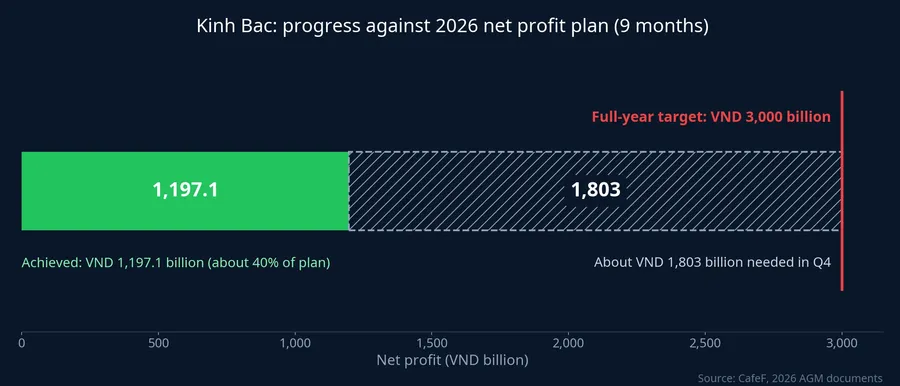
According to the annual general meeting documents released in late March 2026, Kinh Bac set its 2026 plan at consolidated net profit of VND 3,000 billion and consolidated revenue of VND 10,000 billion.Mekongasean The VND 3,000 billion is profit after tax, not before tax.
With VND 1,197.1 billion after nine months, the company has covered about 40% of the plan. To reach VND 3,000 billion, Q4 must deliver about VND 1,803 billion of net profit, nearly double the Q3 figure just reported and more than the entire nine months combined.
History is not on the plan's side. In 2025 the company targeted net profit of VND 3,200 billion but delivered VND 2,208 billion, the sixth consecutive year Kinh Bac missed a key financial target.Mekongasean Management at the time pointed to Trang Cat not yet being in operation, US tariffs delaying major investors' plans, and several new industrial parks, such as Trang Due 3 and Loc Giang, not yet generating revenue.
Q3 can be read in two ways. First: the 170 hectares already signed are starting to turn into revenue, and Q4 will continue the run. Second: Q3 was a single handover, and the rest is still stuck in site clearance. The data released today cannot settle the question, because the report does not say how many hectares were handed over in the quarter.
What the Q4 report will answer
One strong quarter at Kinh Bac does not say what the next one looks like, because this company's profit depends on whether land is handed over on time. What is more certain is interest expense. With debt above VND 33,800 billion, interest expense in the last two quarters was VND 289.4 billion and VND 357 billion, and it accrues whether or not land changes hands that quarter.
A reasonable reading, then, is to treat the VND 3,000 billion plan as a plausible ceiling for 2026 rather than a baseline. The Q4 financial statements, expected in late January 2027, will show whether the remainder turns into profit. Two numbers need to be read side by side. The first is Q4 gross profit. The second is Q4 interest expense. If gross profit is several times interest expense, as in Q3, the big handover from the 170 hectares has arrived. If interest again eats most of gross profit, as in Q2, the gap to the plan will be wider than in 2025.