

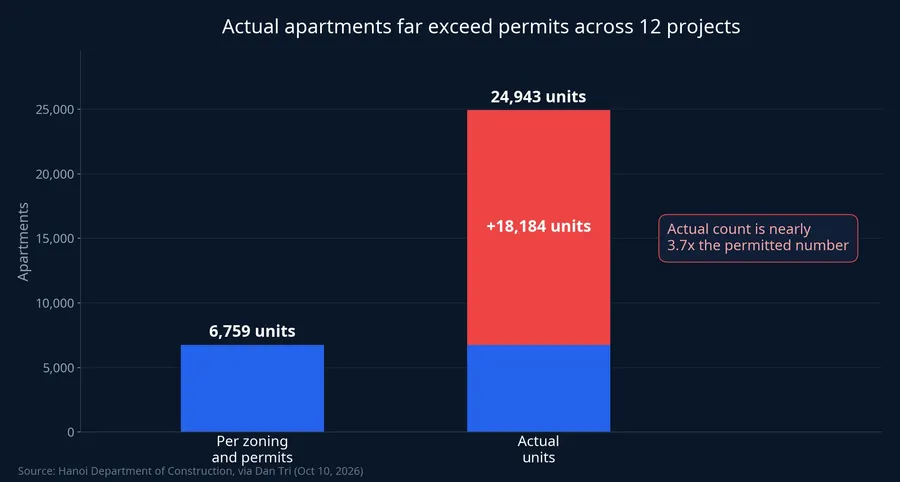
Permits and zoning for 12 residential projects developed by companies linked to Le Thanh Than, Chairman of Muong Thanh Group, allow only 6,759 apartments. According to an impact assessment by Hanoi's Department of Construction, the buildings now hold 24,943 units, up 18,184.Dan Tri The actual count is nearly 3.7 times the permitted number.
Since October 10, Hanoi has been collecting feedback on a draft resolution of the city People's Council that sets a special mechanism for handling land and construction violations at these 12 projects.VnExpress The draft does not say which buildings stay and which come down. It sets criteria for sorting each building into one of three tiers, and each tier leads to a very different outcome for the apartment and the pink book of the person living in it.
Where the draft stands
The list covers CT6 Kien Hung, Dai Thanh, CT5 Tan Trieu, the Xa La housing area, CT11 and CT12 in Kim Van - Kim Lu, towers VP3, VP5 and VP6, and HH1 to HH4 in Linh Dam.VietNamNet Per the Hanoi People's Committee's submission, the People's Council is expected to review the draft at a session in October.Dan Tri If passed, the resolution takes effect 10 days after signing.Dan Viet Only after that would the People's Committee decide which building falls into which tier, based on a review by specialist agencies.VnExpress
So right now nobody knows which tier their building belongs to. Everything below is the content of a draft under consultation, not a rule in force. The draft also states that letting a building remain is a remedial measure, not a legalization of the violation.
Tier 1: stays as built, but not every unit stays
A building must meet several criteria at once: completed and in use, free of disputes, structurally safe, compliant on fire prevention and rescue, not affecting neighboring buildings, and with infrastructure that can serve the actual population or a plan to add capacity.VietNamNet
Apartments in a Tier 1 building are kept. But the draft requires residents to move out of units and violating floor area in the podium, technical floors and community spaces, so the original function under zoning can be restored.VnExpress Anyone living in a unit converted from a technical floor still has to leave, even if the building is in the safest tier.
The pink book does not arrive automatically either. The developer must pay back the unlawful gain from the excess construction and settle its land-related financial obligations. Only then does it complete the paperwork for the authorities to issue the certificate to the buyer.VietNamNet
Tier 2: stays with conditions
This tier is for buildings that miss one or more Tier 1 criteria. To stay, the shortfall must be fixable through technical solutions, added infrastructure, or relocating some residents and changing the use of parts of the building.
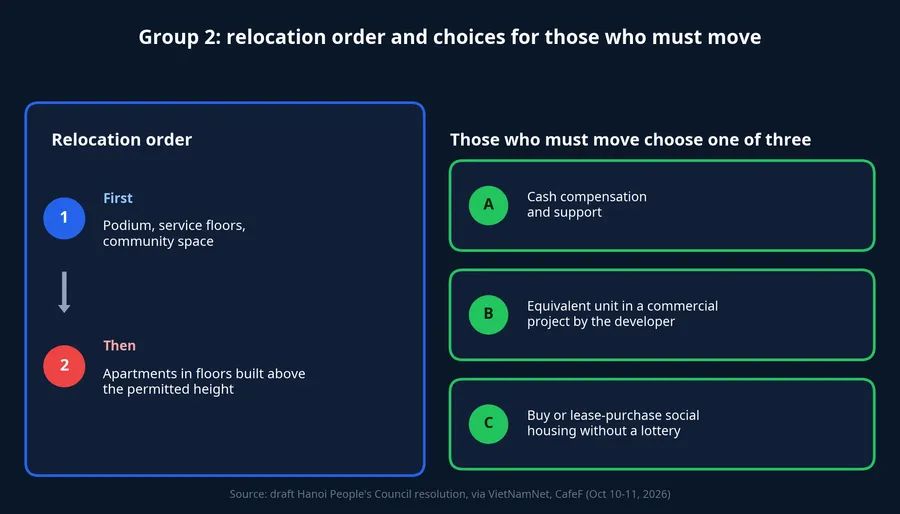
The deciding factor is the infrastructure plan the developer proposes. If infrastructure has been added and still cannot serve the extra units and residents, the draft requires relocation in a priority order.CafeF People in the podium, technical floors and community spaces go first. Then come units in the part built above the floor count allowed by the permit or detailed plan.
The consequence is concrete. In one building, two households with the same kind of contract and the same years of waiting for a pink book can end up with different outcomes, depending on whether their unit sits below or above the highest floor the permit allows.
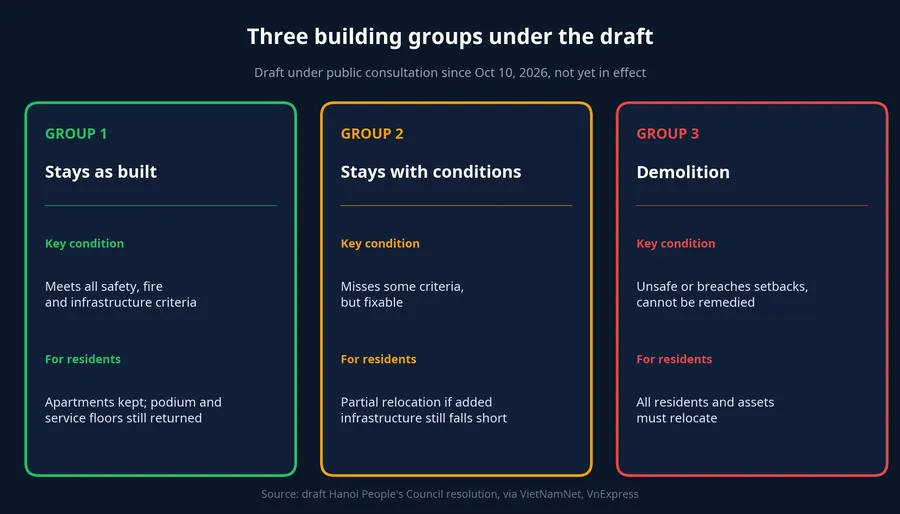
Tier 3: demolition
Tier 3 covers buildings that are structurally unsafe, fail fire safety rules, or breach setbacks and protection corridors in ways that cannot be remedied, plus buildings that cannot fix the Tier 2 shortfalls.VnExpress All residents and belongings must move out.VietNamNet The draft offers one way out: if demolition is not possible, the building can change use to serve residents in the area. Either way, the apartment stops being the buyer's home.
What those who must move can choose
For every case that requires relocation, buyers can choose and negotiate with the developer one of three options:CafeF
- Cash compensation or support from the developer.
- An equivalent apartment in a commercial housing project by the developer that is eligible for sale.
- Buying or lease-purchasing social housing without a lottery in the developer's projects, if eligible under the Housing Law.
All three options run through the same party. The Department of Construction's report also raises the possibility of a large number of residents moving to the Thanh Ha - Cienco5 project, and warns that infrastructure there will be under pressure without a preparation plan.Dan Tri Thanh Ha - Cienco5 is itself one of the developers named in the draft.
Who pays, and with what
The draft puts the full cost of remediation, relocation, compensation, temporary housing, demolition and added infrastructure on the developer. State budget funds may not be used. Funding is secured by the developer's deposits and assets.Dan Viet
Buildings allowed to remain must also pay the unlawful gain, calculated as excess floor area multiplied by the construction unit cost based on the capital investment rate when the building entered use, then multiplied by 50%.VietNamNet Land financial obligations follow the land price table times a coefficient set by the city People's Committee.VnExpress Sources published through October 11 do not give the total of these amounts, the developer's deposits on hand, or how any shortfall would be handled. The draft says only that if the developer fails to carry out relocation duties, the People's Committee applies measures within its authority.VietNamNet
The pink book: a new route that still passes the developer
The draft opens a new right: if the developer has met its financial obligations but does not complete the filing, buyers can submit the application for the certificate themselves.VietNamNet That fixes the case of a developer who has paid but dawdles on paperwork. It does not fix the bigger bottleneck, because the condition is still that the developer has paid in full. If the 50% payback and land charges remain unpaid, buyers wait where they always have.
For many households the wait has been long. The Department of Construction's report notes that many residents have lived in these projects for around 10 years or more,Dan Tri while some buyers still have no certificate.VnExpress
Who gains, who carries the risk
By the draft's design, the biggest beneficiary is the owner of a lawful unit in a Tier 1 building: no move, a written route to the pink book, and the right to file on their own if the developer stalls.
The biggest risk falls on owners of units in the podium, technical floors and community spaces, then on residents of the above-permit floors. Podium and technical-floor units must be returned even when the building is Tier 1. Above-permit units sit in the Tier 2 relocation queue if added infrastructure falls short, and must go if the building is Tier 3. The Department of Construction itself foresaw the risk of lawsuits when one project has units that stay and units that must go.Dan Tri
What decides whether the promises hold is the developer's financial capacity. Compensation, replacement units, social housing, the 50% payback, land charges and infrastructure costs all land on one party. With the budget barred, if deposits and assets fall short, buyers' options exist only on paper. Even for those who stay, the pink book arrives only once the developer has paid in full.
Signals to watch
The first milestone is the People's Council session in October: if it passes the draft without changing the criteria, the three scenarios above stand; if it alters the Tier 2 relocation order or adds rules for a developer that runs short of money, the risk for above-permit residents changes. The second is the People's Committee's decision on the list, when each building in Linh Dam, Kien Hung, Xa La or Kim Van - Kim Lu learns its tier. The third is two missing numbers: what the developer must pay back and what it has on deposit. The gap between them will show whether the draft's options can actually be delivered.