
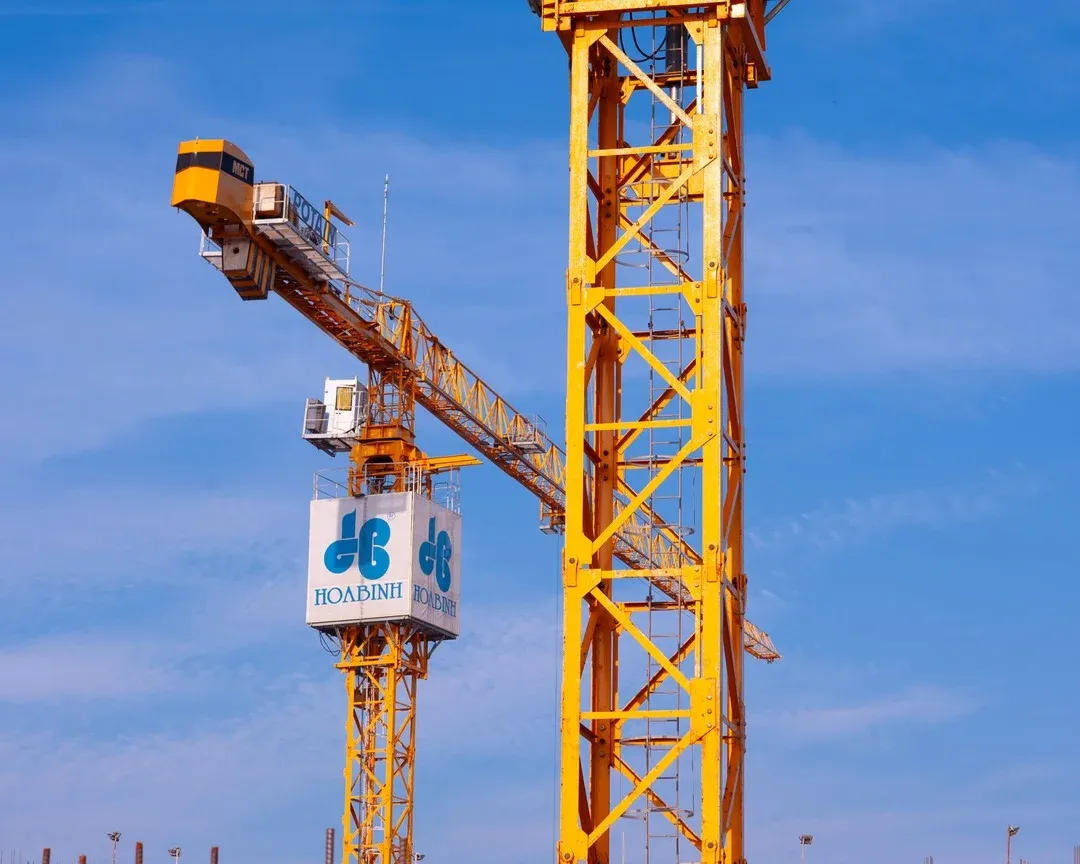

Hoa Binh Construction Group (HBC) has announced that it won the contract to build phase 2 of a commercial housing project on plot N01A in the Tu Hiep New Urban Area, Hanoi, worth nearly VND 1,700 billion. The developer is Tu Hiep Hong Ha Dau Khi JSC, and the building has 2 basement levels, 34 floors and 1,280 apartments.Người Quan Sát Hoa Binh had earlier broken ground on three projects in Dong Nai worth more than VND 1,000 billion, and says contracts won since the start of the year now exceed VND 8,600 billion.
On the evidence, the question of whether Hoa Binh has work is settled. The more useful question for shareholders is what stages each dong of contract value passes through before it becomes profit, and how much each stage keeps.
Contract value is not yet revenue
A contractor does not book the full value of a contract the day it wins. Under construction-contract accounting, revenue is recognised progressively as work is completed, usually tied to the volume accepted by the client. A 34-storey tower with two basements goes through piling, substructure, superstructure and finishing, so the VND 1,700 billion package will be spread over many quarters, most likely into next year.
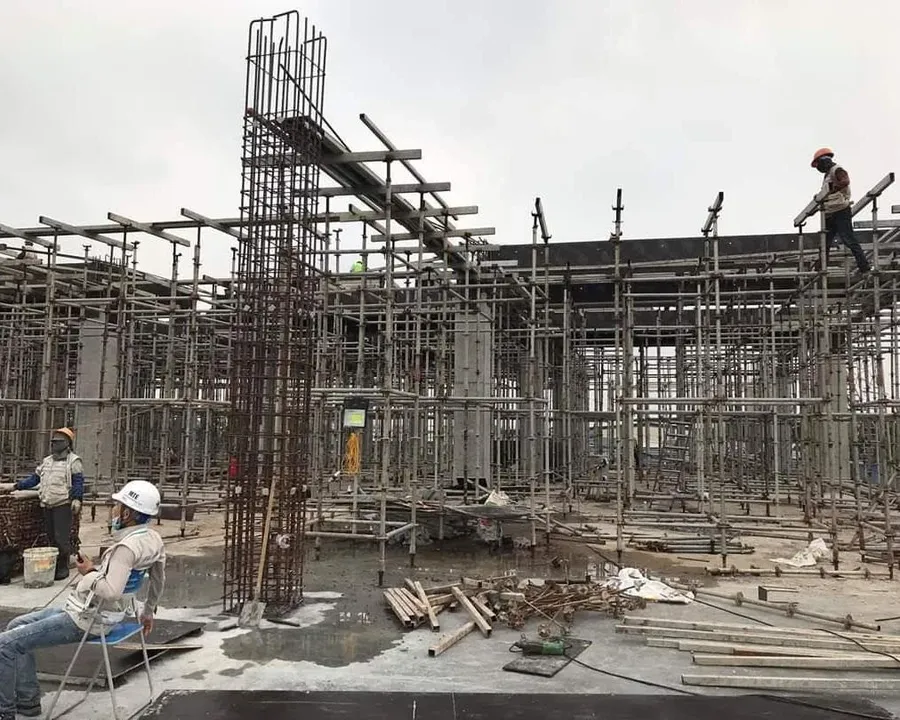
For scale, Hoa Binh's consolidated net revenue for the first half of 2026 was VND 3,260 billion after review, double a year earlier.Người Quan Sát Contracts won this year, above VND 8,600 billion, are about 2.6 times that half-year revenue, and most of that work has yet to reach the income statement. What remains unclear is how much of each dong of revenue is left for shareholders.
From VND 3,260 billion of revenue to VND 50 billion of net profit
Here is how the money moved in the first half. After cost of goods sold, Hoa Binh kept VND 336 billion of gross profit, a gross margin of 10.3%.Người Quan Sát A year earlier the margin was only 7.16%, so the building work itself has clearly improved.
The largest item between gross profit and net profit is interest. Financial expenses in the first half were VND 193.11 billion, of which interest expense was VND 187.46 billion. More than half of gross profit therefore went to lenders, and the figure is almost unchanged from VND 189.62 billion a year earlier even though revenue doubled.
Next come selling and administrative costs. Selling expenses rose to VND 66.37 billion from VND 14.29 billion, while administrative expenses fell to VND 42.35 billion from VND 72.19 billion. Together they come to about VND 109 billion, just over 3% of revenue. After that, pre-tax profit was VND 76.75 billion, corporate income tax about VND 26.7 billion (derived from the gap between pre- and post-tax profit), leaving shareholders with VND 50 billion of net profit.Người Quan Sát
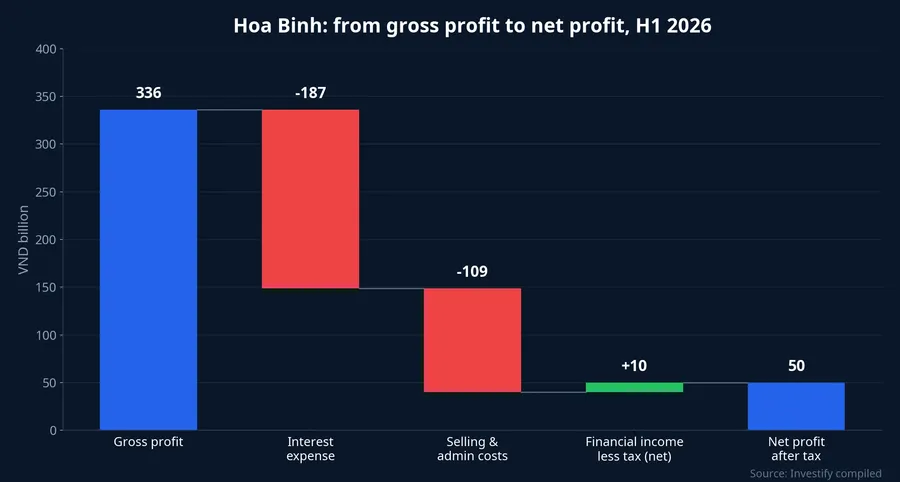
Per VND 100 of revenue, that is roughly VND 10 of gross profit, nearly VND 6 of interest, just over VND 3 of selling and administrative costs, almost VND 1 of extra tax, and about VND 1.5 for shareholders. The net margin for the half was 1.53%.
One detail deserves a mention: the company's original self-prepared report showed net profit of VND 41.6 billion. After review it rose to VND 50 billion, mainly because cost of goods sold was adjusted down by more than VND 65 billion.Người Quan Sát For a thin-margin business, an adjustment of that size can move net profit by about a fifth.
Why revenue doubled but net profit stayed flat
First-half net profit was VND 1.3 billion lower than a year earlier.Người Quan Sát At first glance, the company did twice the work and earned nothing extra. Break the lines apart and the story changes.
In the first half of 2025, Hoa Binh's operating profit was negative VND 103.47 billion, yet pre-tax profit still reached VND 60.21 billion. The gap of about VND 164 billion came from other income, outside construction work. This year the core business generated VND 77.96 billion on its own, while other income was close to zero.
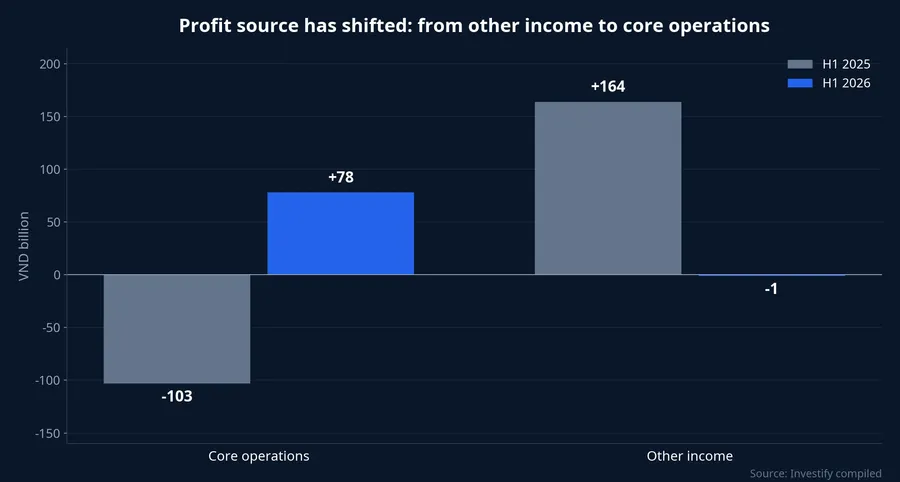
On the numbers, the biggest factor in absolute terms is that last year's roughly VND 164 billion of other income did not repeat, and it nearly cancels the extra gross profit after selling costs. Tax also weighed more: the gap between pre- and post-tax profit was about VND 26.7 billion against about VND 8.8 billion, so pre-tax profit grew 27.48% without flowing fully to the bottom line. Interest expense held at VND 187 billion and kept absorbing more than half of gross profit.
So flat net profit hides a change in quality. Last year's profit came from outside construction; this year's comes from the building sites themselves, which gives the same figure firmer footing. One caution: first-half EPS was VND 142 against VND 205 a year earlier. With net profit nearly equal, a roughly 31% drop in EPS indicates the share count has risen, so each share's slice is thinner.
Fixed interest cost works as leverage in both directions
Why did interest barely move while revenue doubled? Because it follows debt, not revenue. At June 30, 2026, Hoa Binh's borrowings were VND 3,999 billion, almost all short-term, against equity of just VND 2,029 billion.
That debt exists because of how contracting works: the contractor pays for construction up front and the client pays after acceptance. Hoa Binh's total receivables at June 30 were VND 10,950 billion, 65.49% of total assets. The gap between spending and collecting is filled with borrowings, and borrowings carry interest.
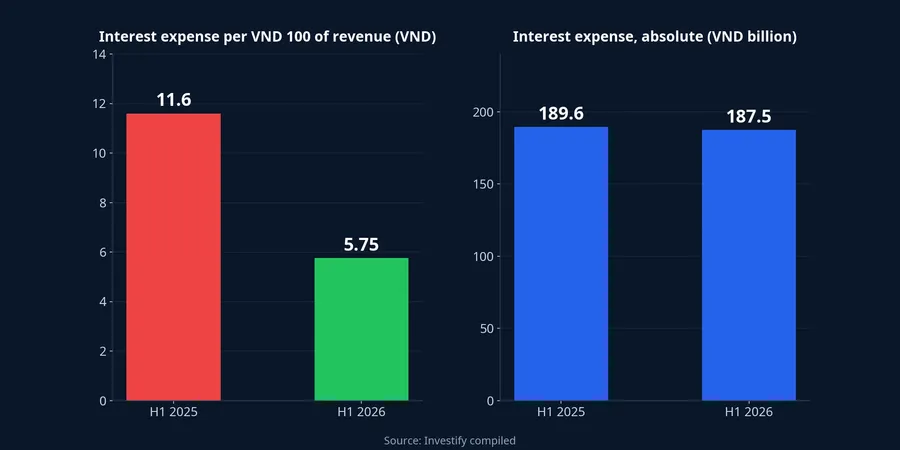
Measured per VND 100 of revenue, the mechanism shows. In the first half of 2025 interest was about VND 11.6 per VND 100 of revenue (VND 189.62 billion over VND 1,636.45 billion). In the first half of 2026 it was VND 5.75 (VND 187.46 billion over VND 3,260.42 billion). When revenue grows and debt does not swell with it, this fixed cost is diluted and more gross profit remains for shareholders.
That is why more than VND 8,600 billion of contracts matters for profit, not just for revenue. But the mechanism runs both ways. If the new contracts require Hoa Binh to advance more working capital, and receivables grow faster than cash collected, debt and interest will rise too, and extra revenue will no longer dilute the cost of capital. And if gross margin on new projects falls below 10.3%, the gross profit available to carry the interest bill will shrink.
What the third-quarter report will show
The backlog gives Hoa Binh revenue for many quarters ahead. Shareholders' profit depends on gross margin and interest expense, and the third-quarter financial report, due soon, is the first time those two lines will be measured as the new workload starts to run.
On gross margin, the first-half 10.3% is the reference point. Holding near it as new projects start means Hoa Binh is not cutting prices to win work. On interest, if third-quarter expense stays near the first-half average of more than VND 90 billion a quarter while revenue rises, the fixed cost is still being diluted. Finally, receivables and borrowings on the balance sheet show how much cash Hoa Binh is advancing to new projects; fast-rising debt would be a sign that interest will no longer stand still.
This article does not forecast the HBC share price.