
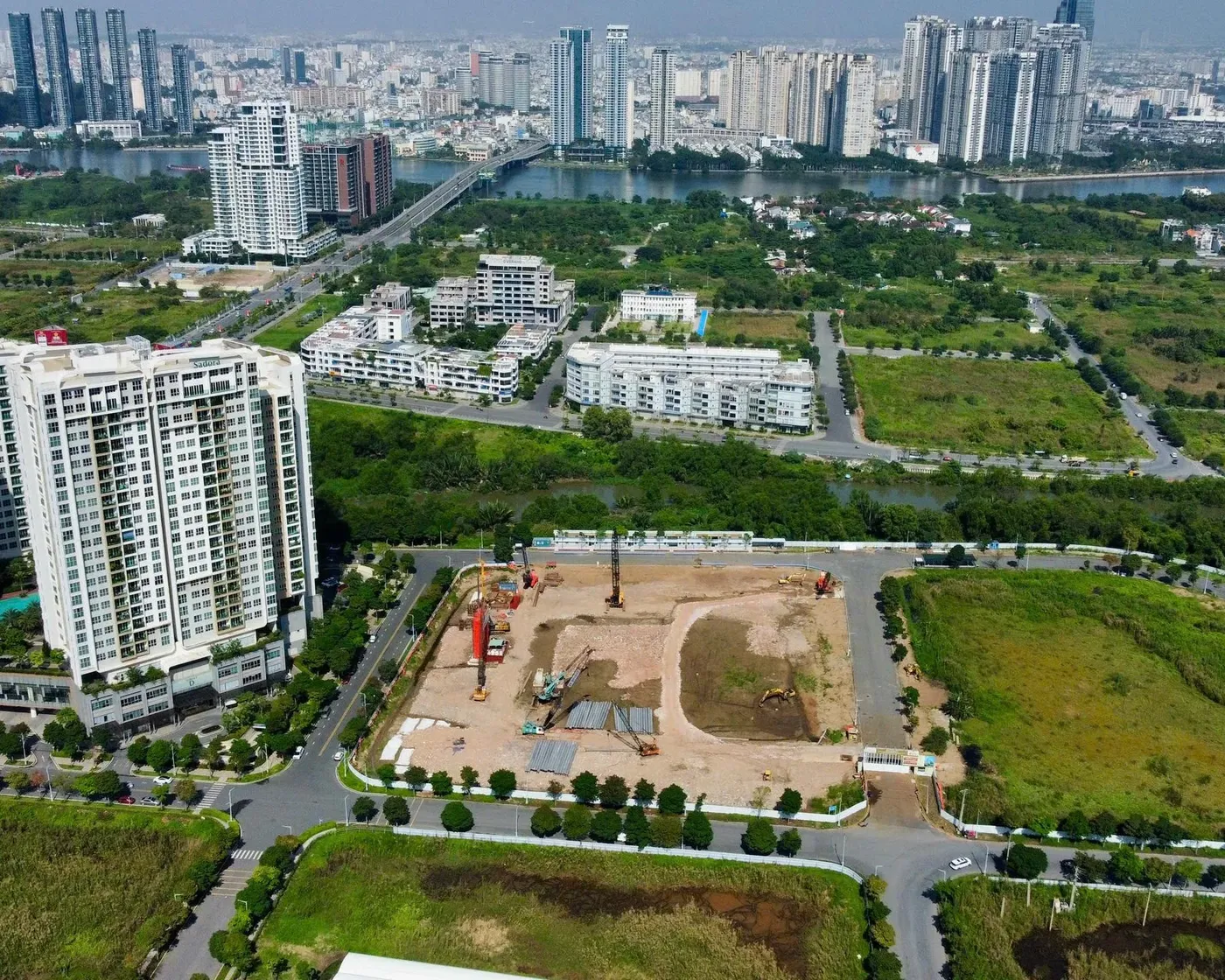

Dai Quang Minh, a property developer in the THACO group and the developer of the Sala urban area in Thu Thiem, has just completed its second bond issue in little more than a month. According to its offering report to the Hanoi Stock Exchange (HNX), the company sold 5,000 bonds under code DQML12602, each with a face value of VND 100 million, raising VND 500 billion between September 29 and October 2, 2026. The bonds have a three-year term, mature on September 29, 2029, and pay a fixed 11% a year.CafeF
That 11% looks different next to the company's own borrowing history. Its first issue, DQM12501, was released on December 30, 2025 for VND 1,500 billion, starting at 9.75% a year.CafeF Less than nine months later, on the same three-year term, the price of borrowing has risen to 11%. This piece asks two questions: where is the new money going, and who is carrying the risk of this debt?
Three bond issues, two price levels
Since the end of 2025, Dai Quang Minh has had three bond issues outstanding, totalling VND 3,000 billion.
| Code | Issue date | Size | Term | Rate |
|---|---|---|---|---|
| DQM12501 | Dec 30, 2025 | VND 1,500 billion | 3 years | 9.75% a year (stepped rate, with a buyback clause) |
| DQML12601 | Aug 29, 2026 | VND 1,000 billion | 3 years | 11% a year, fixed |
| DQML12602 | Sep 29–Oct 2, 2026 | VND 500 billion | 3 years | 11% a year, fixed |
The gap needs careful reading. DQM12501 carries a stepped rate: 9.75% applies to year one and later years are higher, so the average cost over its life is not as low as 9.75%. The real gap between the old issue and the two new ones is therefore narrower than the 1.25 percentage points visible on the surface. The direction is still clear: Dai Quang Minh's new borrowing is more expensive.
Where the new money goes
The VND 1,000 billion issue of late August is the best documented. According to Saigon Ratings' credit rating report, cited by Vietbao, the proceeds were expected to prepay part of Dai Quang Minh's loan from its parent THACO (contract signed December 31, 2025) and a loan from BIDV (contract signed December 15, 2023).Vietbao
Put simply, this issue did not bring fresh capital to any construction site. It changed creditors: part of the debt owed to the parent and a bank is replaced by debt owed to bondholders. On its own, swapping funding sources does not reduce total debt. What changes is who lends and on what terms.
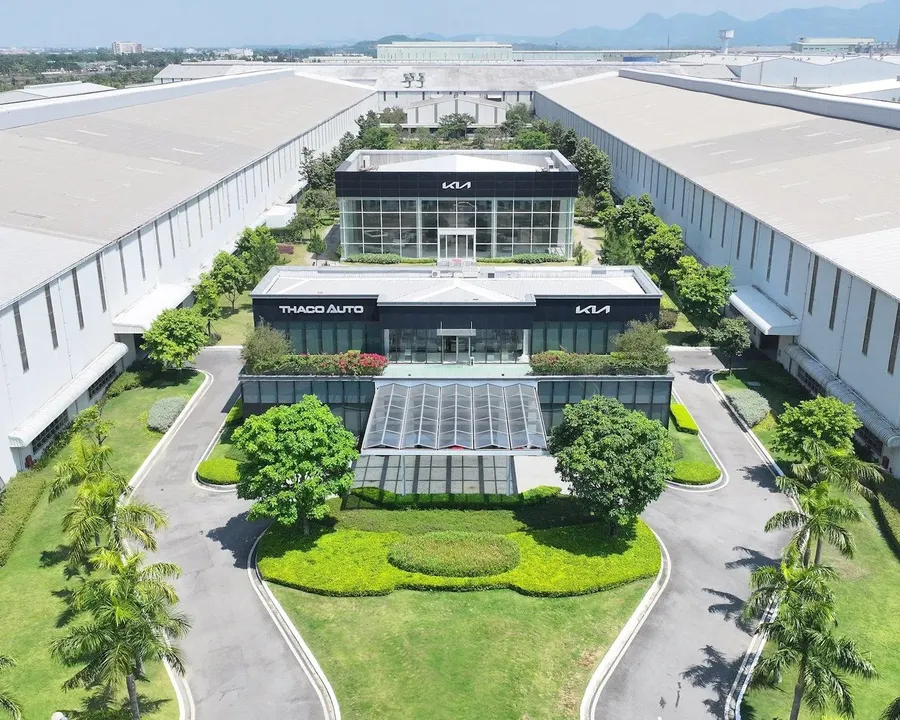
The issue offers bondholders two layers of protection. The first is collateral: more than 164 million shares of Truong Hai Agriculture (THACO Agri), owned by THACO and valued at VND 2,000 billion, twice the size of the issue. The second is a guarantee: THACO guarantees all payment obligations on principal, interest and other amounts due.Vietbao
For the VND 500 billion issue just completed, the picture is less complete. The offering report, as republished by CafeF, MarketTimes and Vietbao, states only the size, term and rate. Collateral, any THACO guarantee and the use of proceeds have not been disclosed in those documents. So there is no basis yet to assume the VND 500 billion issue carries the same protection as the VND 1,000 billion one, even though the rate is identical and the two were issued a month apart. The answer should come from bond disclosures on HNX's dedicated page and from the company's half-year financial statements.
The balance sheet of a company borrowing more
Dai Quang Minh is not a weak company. According to MarketTimes, it earned VND 4,069 billion in profit after tax in 2025, more than 22 times the VND 183.2 billion of 2024. Year-end equity reached more than VND 32,223 billion, and the ratio of liabilities to equity fell from 2.48 times to 1.09 times.MarketTimes
Even so, the debt mix is shifting toward interest-bearing borrowing. Bank loans rose from VND 9,794 billion at the start of 2025 to VND 18,656 billion at year-end, nearly double.MarketTimes Bonds outstanding now stand at VND 3,000 billion after the two new issues. The VND 4,069 billion profit is an accounting figure, while the company's steady search for new funding suggests debt service is a major concern.
THACO holds 72.75% of Dai Quang Minh's charter capital, and Mr. Tran Dang Khoa is Chairman of the Board of Dai Quang Minh Real Estate Investment JSC.MarketTimes The company also leads the consortium for the Red River Scenic Boulevard project in Hanoi, with a preliminary total investment of about VND 855,000 billion under a public-private partnership.CafeF A commitment of that size points to heavy capital needs for years to come.
Why developers turn to bonds
Dai Quang Minh's case sits inside a sector-wide trend. According to a VIS Rating report cited by Nguoi Dua Tin, property developers issued about VND 149,500 billion of bonds in the first nine months of 2026, up 126% year on year. Vinhomes alone issued VND 31,000 billion.Người Đưa Tin
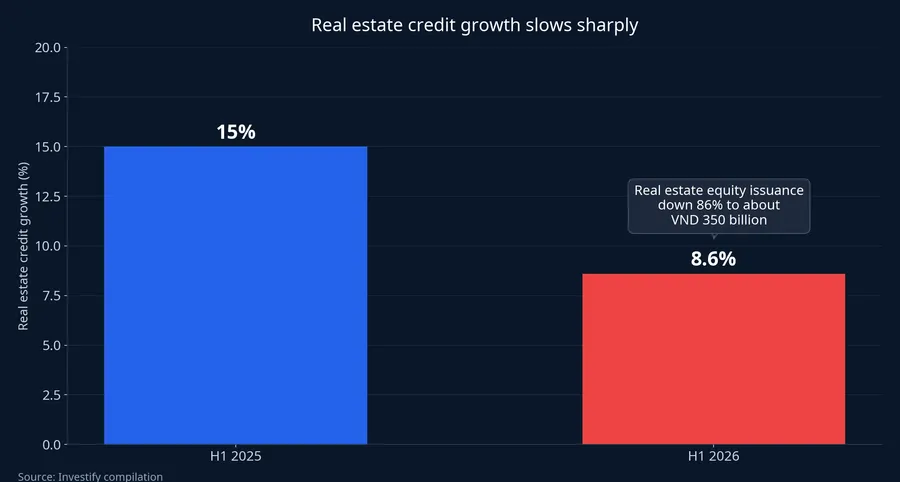
The other two funding channels have narrowed. Real estate credit grew only 8.6% in the first half of 2026, down from 15% a year earlier. The equity channel is nearly shut: property equity issuance was only about VND 350 billion, down 86% year on year.Người Đưa Tin With banks lending more slowly and shareholders not adding capital, bonds are the door still open.
Maturing debt is another factor pushing borrowing costs up. According to VIS Rating, about VND 167,000 billion of property bonds fall due between Q4 2026 and the end of 2027. The sector's average issuance rate is now about 11.4% a year, 110 basis points higher than a year ago.Người Đưa Tin Many developers may be hunting for bond buyers at the same time to repay old debt. The report does not state this as the direct cause of the higher rates, but concentrated demand for funding is a plausible explanation for rising borrowing costs.
There is an alternative reading: Dai Quang Minh's 11% could reflect higher company-specific risk rather than the market backdrop alone. The available data leans toward the backdrop. The company's increase is in line with the sector's roughly 110 basis points, and 11% is still below the 11.4% average. For the VND 1,000 billion issue, collateral worth twice the issue size and the THACO guarantee may explain part of that gap, though no source says so explicitly.
The consequences reach beyond bondholders. VIS Rating records the debt-to-equity ratio of listed developers at 74% in the first half, against an average of 54% over 2022–2025. For shareholders of listed developers, each higher-rate bond issue is interest expense that eats into profit for years. Vinhomes is an exception, with positive operating cash flow of about VND 90,000 billion over the past 12 months, while many other developers still report negative operating cash flow.Người Đưa Tin
Who carries the risk of 11% debt
Bond buyers take the risk directly. For comparison, the highest 12-month deposit rate at the counter on October 9 was 7.5% a year at Sacombank.CafeF Dai Quang Minh's 11% is about 3.5 percentage points higher.
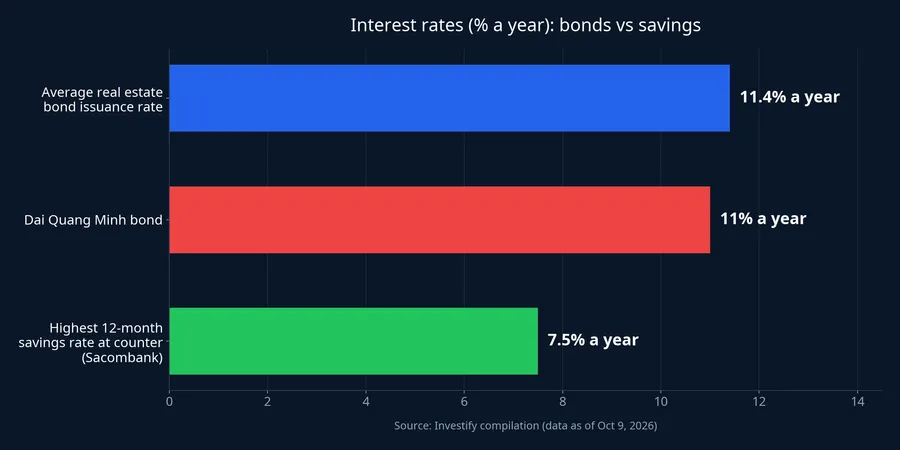
That spread is not a free reward. It is what the issuer pays for three things bondholders accept: the credit risk of a property developer, the difficulty of selling privately placed bonds before maturity, and a three-year term instead of 12 months. Bank deposits are covered up to a limit by deposit insurance; corporate bonds have no such protection.
When a company runs into trouble, a bondholder's chance of recovering money depends almost entirely on those layers of protection. For the VND 1,000 billion issue, the first layer is the THACO Agri shares. The VND 2,000 billion figure is a valuation, while the price actually realised in a sale depends on THACO Agri's business and on who is buying at the time. The second layer is THACO's guarantee, so the parent's financial health is part of the risk bondholders hold. For the VND 500 billion issue, with no disclosure yet on collateral and guarantees, bondholders cannot tell where they stand if something goes wrong.
How to read a property bond paying 11–12%
The rate only tells you what the company pays. Three facts decide how well bondholders are protected: what the specific collateral is and who valued it, whether a parent or bank guarantees the bonds, and what the money is for. An issue used to repay old debt creates no new cash flow, so its repayment depends on future sales and on the company's ability to borrow again at maturity.
Applying that frame to Dai Quang Minh, the conclusion is this: the 11% most likely reflects mainly the sector's borrowing-cost level, and the VND 1,000 billion issue has a clearly documented protection structure. The VND 500 billion issue lacks the information for a similar judgment. Two signals are worth watching: the disclosure for DQML12602 on HNX's bond page, which should state collateral and any guarantee, and Dai Quang Minh's 2026 half-year financial statements, which will show whether bank debt falls after bond proceeds are used to prepay loans. If bank debt falls in step, this is a debt restructuring. If bank debt keeps rising, the company is stacking new borrowing on top of old.