

In the first half of 2026, Kien Long Commercial Joint Stock Bank (Kienlongbank, ticker KLB) reported pretax profit of VND 1,176 billion, up 27.6% from a year earlier.Báo Pháp luật Even so, investors cannot use borrowed money to buy KLB shares throughout the fourth quarter. The bank is on the list of 65 tickers ineligible for margin trading in Q4 2026, published by the Ho Chi Minh City Stock Exchange (HoSE).VnEconomy
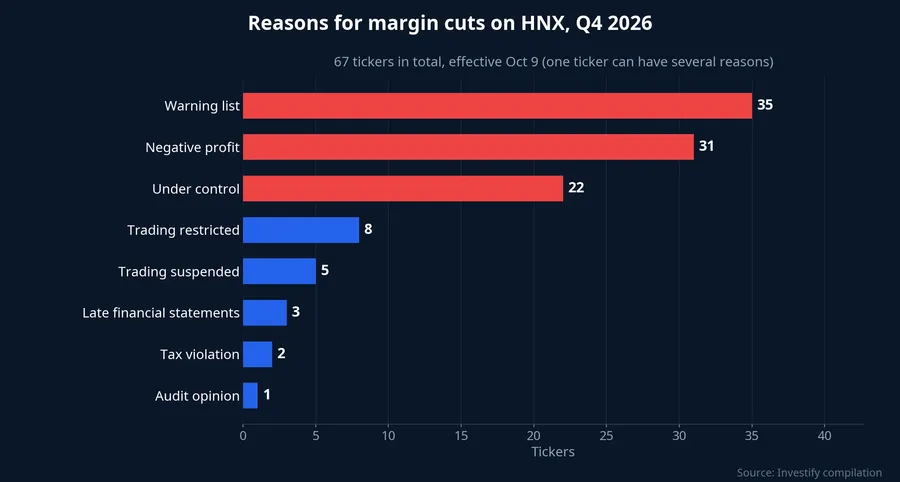
Put simply, this list is not a blacklist of badly run companies. It is built from mechanical criteria: financial statements, auditor opinions, how long a stock has been listed, and the ticker's status on the exchange. It does not score any company's outlook, which is why a profitable bank, a newly listed brokerage and several ETFs can all appear in the same table. At the Hanoi Stock Exchange (HNX), the Q4 list has 67 tickers, effective October 9, 2026.CafeF
Kienlongbank: One Review Opinion Is Enough to Lose Borrowing Rights
HoSE's stated reason for KLB is that the reviewed consolidated H1 2026 financial statements carry a conclusion other than an unqualified opinion from the auditor.CafeF
Specifically, auditor A&C Auditing and Consulting issued a qualified conclusion because the bank has a receivable of more than VND 343 billion still being reconciled with related parties.Báo Pháp luật The auditor said it could not obtain sufficient appropriate evidence to assess the outcome of the reconciliation, or the provision the bank should set aside for it.
According to Kienlongbank's explanation, the amount comes from pending transactions discovered when the bank reconciled with counterparties in June 2026. The bank says it has tightened transaction controls and expects to propose a resolution based on records and documents gathered in September 2026.Vietstock The latest press reports do not describe a specific resolution.
The notable point is that this criterion does not weigh severity. VND 343 billion is small against the bank's half-year profit, but the rule does not ask whether a qualification is large or small. It asks only whether the auditor gave an unqualified opinion. Kienlongbank is not alone: HoSE also lists AAT, GIL and VTB for the same type of review conclusion.
Vietbank and LPS Securities: Listed Too Recently
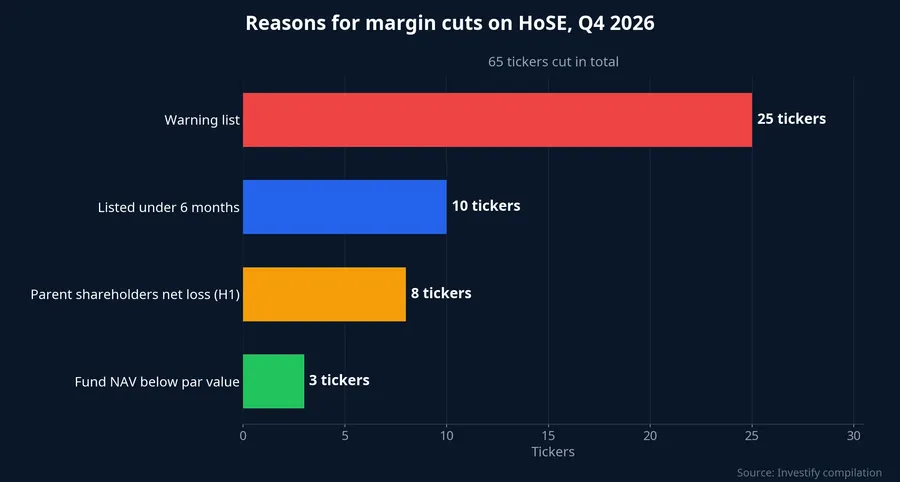
Vietnam Thuong Tin Commercial Joint Stock Bank (Vietbank, ticker VBB) and LPS Securities (ticker LPS) are on the list because they have been listed for less than six months.CafeF This is purely a matter of time. A newly listed stock must trade for six months before it is considered for margin lending, whether the company is big or small, profitable or not. On HoSE, this group has 10 tickers.VnEconomy
For VBB and LPS, the deciding fact is simply the calendar. Once six months have passed since the first trading day, and provided the other criteria are still met, the ticker can be considered in a later round.
Three Fund Certificates: Net Asset Value Below Par
Fund certificates can also lose margin eligibility, which surprises many people. The three are FUCVREIT of the Techcom Vietnam Real Estate Investment Fund, FUEABVND of the ABFVN DIAMOND ETF and FUETPVND of the VFCVN DIAMOND ETF.VnEconomy The listed reason is that net asset value (NAV) per certificate was below par in at least one month, based on monthly NAV reports reviewed over three consecutive months.
You can read this test as a simple question: does the fund keep at least as much value per certificate as the money investors originally put in? One month below par within the three-month window is enough to land on the list.
Also on HoSE's list, three other ETFs, FUEMTEC, FUEPHVNS and FUEVN50G, appear because they have been listed for less than six months.CafeF The two mechanisms differ, but the effect on a margin borrower is the same. For anyone buying fund certificates with their own cash, nothing changes: they can trade normally on the exchange. Only the part bought with borrowed money is blocked.
Warnings, Losses, Taxes: Most of the List
Most of the list still consists of familiar reasons. On HoSE, 25 tickers are under warning status, and 8 have negative after-tax profit attributable to parent shareholders in the reviewed consolidated H1 2026 statements (MHC, PNC, ST8, STK, TNH, VID, VNG, VNS).VnEconomy ABS, DQC, HAS, SBV and TTF are under control status. DGC, DRH and VMD are under trading restrictions, and ITD is listed because the tax authority concluded the company violated tax law.
Large names such as HVN of Vietnam Airlines (warning status) and DGC of Duc Giang Chemicals (trading restrictions) show that a big market cap is no exemption.CafeF A ticker's status on the exchange is enough.

On HNX, 35 tickers are under warning, 31 have negative profit and 22 are under control.VnEconomy Three brokerages are named: APS (Asia-Pacific Securities), HBS (Hoa Binh Securities) and VIG (Vietnam Investment and Finance Securities). NRC (NRC Group) and CAR (Tri Viet Education Group) were excluded because of tax authority conclusions on tax-law violations.CafeF The most extreme case is BNA of Bao Ngoc Investment Group, which is at once under warning and control, suspended from trading, loss-making, and late with its H1 financial statements.
How the Count Changed From the Previous Quarter
HoSE's Q4 list has 65 tickers, down 8 from the 73 announced on September 11.VnEconomy HNX's list moved the other way: 67 tickers, up 9 from the list at the start of Q3.VnEconomy
These opposite moves say little about the overall health of the two exchanges. HoSE's list is also updated mid-quarter, and the 73 tickers on September 11 already included names that surfaced after the half-year reporting season. On HNX, the count depends heavily on how many companies entered warning or control status, or moved exchanges, during the period. In other words, the count follows the rhythm of financial reporting and listing procedures, not the rhythm of prices.
What Changes in a Borrower's Account
The most direct effect is that investors cannot use credit limits from their brokerage to buy tickers on the list.CafeF A margin order for KLB, VBB or FUETPVND will be rejected for as long as the ticker stays on the list.
For loans taken out earlier, treatment depends on the contract and each brokerage's notice. Brokerages commonly cut the lending ratio on an excluded ticker, in some cases to zero. The ticker then adds no buying power to the account and, depending on policy, may be valued lower when the margin ratio is measured. This reaches your wallet directly: an account borrowing close to its limit can fall to the level of a margin call even if the share price has not dropped.
The exchange's list is only the outer boundary. Each brokerage may lend only on eligible tickers, and can choose a narrower universe with its own lending ratios. So a ticker absent from the exchange's list may still be unavailable for margin at your brokerage. The reverse does not hold: a ticker on the exchange's list cannot be bought on margin at any brokerage.
What Will Take Each Ticker Off the List
Because the list is a paperwork filter, each group has its own fact that decides whether it returns:
- Kienlongbank: financial statements with an unqualified opinion. The nearest decisive milestone is the audited 2026 annual report, due in early 2027. Before then, the signal to watch is the resolution of the VND 343 billion receivable that the bank said it would propose.
- Vietbank and LPS: six months of listing counted from the first trading day, with the other financial criteria still met.
- The three fund certificates with NAV below par: monthly NAV reports must stay at or above par across the full three-month window under review.
- Tickers under warning, control or trading restrictions: they must first leave that status, which in turn depends on financial statements and timely disclosure.
- Loss-making tickers: the next report the exchange uses must show positive after-tax profit.
The margin-cut list is therefore a filter for procedural risk. It tells you what is missing from a company's paperwork, while the value of the business is a separate story. For borrowers, the sensible step is to read the brokerage's notice on the lending ratio applied to each ticker they hold. For KLB, the line most worth following in the coming months is the auditor's opinion in the 2026 annual report.