

On December 15, shareholders of Nam Viet Corporation (ANV, HoSE) will receive VND 1,000 per share, exactly what they were paid last November. What has changed is the profit behind the payout. In the first half of 2026, Nam Viet's consolidated net profit fell 29% to VND 330.2 billion, even though revenue grew by more than a third.
This piece follows the payout itself: what it is made of, who needs to be on the register and by when, how large it is against profit and cash, and which report will show the rest of the 2026 dividend. Our thesis is simple. The payout is unchanged, but the earnings base under it is thinner, so the real question is whether gross margin has bottomed.
The VND 1,000 has two halves, in a pattern that repeats
According to the notice published by Tin nhanh chung khoan on October 9, 2026, Nam Viet is paying a total of 10% of par value in cash. Half of that, 5% (VND 500 per share), is the 2025 dividend, and the other 5% (also VND 500) is an advance on the 2026 dividend. The record date is October 30, 2026 and the payment date is December 15, 2026.
The structure is not new. The October 2025 round also had two halves: 5% for 2024 and a 5% advance for 2025, with the record date on October 24, 2025 and payment on November 10, 2025. Nam Viet follows a steady rhythm: each autumn it pays out the balance of the prior year and advances part of the current one.
Put the two rounds side by side and 2025 is paid in two instalments, a 5% advance in November 2025 and a 5% payment in this December 2026 round. The 2026 shareholder meeting materials proposed a 2025 dividend of 5%, equal to VND 133.1 billion, which matches the part now being paid. Shareholders therefore receive 10% in total for 2025, just across two rounds more than a year apart. With 266,255,750 shares outstanding, the total outlay is about VND 266 billion, nearly the same as last year.
Three dates for ANV holders
Because shares bought on the exchange take two business days to settle, buyers must complete their purchase before the ex-dividend session. The three dates are:
- October 29 (expected): the ex-dividend date. ANV's reference price is adjusted down by exactly VND 1,000. Anyone buying from this session onward will not be on the register, while those who already held the shares still receive the cash even if they sell during the session.
- October 30: the record date, when the shareholder list is closed.
- December 15: the payment date, when the cash reaches securities accounts.
ANV closed at VND 18,650 on October 9. At that price, VND 1,000 is about 5.4% of the share price. That figure bundles two years' worth of dividend halves into one receipt, so it should not be read as a single-year dividend yield.
Same payout, a different earnings base
When Nam Viet paid out about VND 266 billion in November 2025, its first-half 2025 net profit was VND 464.8 billion, so the payout equalled roughly 57% of six-month profit. This year the same payout sits against first-half profit of VND 330.2 billion, lifting the ratio to about 80%. Measured against the parent company's own profit, which is what actually funds the dividend, six-month profit was VND 302.4 billion, and the VND 266 billion payout takes nearly 88% of it.
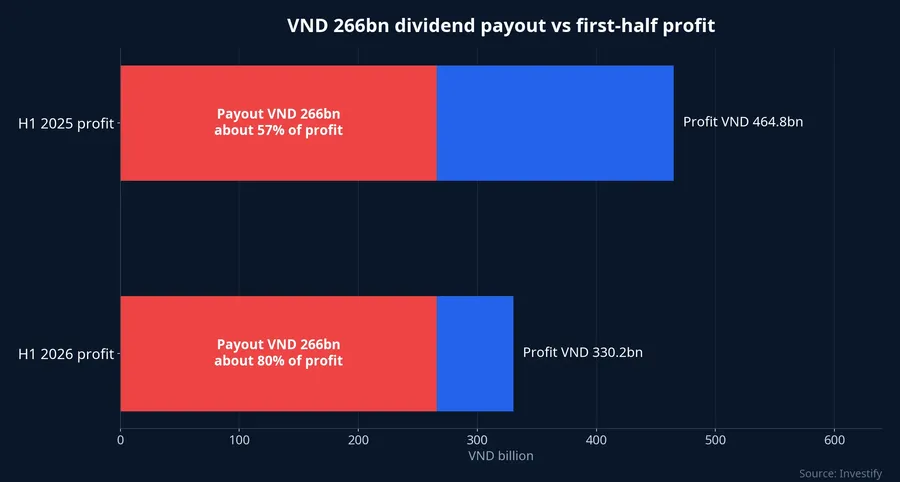
To be clear, dividends are drawn from accumulated retained earnings, not only from six-month profit. Nam Viet earned a lot in 2025, so it has ample resources to pay. The comparison is not meant to suggest the company cannot afford the dividend. It shows that the same payout now takes a much larger share of what the company is earning this year.
The balance sheet leans the same way. At June 30, 2026, Nam Viet's cash and short-term financial investments came to VND 695.6 billion, so the upcoming dividend equals about 38% of that. At the same date, total borrowings were VND 1,862.9 billion, up VND 209.4 billion from the start of the year, almost entirely short-term. Receivables and inventories both rose by more than 10% from the start of the year, a sign the business needs more working capital to generate its revenue.
Why profit falls while revenue rises
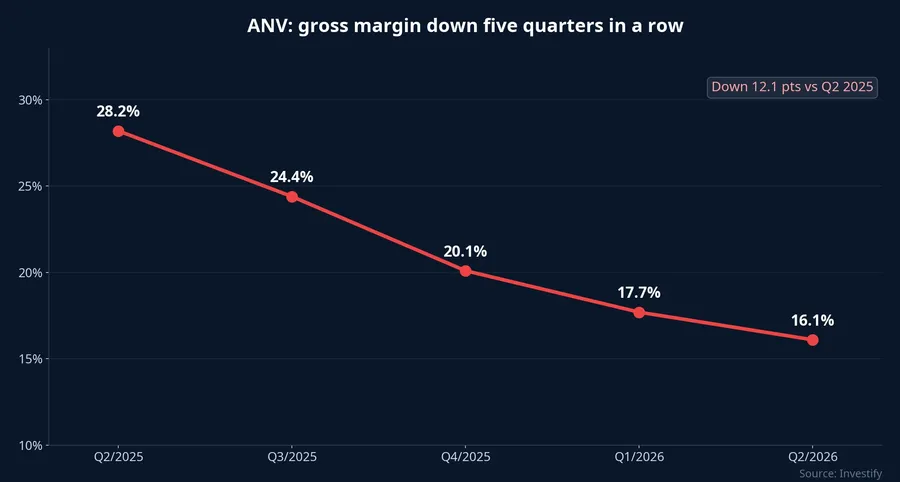
In the second quarter of 2026, Nam Viet booked net revenue of VND 1,937 billion, up 12.2% year on year. Cost of goods sold grew much faster, by about 31%. Gross margin therefore dropped from 28.2% to 16.1%, and quarterly net profit fell by nearly 60% to VND 134.9 billion.
The 16.1% is not a one-quarter drop. According to the financial statement data, gross margin has fallen five quarters in a row: 28.2% in Q2 2025, 24.4%, 20.1%, 17.7% in Q1 2026, then 16.1% in Q2 2026. First-half revenue rose 33.4%, yet gross profit fell 10.1%.
The parent company attributes the lower gross margin to higher input material costs. An update from Shinhan Securities after Q2 is more specific: fishmeal, the main ingredient in pangasius feed, is holding at high levels, and transport costs have also risen. In Nam Viet's vertically integrated farming model, feed is the largest part of production cost, so fishmeal prices flow straight into cost of goods sold.
Financial expenses in Q2 also rose 102% to almost VND 39 billion, mostly interest, and selling and administrative expenses rose 24.8%. Even so, financial expenses are only about 2% of quarterly revenue. Among the forces pulling profit down, gross margin dominates: Q2 gross profit fell nearly VND 175 billion short of the year-earlier quarter, roughly four times the combined increase in interest and selling costs.
The rest of the 2026 dividend depends on the second half
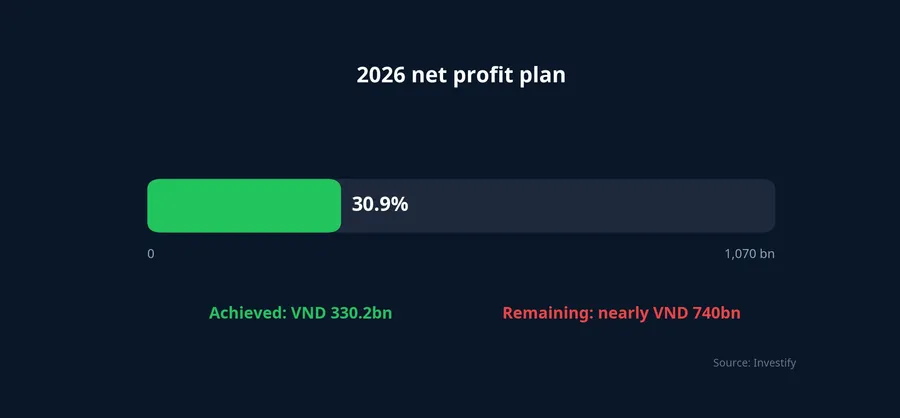
The 2026 shareholder meeting materials set a net profit plan of VND 1,070 billion and an expected 2026 dividend of 15%. After six months, Nam Viet has completed only 30.9% of its profit plan. To reach the target, the second half would need to generate almost VND 740 billion, an average of about VND 370 billion a quarter, nearly three times the second quarter.
This 5% advance is only one third of the expected 15%. If the original plan holds, the remaining 10% is worth about another VND 266 billion, and on the pattern of the past two years it would most likely be paid in autumn 2027. Its actual size will depend on 2026 profit as it turns out.
The nearest checkpoint is the Q3 2026 financial statements, due in the reporting season at the end of October. They answer directly whether gross margin has bottomed. If Q3 gross margin recovers above Q1's 17.7%, the profit plan and the 15% dividend scenario remain credible. If it stays below 16.1%, the gap to VND 1,070 billion widens, and today's 5% advance could make up most of the dividend actually received for 2026.
Our conclusion: the VND 1,000 on December 15 has a clear schedule for anyone on the October 30 register, while the next part of the 2026 dividend does not. Gross margin in the Q3 report is the first place that answer will show.