

Within a week, two of Vietnam's larger joint-stock banks passed VND 100,000 billion in charter capital. According to Thanh Tra, MB completed its capital increase to VND 100,687.5 billion on October 3.Thanh Tra On October 8, VPBank announced its charter capital had risen from VND 79,339 billion to VND 100,000 billion.CafeF
It is easy to read the headlines and assume both banks got equally richer. Charter capital is simply the total par value of shares outstanding. It does not tell you how much real money the bank gained. For that, you have to ask where the extra capital came from. At MB, part of it is cash that shareholders paid in. At VPBank, all of it is old profit converted into shares.
Two routes to a higher charter capital
Converting profit into shares. The bank takes part of its undistributed profit, the earnings from earlier years it has kept, moves it into the share capital line and issues new shares to existing shareholders. On the balance sheet, money just shifts from one drawer to another inside shareholders' equity. Total equity is unchanged, and the bank has no extra money to lend.
Selling shares for cash. The bank issues new shares and buyers pay for them. The money goes straight into the bank, and equity rises by exactly the amount raised (less issuance costs).
MB used both routes. VPBank has so far used only the first.
MB: about 60% from profit, about 40% new money
MB's first step was a 15% stock dividend paid out of undistributed profit. It lifted charter capital to VND 92,632.5 billion, an increase of about VND 12,082.5 billion from VND 80,550 billion.Thời báo Tài chính That part works exactly as VPBank's did: no new cash.
The second step is where the two diverge. MB offered more than 805 million shares to existing shareholders at VND 10,000 each. The offering closed on September 23, 2026 and raised nearly VND 8,055 billion.Thời báo Tài chính That is real shareholder money moving into the bank.
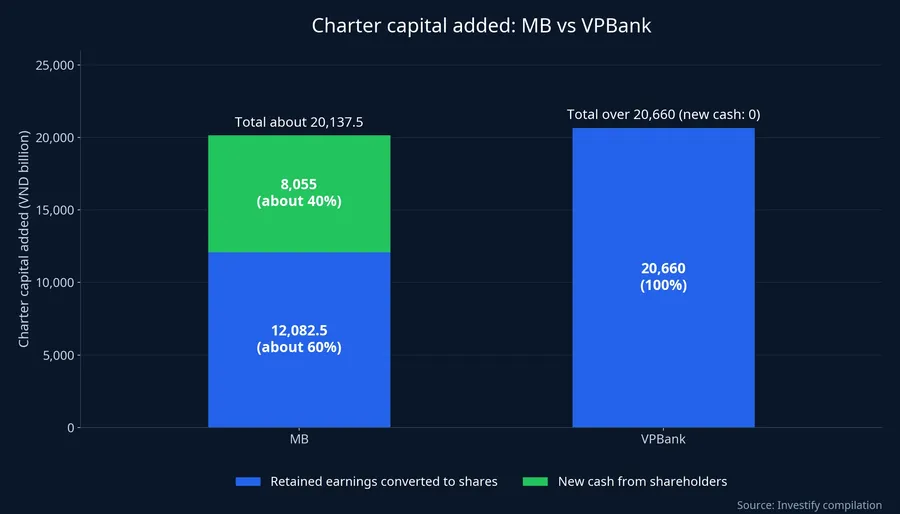
Adding the two steps, MB's charter capital rose by about VND 20,137.5 billion: roughly VND 12,082.5 billion of converted profit and roughly VND 8,055 billion of new cash. At the end of June 2026, MB's undistributed profit still stood above VND 40,000 billion, so the bank has room for further share distributions like this.Thời báo Tài chính
VPBank: a single step, no new cash
VPBank got to VND 100,000 billion in one step. According to its results report dated September 30, 2026, it distributed 2,066,076,399 shares with total par value above VND 20,660 billion, a ratio of 26.04104%.CafeF The shares were issued from accumulated, undistributed after-tax profit, and shares outstanding rose from just over 7.93 billion to 10 billion.Thời báo Tài chính
On October 5, the State Securities Commission sent Official Letter No. 9876/UBCK-QLCB saying it had received the report on the issuance results, and asking VPBank to complete supplementary registration and listing with HOSE and VSDC. The new shares are expected to be delivered between October and November 2026.Thời báo Tài chính
So the VND 20,660 billion of added charter capital came with no cash at all. That profit already sat inside shareholders' equity. It has only been relabeled.
The two banks side by side
| Item | MB | VPBank |
|---|---|---|
| Charter capital, before and after | VND 80,550bn to 100,687.5bn | VND 79,339bn to 100,000bn |
| Charter capital added | about VND 20,137.5bn | over VND 20,660bn |
| From profit converted into shares | about VND 12,082.5bn | over VND 20,660bn |
| New cash into the bank | nearly VND 8,055bn | 0 |
| Do shareholders have to pay? | Yes, if they join the offering | No |
| Increase in shares outstanding | about 25% | about 26% |
The percentage increase in shares is charter capital divided by the VND 10,000 par value. The last two rows matter most: the share counts at both banks grew by about a quarter. But at MB, about 40% of the increase was paid for in real money, while at VPBank the figure is zero.
Following one shareholder's account
Take an investor holding 10 million shares in each bank before the issuances.
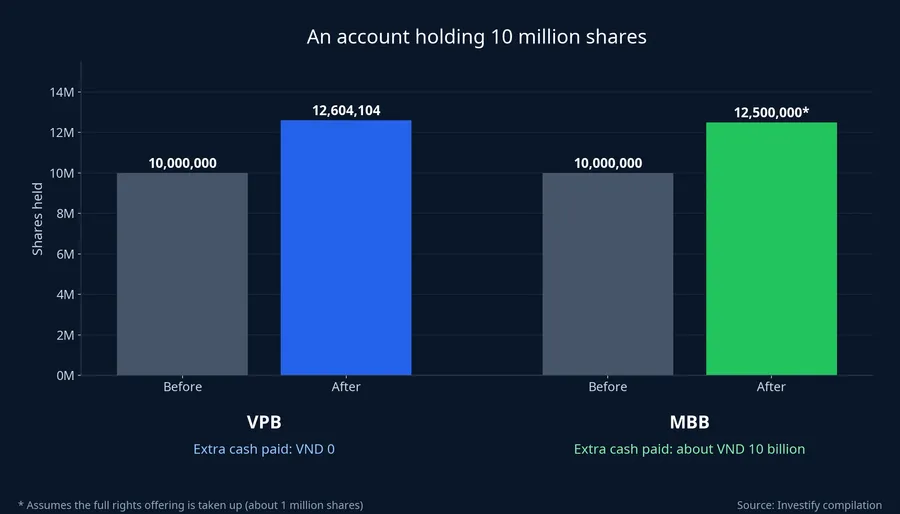
The holder of 10 million VPB shares receives another 2,604,104 shares, taking the position to 12,604,104, and pays nothing.CafeF Their ownership stays at about 0.126%, because every shareholder gets the same ratio. The bank's total equity is unchanged, so their claim on it is unchanged too. What changes is the denominator: future profit is divided by 10 billion shares instead of just over 7.93 billion.
The holder of 10 million MBB shares gets 1.5 million extra shares from the 15% stock dividend. In the offering, the number of shares sold was about one tenth of the share count before the dividend (about 8.06 billion shares), so this holder could buy about 1 million more, paying about VND 10 billion at VND 10,000 each. If they take it all up, they end with about 12.5 million shares. Unlike the VPB holder, that VND 10 billion goes into the bank and becomes new equity. A holder who does not buy pays nothing more, but their ownership share shrinks, since MB's total shares rose to more than 10.068 billion while theirs stayed put.Thời báo Tài chính
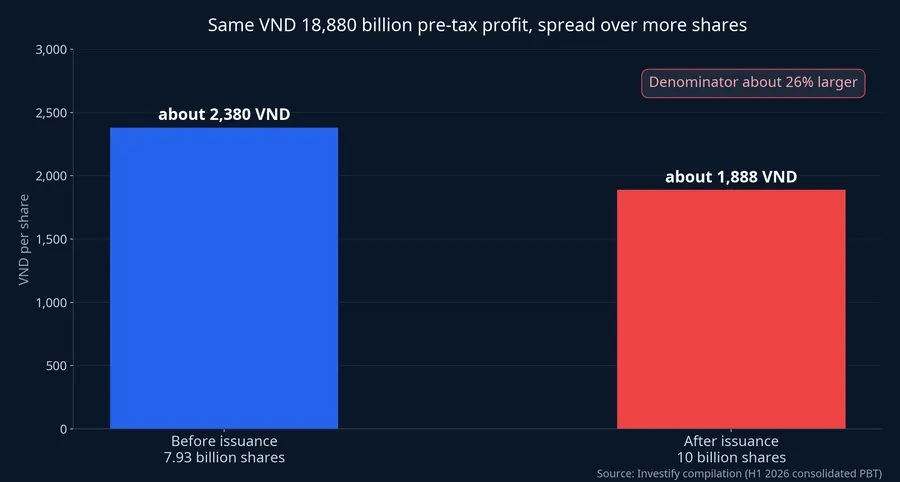
Here is where this touches your wallet. In the first half of 2026, VPBank reported VND 18,880 billion in consolidated pre-tax profit.CafeF Divided by just over 7.93 billion old shares, that is about VND 2,380 per share. Divided by 10 billion new shares, it is about VND 1,888. The bank did not earn less. The same profit is simply spread over more shares. When later quarters report earnings per share, remember the denominator is about 26% larger.
One practical detail: until the new shares complete their supplementary listing, the extra shares cannot be sold on the exchange.
Where VPBank's new money will come from
VPBank is not finished. Its next step is a planned private placement of more than 624 million shares to a foreign investor, which would lift charter capital to about VND 106,244 billion.CafeF Timing is planned for the third to fourth quarter of 2026.Thời báo Tài chính This is the step that would bring fresh cash into VPBank.
It will shrink the ownership of every existing shareholder. Ten billion current shares plus about 624 million new ones comes to roughly 10.62 billion. The new investor would hold about 5.9%, and a holder with 0.126% would drop to about 0.119%.
A smaller ownership share is not automatically a loss. The price decides it. If the foreign investor pays more than book value per VPB share, equity per old share rises after the sale. If the price is lower, it thins out. So far VPBank has not disclosed the price, the investor's name or the issue date.
How to read the VND 100,000 billion milestone
The same charter capital figure can hide very different amounts of new money. At MB, about VND 8,055 billion of cash entered the bank, on top of the converted profit. At VPBank, so far the increase is entirely bookkeeping: total equity is unchanged.
That does not make either route better. Converting profit into shares keeps money inside the bank instead of paying it out as a cash dividend, and it does not make shareholders poorer. It also does not make the bank stronger than it was the day before.
The thesis is one sentence: the charter capital milestone alone does not say how much money a bank gained, so read it alongside the source of the increase. Two things are worth tracking next. For VPB, the price of the private placement of over 624 million shares, set against book value per share in the latest quarterly report. For MBB, how well the bank puts the new capital to work in the coming quarters. This post does not take a view on the direction of either share price.