
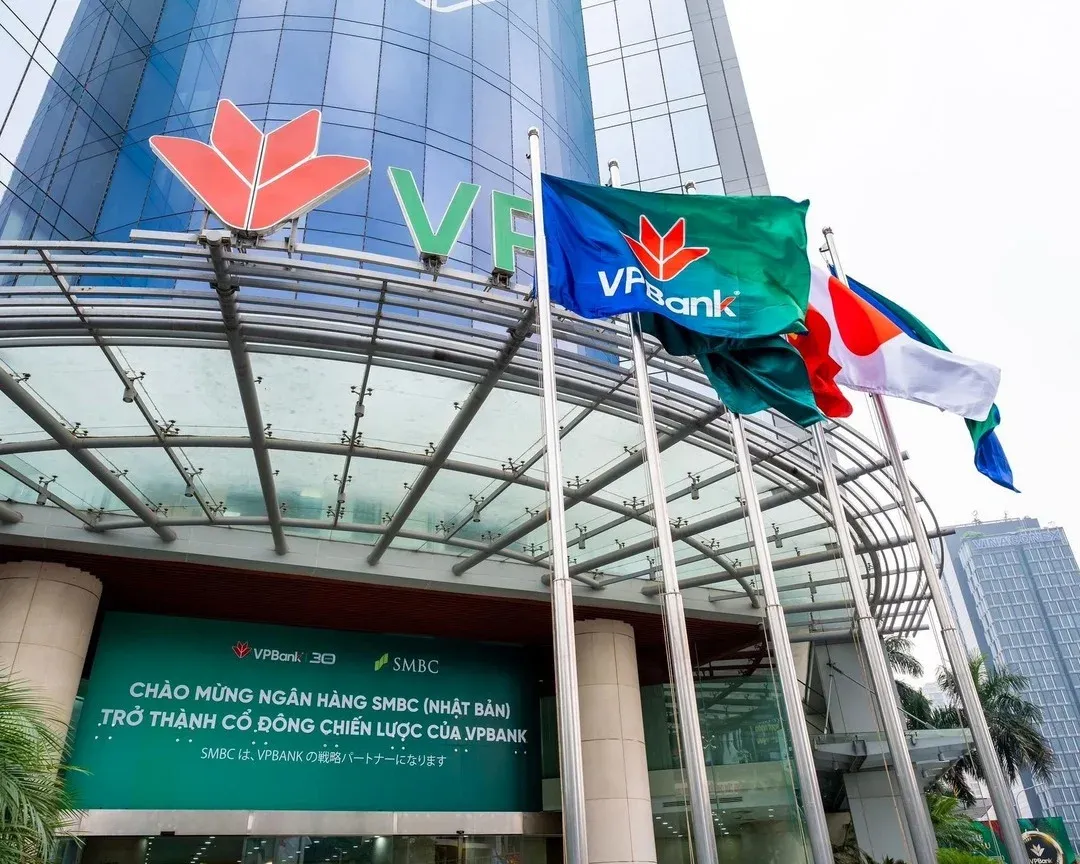

VPBank has just updated its list of shareholders holding at least 1% of charter capital, and there is a new name on it. According to CafeF on October 9, VIX Securities holds nearly 117 million VPB shares, equal to 1.17% of charter capital.CafeF At the October 8 close of VND 23,450, the stake is worth about VND 2,700 billion.
For VIX shareholders, this is more than news about a new name on a register. The VPB stake sits in the firm's proprietary portfolio, the money a brokerage invests in stocks for its own account. At VIX that portfolio is large enough that quarterly profit depends more on the prices of its holdings on the quarter-end date than on lending or brokerage.
Why VIX's name is now public
Since the 2024 Law on Credit Institutions took effect, shareholders owning 1% or more of a bank must provide information to the bank, and the bank must publish their names, share counts and ownership ratios on its website.Tạp chí Công Thương An investment that used to surface only in the notes to a brokerage's financial statements can now be seen earlier, through the bank's own list.
On trading context, CafeF reports that between September 8 and October 8, brokerages' proprietary desks were net buyers of more than 111 million VPB shares, worth nearly VND 2,800 billion.CafeF No source says how much of that was VIX, when it bought, or at what cost basis.
How big is VIX's proprietary portfolio
According to the reviewed 2026 half-year financial statements, at June 30, 2026 the market value of VIX's financial assets recognized through profit or loss exceeded VND 20,800 billion. Listed shares alone accounted for VND 16,180 billion.Pháp luật Việt Nam CafeF calls this the highest among Vietnamese brokerages.
VIX's charter capital was nearly VND 26,000 billion at the end of September, so listed shares equal roughly three-fifths of it, and the whole profit-or-loss asset group about four-fifths.
The portfolio centers on GEE, GEX, EIB, VPX and VSC. In the first half, VIX also deployed more than VND 1,000 billion into 33 million TCB shares and added VND 500 billion to EIB.Pháp luật Việt Nam With about VND 2,700 billion of VPB on top, the bank-stock share of the portfolio (VPB, TCB, EIB) is clearly larger than at the end of Q2.
The mechanism: quarter-end prices become profit or loss without a sale
Most of VIX's portfolio is classified as "financial assets recognized through profit or loss." This accounting differs from how individual investors think about their gains.
For this asset group, a brokerage must revalue the whole portfolio at market price on the last day of each reporting period. If the quarter-end price is higher than at the prior period, the difference is booked as revenue. If lower, it is booked as expense. Both flow straight into the quarter's pre-tax profit, even though no shares have been sold.
So VIX's quarterly profit has two very different parts. The first comes from day-to-day business such as margin lending and brokerage, which moves fairly steadily with market liquidity. The second is the price difference of the portfolio on a single day, the last day of the quarter. When the portfolio is close in size to charter capital, the second part usually decides the result.
First half of 2026: lending and brokerage up, profit down sharply
The numbers make the first half the clearest example of this mechanism. Lending and receivables, mostly margin lending, brought in VND 697.3 billion, up 86% year on year. Brokerage revenue was nearly VND 91 billion, up 43%. Total revenue reached VND 3,033 billion, slightly above VND 2,956 billion in the first half of 2025.Pháp luật Việt Nam
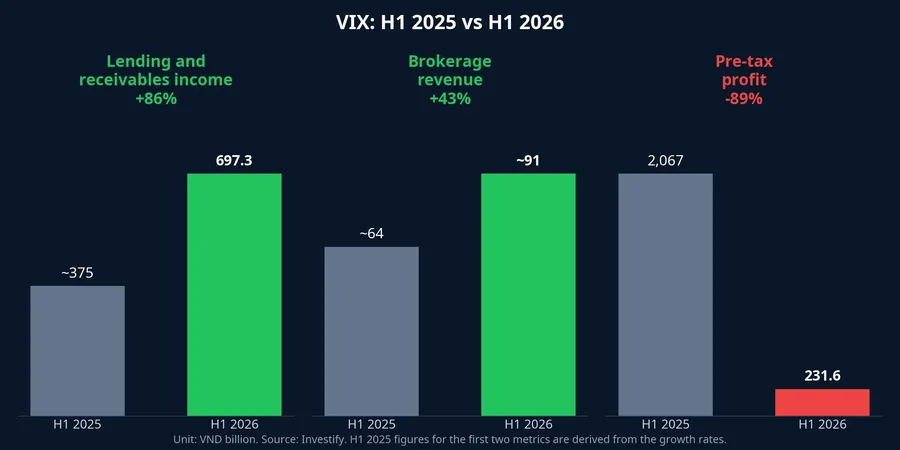
Even so, pre-tax profit was only VND 231.6 billion, against more than VND 2,067 billion a year earlier, a fall of about 89%. The half-year report attributes the decline mainly to heavily weighted holdings losing value versus end-2025. The clearest case is GEE, whose market value fell from VND 4,419 billion at end-2025 to VND 2,900 billion on June 30.Pháp luật Việt Nam
That suggests a simpler way to read VIX: its profit behaves more like the result of an equity fund than that of a brokerage. Brokerage and lending build a fairly stable base. The proprietary portfolio decides whether a quarter is a big profit or a thin one.
What the VPB stake changes
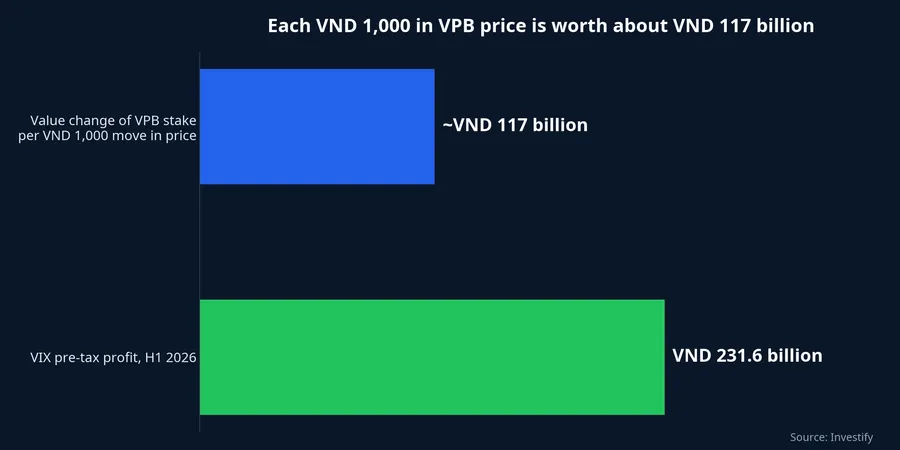
Nearly 117 million shares means that each VND 1,000 move in VPB's price changes the stake's value by about VND 117 billion. That is roughly half of VIX's pre-tax profit for the entire first half. If the VPB stake is classified in the profit-or-loss group like most of the portfolio, each VND 1,000 step in VPB's price on the quarter-end date would add or subtract that amount from the quarter's pre-tax profit.
A brokerage can classify an investment in another group, in which case price changes do not pass through the income statement; the Q3 report will show how it was booked. The bigger change is concentration. VIX's results used to track the Gelex group (GEX, GEE) and a few names such as VSC and VPX. As VPB, TCB and EIB take a larger share, VIX's quarterly result tracks bank-stock prices on the quarter-end date more closely. This concentration says nothing about whether VPB will rise or fall. It only means the swings of the banking group will show up more clearly in VIX's reports.
Q3: the data we have and what is missing
Part of the answer is already on the price board. On adjusted prices, from June 30 to September 30, GEE fell about 17.3%, GEX about 23.4%, EIB about 18.8%, VSC about 30.8%, VPX about 9.8% and TCB about 2.8%. Over the same period the VN-Index fell about 4.9%, from 1,860.01 to 1,768.62 points. Five of the six stocks fell more than the broad index.
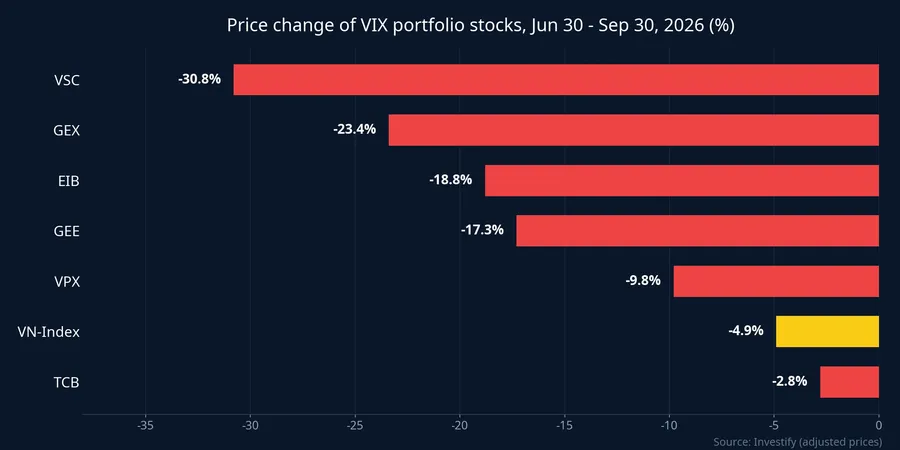
That is not enough to say whether VIX made or lost money in Q3, for three reasons. First, the portfolio may have changed during the quarter: VIX appearing on VPBank's list shows it bought more, and it may have sold other names. Second, gains from share sales, dividends and entrusted investments flow into the same line. Third, the cost basis of the VPB stake has not been disclosed. If VIX bought VPB in September sessions, when the price was near VND 23,000, the stake created little price difference in Q3, and the effect would show more from Q4.
Under disclosure rules, a listed brokerage must publish its quarterly financial statements within 20 days after the quarter ends. For Q3 that deadline is October 20.
Lines to read when the Q3 report arrives
To see where Q3 profit comes from, split the figures into three groups.
- Lending and receivables income, plus brokerage revenue: the day-to-day business. Compare with VND 697.3 billion and nearly VND 91 billion in the first half.
- Gains and losses on financial assets through profit or loss, especially revaluation gains and losses: the part driven by share prices on September 30. If it is sharply negative, Q3 is mainly a portfolio story.
- Portfolio notes: find the VPB stake, check which group it belongs to, its cost basis, and its fair value at September 30. The gap between the last two shows whether the stake has a paper gain or loss.
Under the current structure, the sensible reading is lending and brokerage as the base, and the proprietary portfolio as what sets the range of each quarter's profit. The VPB stake does not change that reading. It makes bank share prices on the quarter-end date a larger variable.